What Does It Mean to Quarantine Something?
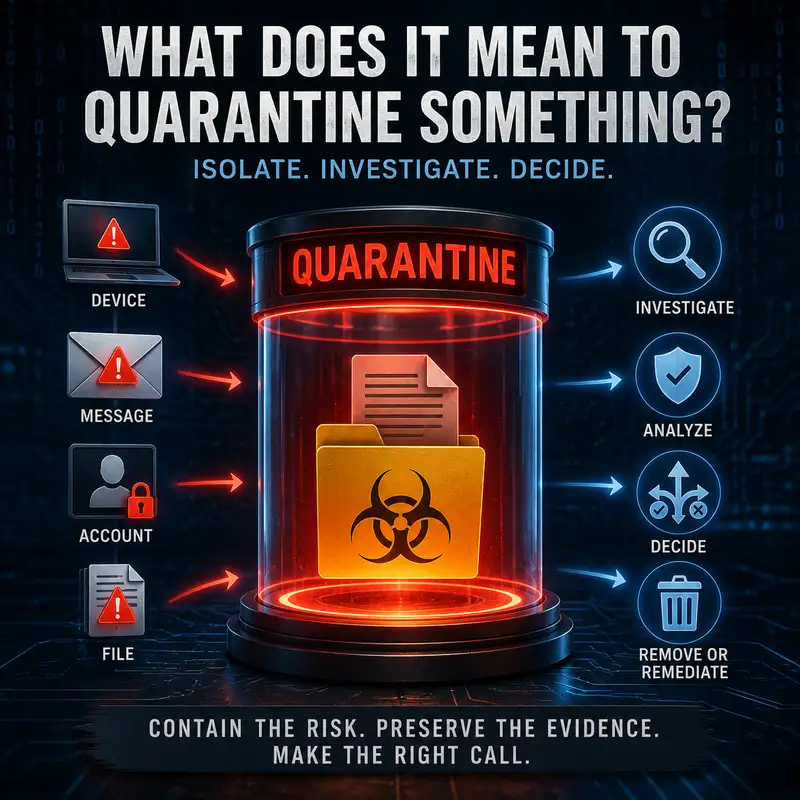
People often use quarantine and deletion as though they describe the same security action, but they solve different problems. Deletion attempts to remove an item, while quarantine restricts what the item can do and what can interact with it. That difference affects whether evidence remains available, whether a false alarm can be corrected, and whether investigators have time to understand what happened. A suspicious file, device, message, or account may need to be contained immediately even when the security team does not yet know whether it is truly malicious. Quarantine creates that temporary controlled state. By the end of this episode, you should be able to explain what quarantine means, what it does not guarantee, how it differs from deletion, and why isolation is usually followed by investigation rather than treated as the final answer. Quarantine is a containment action that isolates something suspicious from its normal environment. The isolated object usually still exists, but its ordinary ability to run, communicate, deliver content, authenticate, or reach other resources is reduced or blocked. Deletion is different because it is intended to remove the object or record rather than preserve it in a restricted state. Quarantine is also not the same as proving that something is malicious. A security product or administrator may quarantine an item based on indicators, behavior, policy, or uncertainty, and the decision can later be confirmed, reversed, or replaced with a stronger response. The central distinction is simple: quarantine controls interaction while keeping the subject available for review, whereas deletion focuses on removal after the organization has decided that continued retention is unnecessary or unsafe. The immediate purpose of quarantine is containment. When defenders identify something that may cause harm, they often need to stop its activity before they can complete a careful analysis. The speed of that containment matters because uncertainty can remain high while the opportunity for additional harm continues. Isolation can interrupt access to systems, prevent a message from reaching a recipient, keep a file from executing, or stop an account from being used normally. That pause reduces the chance that the suspicious item will continue spreading, communicating, or affecting business operations. It also creates a safer condition for collecting evidence and deciding what should happen next. Quarantine therefore sits between detection and final disposition. Detection raises concern, quarantine limits exposure, investigation tests the concern, and the final decision may be release, remediation, deletion, account recovery, device rebuilding, or another action that fits the evidence. File quarantine is the form many people recognize from antivirus and endpoint security tools. A product may move the file to a protected location, change its name, encrypt or wrap its contents, remove ordinary permissions, or otherwise prevent normal programs and users from opening or executing it. The exact method depends on the product, so the word quarantine describes the security outcome rather than one universal technical procedure. The file may remain available to the security tool for analysis, restoration, evidence collection, or later deletion. Quarantining the file does not automatically undo anything the file did before isolation. If it already launched a process, changed a setting, created another file, or affected an account, those consequences may remain. Defenders therefore need to separate the question of whether the original file is contained from the question of whether the system is fully clean. A quarantined device is usually restricted from communicating normally with the rest of the network. Endpoint tools, network access controls, wireless systems, or other management platforms may place the device in an isolated segment or block most inbound and outbound connections. The device may still be allowed to communicate with selected security or management services so that defenders can investigate it, collect information, or apply remediation. That limited communication is intentional and does not mean the isolation failed. Device quarantine is also different from shutting the device down. A powered-on isolated system can preserve active evidence and remain manageable, while a shutdown may interrupt activity but also remove information that existed only in memory. The correct choice depends on the incident, the evidence needed, and whether continued operation creates additional risk. Message quarantine is commonly used in email and collaboration systems. A suspicious message may be held before it reaches the recipient, removed from normal access after delivery, or placed in a review area where an administrator or authorized user can examine it. The goal is to prevent the message, attachment, or embedded link from being used while the system evaluates indicators and policy rules. Quarantine does not necessarily mean the message has been erased from every mailbox, server, archive, or connected service. It also does not prove that the sender acted maliciously, because legitimate messages can trigger filters through unusual content, new domains, authentication problems, or policy violations. Releasing a quarantined message should therefore be a controlled decision based on verification, not a routine response to user pressure or inconvenience. Account quarantine applies the same isolation principle to identity and access. An organization may disable sign-in, revoke active sessions, block selected applications, remove privileged roles, require credential recovery, or place other restrictions on an account that appears compromised or misused. The account record may remain intact so that ownership, permissions, activity history, and related evidence can be reviewed. Deleting the account too early can disrupt records, break business processes, or make it harder to understand what access existed. At the same time, merely disabling a password may not contain every form of access. Existing session tokens that keep a user signed in, application passwords, access keys, delegated permissions, and connected devices may continue to matter. Effective account quarantine requires defenders to identify the different ways the identity can authenticate and then verify that the intended restrictions actually took effect. Before we continue, a brief promotional note. This episode is brought to you by the Bare Metal Cyber Academy. The Academy provides a place for people who want to continue developing practical cybersecurity knowledge through clear, structured education. Its approach supports steady learning that can be applied to everyday security work and professional judgment. The goal is to help learners and working professionals build a stronger understanding of security concepts, decisions, and responsibilities without relying on hype or shortcuts. You can visit Bare Metal Cyber dot com to explore the Academy and see the learning opportunities currently available. Now, let’s return to quarantine and the decisions that must follow isolation. Quarantine and deletion differ most clearly in reversibility, evidence preservation, and timing. Quarantine is often chosen when the organization needs to act quickly but does not yet have enough confidence to destroy or permanently remove something. A false positive can then be corrected by restoring a clean file, releasing a legitimate message, reconnecting a trusted device, or returning an account to normal use. Preserved evidence can also help defenders determine where the item came from, what it touched, and whether related activity exists elsewhere. Deletion may become appropriate after the evidence supports a final decision and any required records have been preserved. Even then, deletion is not always the entire remedy. Removing one malicious file does not repair every change it caused, and deleting one message does not prove that no recipient interacted with it before containment. A quarantined item should be treated as suspicious, not automatically guilty. Security tools make decisions from signatures, reputation, policy, behavior, statistical models, and other indicators, and every detection method has limits. The restriction protects the environment while analysts separate reliable evidence from a detection that may be incomplete or misleading. A legitimate file can resemble harmful behavior, a normal message can violate a strict rule, and an account can appear unusual because the user changed locations or work patterns. The opposite problem also exists, because an item can be harmful without triggering the control that should have isolated it. Quarantine is valuable precisely because it gives defenders room to manage uncertainty without allowing normal interaction to continue. The investigation should test the reason for isolation, compare it with additional evidence, and determine whether the concern applies only to the quarantined object or points to a broader incident. Investigation after quarantine should answer what the item is, how it entered the environment, what activity occurred, and what else may be connected to it. For a file, defenders may examine its source, timestamps, cryptographic hash, which acts as a digital fingerprint, observed behavior, and relationship to other processes or files. For a device, they may review running activity, recent connections, authentication events, configuration changes, and signs that other systems were affected. For a message, they may examine delivery paths, sender authentication, links, attachments, and whether recipients opened or acted on it. For an account, they may review sign-ins, session use, permission changes, application access, and actions performed under the identity. The purpose is not merely to label the isolated object. It is to determine scope, preserve useful evidence, and support a defensible next decision. Quarantine has limits, and those limits must be understood rather than assumed away. Isolation is only as effective as the control that enforces it and the interactions that control can actually block. A quarantined device with a second network path, an unmanaged modem, or an active cloud session may still have routes outside the intended boundary. A quarantined account may still be represented by tokens, keys, delegated access, or automation that was not included in the restriction. A file may be isolated while copies, related malicious components, or earlier changes remain elsewhere. A message may be held in one platform while a forwarded copy exists in another. Defenders should verify the actual containment state and search for connected activity instead of treating the quarantine label as proof that the risk has ended. The final disposition of a quarantined item should follow evidence, policy, and operational need. A clean item may be restored after the reason for the detection is understood and any unsafe condition is corrected. A malicious file may be deleted after evidence is preserved and the system is checked for related changes. A compromised device may require remediation, rebuilding, credential changes, or continued isolation until confidence is restored. A suspicious account may need ownership verification, session revocation, credential reset, permission review, and monitoring before normal access returns. Organizations also need clear authority for release decisions, because restoring the wrong item can reopen the path that quarantine was meant to close. Quarantine queues should be reviewed rather than allowed to become permanent storage for unresolved alerts, abandoned evidence, or business-critical items that nobody owns. A practical way to evaluate any quarantine action is to ask four connected questions. First, identify exactly what has been isolated, because a file, device, message, and account require different controls. Next, determine which interactions are blocked and which are still allowed, including management access, active sessions, alternate communication paths, and connected services. Then confirm what evidence has been preserved and what investigation is needed before the object can be released, remediated, or removed. Finally, assign an owner and a decision point so the item does not remain in an indefinite state. The strongest test is verification: check that the restriction actually works, look for related activity outside the isolated object, and document what must be true before normal interaction resumes. That method turns quarantine from a product label into a controlled security process. To quarantine something means to isolate a suspicious file, device, message, or account so that it cannot continue interacting normally with the environment. The item usually remains available in a restricted state, which separates quarantine from deletion and preserves the possibility of investigation, recovery, or correction. Quarantine reduces immediate exposure, but it does not prove maliciousness, reverse earlier actions, or guarantee that every related path has been contained. Defenders still need to verify the isolation, determine the scope of the concern, preserve necessary evidence, and choose a final disposition supported by the facts. The practical decision is therefore not simply whether to quarantine. It is whether the isolation is broad enough, whether the investigation is complete enough, and whether release, remediation, or removal is now the responsible next action. Quarantine is a controlled pause that protects the environment while that decision is made.