What Is a Security Misconfiguration?
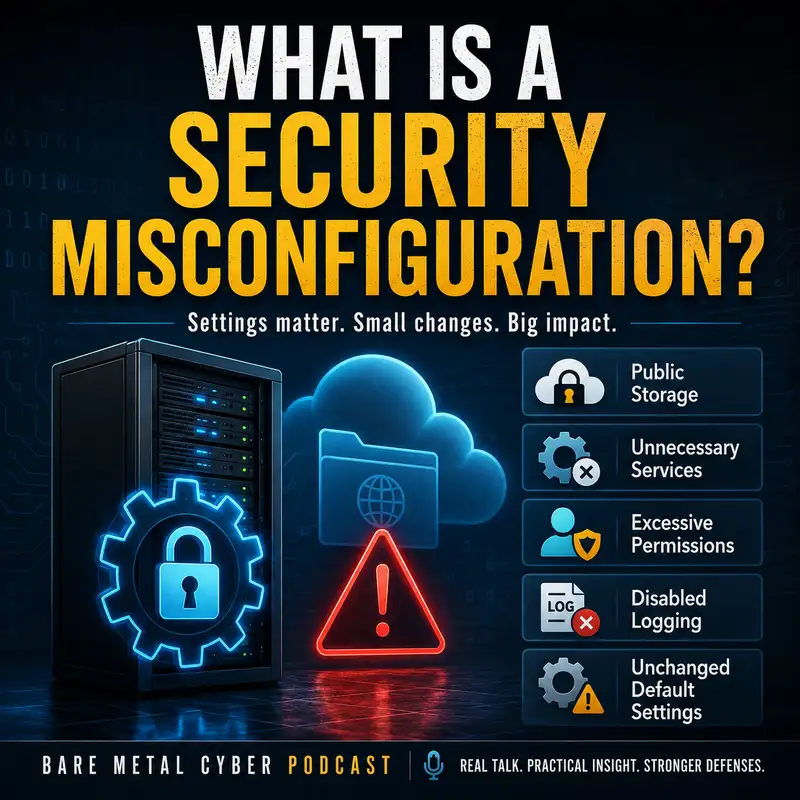
A security misconfiguration is easy to underestimate because nothing may appear broken. The system can start normally, users can sign in, applications can respond, and data can move exactly as expected. The problem is that one or more settings leave the environment less protected than the organization intended. That difference affects real decisions because a working system is not automatically a securely configured system. An administrator may see successful operation while a defender sees exposed storage, unnecessary services, broad permissions, disabled logging, or unchanged defaults. In this episode, we will answer what makes a configuration insecure, how misconfigurations differ from software flaws and other weaknesses, and how to recognize the settings that create meaningful exposure. By the end, you should be able to explain why configuration is part of security, not merely a technical setup task, and why small settings can have consequences far beyond the device or application where they appear. A security configuration is the collection of settings that determine how a system operates and protects itself. Those settings control who can connect, what users can do, which services are available, what information is recorded, how data is shared, and which protections are enabled. A security misconfiguration occurs when those settings create weaker protection than the intended security requirement or approved baseline. It may result from an unsafe default, an incorrect change, an incomplete deployment, excessive access, or a setting that was appropriate once but no longer fits the environment. The central distinction is that the system may be functioning according to its configuration while the configuration itself is unsafe. People often confuse misconfiguration with malfunction because both involve something being wrong, but a malfunction prevents expected operation. A misconfiguration can preserve expected operation while quietly allowing access, exposure, or activity that should have been restricted. A misconfiguration is closely related to a vulnerability, but the terms are not identical. A vulnerability is any weakness that could be exploited or triggered to cause harm. A security misconfiguration is one way that such a weakness can be created. A coding defect may exist because software was written incorrectly, while a misconfiguration usually exists because available settings were selected, inherited, or maintained in an unsafe way. The distinction matters when choosing a response. A software flaw may require a vendor patch, a code change, or a compensating control, while a misconfiguration may be corrected by changing permissions, disabling a service, restricting network access, or restoring an approved setting. Some weaknesses combine both conditions. Software may include a risky feature, but the practical exposure may depend on whether an administrator enabled it. Correctly identifying the source of the weakness helps the organization assign ownership and select a response that can actually reduce the risk. Publicly accessible storage is a clear example because the storage service may be working exactly as designed. The security question is whether the access setting matches the intended audience. Storage meant only for authorized staff becomes misconfigured when permissions allow anyone on the internet to read or modify its contents. The same issue can appear in shared folders, cloud repositories, backup locations, document libraries, and database services. Public does not always mean insecure, because some information is intentionally published for unrestricted access. The misconfiguration exists when the actual access is broader than the approved purpose. Defenders therefore need more than a simple check for public access. They must compare the setting with the data classification, business requirement, and documented owner decision. A public setting on a website image repository may be appropriate, while the same setting on a repository containing internal records may create immediate exposure. Context determines whether the configuration supports or violates the intended protection. Unnecessary services increase exposure by making functions available that the system does not need. A service may listen for network connections, accept administrative commands, share files, provide remote access, or expose an application interface. Each enabled service adds code, settings, accounts, communication paths, and maintenance responsibilities. If the service has no approved purpose, that added complexity produces risk without providing a business benefit. The misconfiguration is not simply that the service exists. It is that the system is configured to run or expose something that should be disabled, restricted, or removed. This principle is often described as reducing the attack surface, meaning the number of places where someone could attempt to interact with the environment. Disabling unnecessary services does not eliminate every vulnerability, but it removes opportunities that should never have been available. A secure configuration makes the required functions accessible while refusing connections and capabilities that the system does not need to perform its role. Excessive permissions create a different kind of misconfiguration because the system may correctly identify a user and still allow too much. Authentication determines who the user is, while authorization determines what that user is permitted to do. A configuration becomes unsafe when an account, group, application, or service receives privileges beyond its legitimate responsibilities. This can include the ability to read sensitive data, change security settings, create accounts, delete records, install software, or administer an entire environment. The principle of least privilege addresses this problem by limiting access to what is necessary for an approved task. Excessive permission does not require malicious intent to cause harm. An ordinary mistake can have a larger effect when the account has broad authority, and stolen credentials become more valuable when they unlock powerful capabilities. Permission reviews should therefore examine both who has access and what that access permits. A valid account with unnecessary authority is still a security weakness. Logging settings influence whether an organization can observe activity, investigate problems, and demonstrate what occurred. Disabled or incomplete logging may not directly allow an intruder to enter, but it can prevent defenders from seeing failed sign-ins, permission changes, administrative actions, data access, and other important events. That makes logging configuration part of security rather than a purely operational preference. The correct setting depends on what events the organization needs, how long records must be retained, where logs are protected, and who can review them. Collecting everything without purpose can create cost and noise, while collecting too little leaves serious gaps. A security misconfiguration exists when required events are not recorded, records can be altered without detection, timestamps are unreliable, or logs are unavailable to the people responsible for monitoring and response. Good logging does not prevent every incident, but it provides evidence that supports detection, investigation, accountability, and recovery. Without that evidence, uncertainty becomes part of the harm. We will pause briefly for a transparent promotional message. This episode is brought to you by the Bare Metal Cyber Academy. The Academy provides a place for people who want to continue developing practical cybersecurity knowledge through clear, structured education. Topics such as secure configuration become more useful when you can connect the definition to the decisions administrators, analysts, and leaders make in real environments. Visit Bare Metal Cyber dot com and explore the Academy to see the learning opportunities currently available. The focus is steady development of understandable, practical knowledge without promises of guaranteed outcomes. Now, let’s return to security misconfigurations and examine why default settings deserve particular attention. Default settings exist so a product can be installed, started, and used without requiring every decision in advance. That convenience does not mean the defaults match the organization’s risk, data, users, or operating environment. Default accounts may remain enabled, sample applications may be present, administrative interfaces may accept broad connections, and optional protections may be turned off. Default passwords are especially dangerous when they are published, predictable, reused across devices, or never changed after installation. Even a default that was reasonable when a product shipped may become inappropriate after the system is connected to a different network or assigned a more sensitive role. The right question is not whether a setting came from the vendor. The question is whether the organization has reviewed and approved it for the way the system is actually used. Secure deployment replaces passive acceptance of defaults with deliberate configuration decisions, documented ownership, and verification that the intended protections are active. Misconfigurations often appear during change because settings rarely remain fixed for the entire life of a system. New users are added, applications are updated, integrations are connected, cloud resources are copied, and temporary access is granted for maintenance or troubleshooting. A change may be correct at the moment it is made and become unsafe when the temporary need ends. Configuration drift describes the gradual movement away from an approved or known state. Drift may occur through manual changes, inconsistent automation, inherited templates, emergency fixes, or differences between development and production environments. The danger is that no single change appears severe enough to attract attention, yet the combined result can leave protections inconsistent and difficult to understand. Managing configuration therefore requires more than a secure installation checklist. Organizations need an approved baseline, controlled changes, version history, periodic comparison, and a process for correcting deviations. Security depends on maintaining the intended state, not merely reaching it once. Cloud services make configuration especially important because many security boundaries are defined through software settings rather than physical connections. Access policies, network rules, encryption options, identity roles, sharing controls, and service integrations can often be changed quickly through a console or automated template. That speed is valuable, but it also allows a single incorrect setting to affect many resources at once. Inherited permissions can expand access unexpectedly, copied templates can repeat the same weakness, and automation can deploy an insecure configuration consistently across an entire environment. The lesson is not that cloud systems are inherently misconfigured. The lesson is that cloud security depends heavily on understanding shared responsibility and verifying the controls that remain under the customer’s management. A provider may secure the underlying service while the customer determines who can reach a resource and what those users can do. Configuration review must therefore follow the actual service model rather than assumptions carried over from traditional systems. A common misunderstanding is that any permissive setting is automatically wrong. Security does not require every service to be closed, every user to have identical restrictions, or every log source to record the maximum possible detail. Systems exist to perform useful work, and configuration must support that work while controlling unacceptable exposure. The proper evaluation compares the setting with an approved requirement. Is public access intentional? Does the service need to accept connections from that network? Does the account require administrative authority? Is the missing log event necessary for detection, investigation, or compliance? These questions separate a documented business decision from an accidental or unmanaged weakness. Another mistake is treating a passing configuration scan as proof that the system is secure. A scan checks rules that the tool knows how to evaluate, but it may not understand the data, purpose, exception, or dependency behind the setting. Automated checks are valuable evidence, not a substitute for ownership and judgment. Finding a misconfiguration is only the beginning because remediation must account for function, exposure, and consequence. Closing access immediately may be appropriate when sensitive information is publicly available, but an unplanned change can also interrupt a critical service. Defenders should identify what the setting controls, which users and systems depend on it, what could be harmed, and whether compensating protections already exist. Priority should reflect both the likelihood of misuse and the seriousness of the result. An internet-exposed administrative interface with weak access controls usually deserves more urgency than an isolated setting on a noncritical system with no reachable path. Remediation should also address the reason the setting became unsafe. Correcting one permission is useful, but preventing recurrence may require a better template, stronger change review, automated policy enforcement, clearer ownership, or improved deployment guidance. Effective remediation restores the intended protection and strengthens the process that maintains it. A practical way to evaluate a possible security misconfiguration is to compare four things in plain language. First, identify the system’s intended function and the information or capability that requires protection. Second, state the current setting and what that setting actually permits, exposes, records, or disables. Third, compare that condition with the approved baseline, security requirement, or documented business decision. Fourth, determine the consequence if the setting is misused, fails, or remains unnoticed. This method keeps the review focused on meaning rather than labels. Public access, an enabled service, broad permission, or reduced logging is not judged in isolation. It is judged against purpose, authorization, exposure, and potential harm. Record the owner, evidence, exception, and planned correction so the finding can be tracked rather than rediscovered. When possible, verify the change after remediation and continue monitoring for drift. Secure configuration is an ongoing control that must remain visible throughout the system’s life. A security misconfiguration is a setting, combination of settings, or unmanaged default that leaves a system less protected than its approved purpose requires. It can expose data, expand the attack surface, grant excessive authority, weaken monitoring, or preserve unsafe defaults even while the system continues to operate normally. The most important practice is to compare actual settings with intended protection instead of assuming that functional operation, vendor defaults, or a successful scan proves security. Correct identification also leads to the right response. Change the permission when access is too broad, disable the service when it is unnecessary, enable and protect logging when evidence is missing, and strengthen the process when drift or repeated deployment errors caused the weakness. Configuration becomes a security discipline when settings are deliberate, owned, reviewed, tested, and maintained. That is how an organization turns secure configuration from a one-time installation task into a reliable part of everyday protection.