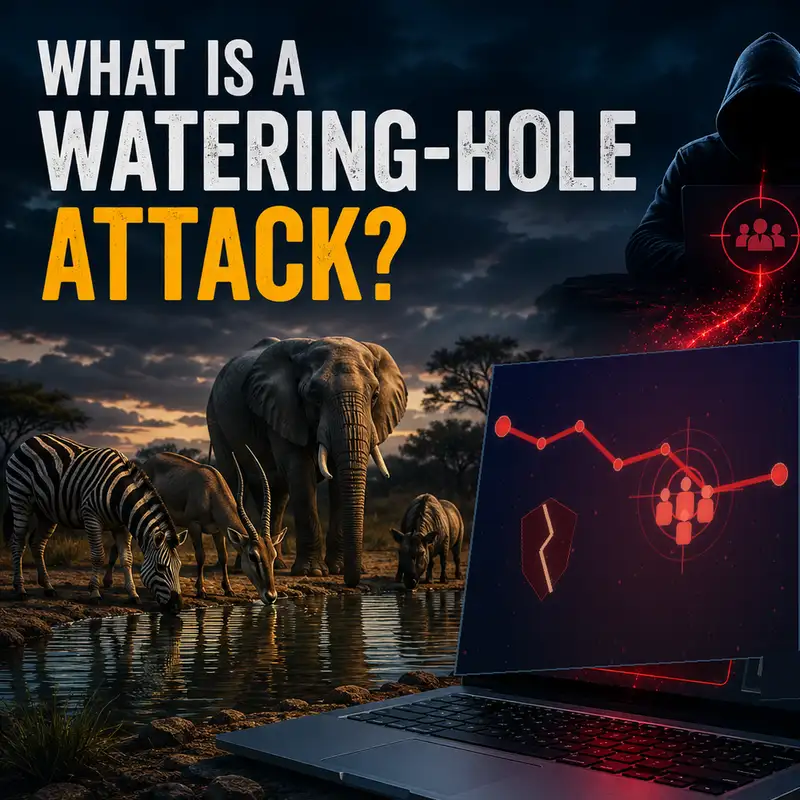
What Is a Watering-Hole Attack?
A watering-hole attack is often misunderstood as an ordinary website breach, but the compromised website may not be the attacker’s primary target at all. The real target is a particular group of people who are expected to visit that site as part of their normal work, research, communication, or professional activity. That distinction changes the defensive question. Instead of asking only how the website was altered, defenders must also ask who regularly used it, which visitors received malicious content, and what happened on their devices after the visit. In this episode, we will answer what makes a watering-hole attack different from other web-based attacks and why a familiar website can become a delivery point for targeted access. By the end, you should be able to explain the attack clearly, distinguish it from nearby concepts, and identify the evidence and controls that deserve attention. A watering-hole attack is a targeted technique in which an attacker compromises or abuses a website frequently visited by an intended group, then waits for members of that group to arrive. The website acts as an intermediary. It gives the attacker a place where likely targets naturally gather without requiring a separate message to every person. The term describes both target selection and delivery method, not merely the fact that malicious code appeared on a web page. An ordinary website compromise may be intended to deface a page, steal customer information, distribute unwanted content broadly, or misuse the site’s computing resources. A watering-hole attack is narrower because the attacker chooses the site based on the people who use it. The main distinction to remember is that the trusted location is compromised because of its relationship to the intended victims. The name comes from the way animals gather at a shared source of water. An attacker does not need to chase every target individually if the targets regularly come to the same place. In digital environments, that shared place may be an industry association site, a vendor portal, a specialized forum, a regional service, a professional resource, or another website used by a recognizable community. The important feature is not the type of website. It is the concentration of people the attacker wants to reach. Identifying such a site requires knowledge of the group’s habits, which is why watering-hole attacks are commonly associated with deliberate targeting rather than indiscriminate traffic. The attacker may be interested in an organization, a profession, a sector, a project, or a geographic community. The website becomes useful because normal behavior brings the selected audience to it. At a high level, the attack path begins when the adversary gains some form of influence over the trusted web location or a component that the location loads. That influence may involve unauthorized changes to the site, abuse of a third-party script, a malicious redirect, or another alteration that causes selected visitors to receive content the site owner did not intend. When a target visits, the malicious content may attempt to exploit an uncorrected browser weakness, present a deceptive sign-in page, trigger an unwanted download, or direct the visitor toward another controlled location. The exact outcome varies, but the purpose is usually to create an opportunity for unauthorized access, credential theft, surveillance, or further compromise. The visit itself is not proof that the device was compromised. Defenders still need evidence showing what the page delivered and what the device did afterward. Trust is the central condition that makes this technique effective. People are more likely to visit a familiar site without suspicion, and security teams may allow that site because it has a legitimate history, a known owner, and a valid business purpose. Technical signals can reinforce that trust even when they do not prove the content is safe. A secure connection and a browser padlock show that traffic is encrypted between the visitor and the site, but they do not guarantee that the site has not been altered. Reputation systems may also continue to treat a long-established domain as safe during the early part of a compromise. The attacker is therefore borrowing trust that someone else earned. This is different from creating an obviously malicious destination and persuading people to visit it. The danger comes from a valid relationship being turned against the people who rely on it. Watering-hole attacks can also be difficult to confirm because the malicious behavior may not appear for every visitor. A compromised site can continue serving normal content to most people while exposing only a limited audience to the harmful material. Selection may be based on broad characteristics such as location, organization, device type, browsing context, or other signals that suggest whether a visitor belongs to the intended group. The malicious change may also be present for only a short period or may depend on a remote component that is no longer available when investigators return. As a result, one person may report an unusual redirect while another opens the same page and sees nothing wrong. That inconsistency does not invalidate the report. It means defenders must preserve endpoint, network, browser, and website evidence before temporary conditions disappear. The closest related techniques are phishing, drive-by compromise, malvertising, and supply-chain compromise, but they are not identical. Phishing usually approaches the victim directly through a message, link, attachment, or request designed to provoke action. A watering-hole attack lets the victim’s normal browsing behavior create the contact. A drive-by compromise describes harmful activity that occurs when a person visits a web location, but it may be broad and opportunistic rather than aimed at a defined community. Malvertising uses advertising systems to place or redirect malicious content, sometimes across many unrelated sites. A supply-chain compromise affects a trusted product, service, update path, or provider relationship. These categories can overlap, especially when a third-party web component is abused, but watering-hole remains the best label when the attacker chose the web location because a particular group regularly visits it. Before we continue, a brief promotional note. This episode is brought to you by the Bare Metal Cyber Academy. The Academy provides a place for people who want to continue developing practical cybersecurity knowledge through clear, structured education. Topics like trusted-site compromise become easier to manage when you can connect attack methods, evidence, controls, and risk decisions instead of memorizing isolated terms. Visit Bare Metal Cyber dot com to explore the Academy and see the learning opportunities currently available. The goal is steady professional development through explanations that remain useful beyond a single tool or product. Now, let’s return to how defenders can recognize and reduce the risk of a watering-hole attack. Detection usually depends on connecting several small observations rather than waiting for one unmistakable alert. On a user device, Endpoint Detection and Response (E D R) may reveal unusual browser behavior, an unexpected process launched after a page visit, a suspicious file written to the system, or an outbound connection that does not fit normal browsing. Network records may show that several affected users visited the same legitimate site shortly before unusual activity began. Domain Name System (D N S) and proxy logs can help establish the sequence of destinations, while browser history and cached content may preserve evidence that later disappears from the live site. Investigators should preserve the time of the visit, the exact destination, redirects, downloads, account activity, and connections that followed. For the website owner, warning signs can include unauthorized file changes, altered scripts, new redirects, unfamiliar administrator activity, or unexpected connections to external services. No single indicator proves a watering-hole attack, but shared timing and a common web destination can reveal the relationship. Website owners reduce the opportunity for this attack by treating their public sites as security-sensitive systems rather than simple publishing platforms. That includes correcting vulnerabilities in the content management system, extensions, server software, and administrative tools before known weaknesses remain exposed for long periods. Administrative access should use strong authentication, limited privileges, and careful monitoring so one compromised account does not automatically permit broad changes. File-integrity monitoring can identify unauthorized alterations to pages and scripts, while secure deployment processes make it easier to distinguish approved updates from unexpected ones. Owners should also review third-party code, embedded services, analytics, advertising, and content-delivery dependencies because a page can become harmful without its main server being directly breached. Reliable backups and preserved logs support recovery and investigation. These measures lower risk, but they do not eliminate the need to watch for misuse of trusted components. Organizations whose people may be targeted need a different but complementary set of controls. Rapid browser and operating-system updates reduce the chance that a page can exploit a known weakness. Least privilege limits what a compromised browser session or user account can immediately reach. E D R, application controls, and browser isolation can detect or contain behavior that appears after a visit, even when the domain itself has a good reputation. D N S filtering, secure web gateways, and threat-intelligence services may block known malicious destinations or newly identified redirects, but reputation alone should not be treated as proof of safety. Multifactor authentication can reduce some forms of credential misuse, although a deceptive page or stolen session may still create risk. Network segmentation and strong identity controls help prevent one affected device from becoming a path to more valuable systems. Layered defense is necessary because the trusted site may pass through any control that relies only on a bad-domain list. User awareness still has a role, but watering-hole defense should not depend on a person recognizing a compromised site by appearance. The page may look completely normal because much of it is normal. Users should report unexpected sign-in prompts, unexplained downloads, repeated authentication requests, unusual browser warnings, or redirects that interrupt a familiar workflow. They should also be cautious when a trusted site suddenly asks for credentials it does not normally require or sends them to a different domain. These behaviors are useful signals, not proof, and reports should be investigated without blaming the person who visited a legitimate resource. Telling users to avoid unfamiliar websites would not solve the problem because the defining feature is misuse of a familiar one. The stronger approach combines reasonable user reporting with technical evidence that can show whether the browser, account, or device behaved abnormally. Risk assessment for watering-hole attacks should focus on exposure, concentration, and consequence. Exposure asks whether a group regularly visits web resources outside the organization’s direct control. Concentration asks whether many high-value users, administrators, researchers, executives, or technical specialists depend on the same small set of sites. Consequence asks what could happen if one of those visits led to stolen credentials, code execution, session misuse, or access to sensitive information. The same compromised site can create very different risk for different visitors because their devices, privileges, data access, and network position are not the same. Threat intelligence may identify sites or sectors under active targeting, but intelligence should guide investigation rather than replace local evidence. Blocking a trusted resource may interrupt legitimate work, so leaders need enough context to balance access, containment, monitoring, and business need. A practical way to apply this lesson is to identify the external web locations that important groups use repeatedly and treat those locations as dependencies rather than invisible background activity. Record which teams rely on them, what business purpose they serve, whether they require authentication, and what data or privileges users carry when visiting them. Keep browsers patched, collect enough web and endpoint telemetry to reconstruct a visit, and define who can quickly evaluate a report involving a trusted site. During an investigation, ask whether the website itself was the final target or a delivery point, whether the visitors share a meaningful relationship, and what changed on the device after the visit. This method avoids labeling every malicious web page as a watering hole. It reserves the term for the targeted use of a shared, trusted destination and connects the label to specific defensive actions. A watering-hole attack, then, is a targeted web-based attack that compromises or abuses a location frequently visited by a selected group and waits for those people to arrive. Its defining feature is not simply malicious content on a website. It is the attacker’s decision to use a trusted gathering place because of who visits it. That explains why the technique can bypass suspicion, why the same page may appear harmless to other visitors, and why investigators must connect web activity with endpoint and identity evidence. Defenders reduce the risk by securing websites and their dependencies, maintaining patched and monitored browsers, limiting user privileges, preserving useful logs, and responding to unusual behavior even when the domain looks legitimate. The practical decision is to trust a website according to current evidence and observed behavior, not only according to its name, reputation, or past history.