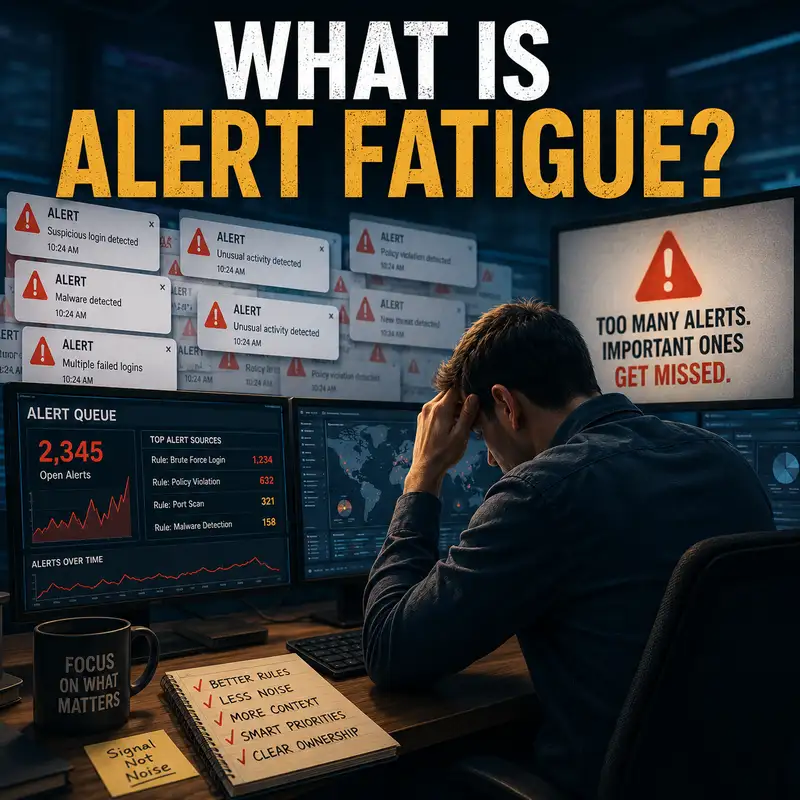
What Is Alert Fatigue?
Alert fatigue begins with a practical contradiction. Security monitoring is meant to draw attention to activity that deserves review, yet an excessive stream of notifications can make attention less reliable rather than more reliable. When nearly everything produces an alert, the analyst has difficulty recognizing which signals require immediate action, which can wait, and which add no useful information at all. The same problem can affect ordinary users when applications, account systems, and devices repeatedly warn them about updates, approvals, suspicious activity, or policy reminders. Over time, people may scan alerts too quickly, dismiss them automatically, or assume the next warning resembles the last harmless one. This episode answers a central question: how does a system designed to improve awareness end up reducing it? By the end, you should be able to explain how alert volume, quality, prioritization, repetition, and context determine whether a notification supports a decision or merely competes for attention. An alert is a notification that a system, rule, or person has identified activity that may deserve attention. Alert volume is the number of those notifications arriving during a period of work. Alert fatigue is the decline in attention, judgment, or responsiveness that develops when the alert stream is too frequent, repetitive, poorly prioritized, or difficult to interpret. The terms are related, but they are not identical. A busy environment can produce many valuable alerts without creating the same level of fatigue when the alerts are clear, distinct, and routed correctly. Fatigue develops when the effort required to separate meaningful signals from low-value noise repeatedly exceeds the attention available. That is why the problem is often misunderstood as a simple staffing issue. More analysts may help with workload, but additional people do not automatically correct rules that produce weak alerts, duplicate detections, missing context, or priorities that do not reflect actual risk. The quality of an alert depends first on what caused it to fire. Security tools usually apply rules, thresholds, behavior models, or known indicators to observed activity. A poor-quality rule is one that triggers too broadly, triggers on normal behavior, or describes something that is technically unusual but not meaningfully suspicious. The alert may be accurate in the narrow sense that the condition occurred, yet still provide little value to the person reviewing it. For example, a rule can correctly report repeated authentication failures while failing to distinguish a user mistyping a password from a coordinated attempt to gain access. The alert is not automatically useless, but it needs enough supporting information to justify attention. When rules repeatedly announce conditions that rarely lead to action, analysts learn that responding is unlikely to produce a useful result. That learned expectation is one of the strongest forces behind alert fatigue. Repeated alerts create another form of noise because they can make one underlying condition appear to be many separate problems. A single device, account, or process may generate the same notification every few seconds, every time a scan runs, or every time a connection is retried. Without suppression, grouping, or correlation, the monitoring system may present each occurrence as an independent item. The analyst then spends time confirming that the new alert is not actually new. Repetition also distorts perception because a frequently reported low-priority condition can dominate the screen while a less frequent but more important alert receives little visual or operational space. Good monitoring should preserve evidence that activity continued without forcing a person to re-evaluate identical information repeatedly. Grouping related detections, showing the first and most recent occurrence, and recording the total count can maintain visibility while reducing unnecessary interruption. Prioritization determines where attention goes first, so weak prioritization can turn a manageable alert stream into a dangerous one. A priority label should reflect more than the fact that a rule fired. It should consider the reliability of the detection, the sensitivity of the affected asset, the privileges of the account, the exposure of the system, the possible consequence, and the urgency of the required response. When too many alerts are labeled critical or high, those labels stop helping. The system has effectively announced that everything is urgent, which leaves the analyst to rebuild the priority model manually. The opposite problem also occurs when a serious alert receives a low ranking because the rule does not understand the business value of the target. Useful prioritization combines technical evidence with operational context. Its purpose is not to predict the future perfectly. Its purpose is to help limited human attention reach the most consequential and time-sensitive work first. Context gives an alert enough meaning for someone to decide what to do next. A bare notification may identify an Internet Protocol address, a filename, a username, or a rule name, but those details alone may not explain whether the activity is expected. Helpful context can include the affected asset, its owner, recent related activity, the user’s normal behavior, the process that created the event, the destination involved, prior investigations, and the control that generated the alert. Context also explains why the alert matters. An unusual login to a low-value test account does not necessarily deserve the same response as unusual access involving a privileged account connected to critical systems. Missing context increases investigation time because the analyst must collect basic facts before judging the alert. When that information is consistently absent, each notification becomes a research assignment, and the alert queue grows faster than decisions can be completed. Alert fatigue also changes human behavior in predictable ways. Attention is limited, and frequent interruptions create a cost each time a person stops one task, evaluates a notification, and then returns to the original work. When most interruptions prove unimportant, the mind begins to treat the alert channel as unreliable. Analysts may skim instead of reading carefully, rely too heavily on familiar patterns, postpone review, or close alerts after only a superficial check. Users may approve prompts automatically, ignore warning banners, or stop reporting messages that appear repetitive. These responses are not evidence that people are careless by nature. They are signs that the notification system has trained people to expect low value. Security design must account for that human tendency. A warning that is technically correct but routinely ignored is not performing its intended function, and the control should be evaluated by the decisions it produces rather than by the number of messages it displays. Before we continue, this episode is brought to you by the Bare Metal Cyber Academy. The Academy is a place for people who want to continue developing practical cybersecurity knowledge through clear, structured education. It supports deliberate learning that helps professionals understand not only what a security term means, but how it affects judgment, communication, and daily decisions. Alert fatigue is a useful example because better monitoring depends on people who can question noisy rules, improve context, and recognize when a control is creating more interruption than insight. Visit Bare Metal Cyber dot com to explore the Academy and see the learning opportunities currently available. Now, let’s return to how security teams can reduce fatigue without losing important visibility. One common misunderstanding is that reducing alert fatigue simply means generating fewer alerts. Lower volume can help, but careless reduction can hide evidence that defenders still need. The real objective is to increase the proportion of alerts that support a meaningful decision while preserving access to lower-level events for investigation and analysis. An event is a recorded occurrence, such as a login, process start, configuration change, or network connection. An alert is a judgment that one or more events may deserve attention. Not every event should interrupt a person. Many events belong in logs where they can be searched, correlated, and retained without becoming individual tasks. This distinction allows monitoring systems to remain observant without demanding human review of every recorded action. Effective tuning decides which conditions deserve interruption, which should be grouped, and which should remain available as supporting evidence. False positives contribute to alert fatigue, but they are not the entire problem. A false positive occurs when a tool reports a threat or violation that is not actually present. A low-value alert can be technically true and still waste attention because it describes expected behavior, repeats known activity, or lacks a response path. That distinction matters during tuning. If a team labels every unwanted alert a false positive, it may adjust the rule incorrectly or overlook a process problem that made the alert legitimate but unnecessary. The reviewer should ask whether the underlying condition occurred, whether the condition is relevant, whether the alert includes enough evidence, and whether a specific action follows from it. These questions separate detection accuracy from operational usefulness. A rule can be accurate, relevant, and still badly presented. Improving alert quality may therefore require better thresholds, richer enrichment, clearer ownership, or more useful grouping rather than simply disabling the detection. Tuning is the disciplined process of adjusting monitoring so that alerts better match the environment and the decisions people must make. It may involve changing thresholds, narrowing rule conditions, excluding approved behavior, adding asset information, correlating related events, or routing notifications to a more appropriate team. Tuning should be based on evidence from investigations, not on frustration alone. If a rule fires often, reviewers should examine how many alerts led to escalation, what patterns caused unnecessary work, which true incidents the rule helped identify, and what information was repeatedly missing. The goal is to reduce avoidable effort without creating a blind spot. That requires documentation and review because environments change. A carefully tuned rule can become noisy after a software deployment, identity change, business expansion, or new administrative process. Monitoring quality therefore depends on continued maintenance rather than a single cleanup effort. Automation can reduce fatigue when it removes repetitive collection and classification work, but automation can also magnify a poor rule. Enrichment can automatically add device ownership, account privileges, reputation data, recent activity, and related alerts before a person begins reviewing the case. Correlation can combine several weak signals into one stronger alert. Deduplication can collapse identical notifications, and automated response can contain certain well-understood conditions when authority and safeguards are appropriate. None of these techniques should be treated as a substitute for judgment. If automation closes alerts using weak assumptions, the organization may simply replace visible fatigue with invisible missed activity. The automated action must be understandable, testable, and monitored for failure. A useful principle is to automate stable, repetitive steps while keeping ambiguous or high-consequence decisions under meaningful human review. That balance saves attention without pretending that every alert can be resolved by a rule. Measurement and ownership determine whether alert fatigue is corrected or merely discussed. Counting how many alerts an analyst closes may reward speed without showing whether the review was accurate, while total volume alone does not reveal which rules create unnecessary work. More useful indicators include the percentage of alerts that lead to escalation, the number of duplicates, the age of the queue, the time spent gathering missing context, and the concentration of alerts produced by a small number of rules. Those measurements need responsible owners who can act on them. Detection authors need feedback about rule performance, system owners must explain expected behavior, and leaders must decide which risks deserve immediate interruption. When ownership is unclear, analysts may repeatedly close the same alerts without authority to change the rule, fix the source, or improve the workflow. A mature process assigns responsibility for each rule, records tuning decisions, schedules review, and gives operational feedback a direct path back into the monitoring system. A practical way to evaluate an alert is to ask whether it helps answer four questions. What happened, why might it matter, how urgent is it, and what action should follow? The alert should identify the relevant activity clearly enough that the reviewer does not have to decode a vague rule name. It should connect the activity to an asset, account, process, or business function that gives the event meaning. Its priority should be supported by evidence rather than by a default severity label. Finally, the alert should point toward a reasonable next step, even when that step is further investigation. If one of these answers is consistently missing, record the gap and feed it into tuning. This method does not require every alert to contain every possible fact. It requires the notification to provide enough value to justify interrupting a person and enough direction to begin a sound decision. Alert fatigue is the loss of reliable attention caused by a notification environment that demands too much review while providing too little distinction, priority, or context. It develops not only because there are many alerts, but because poor-quality rules, repeated notifications, weak severity models, and incomplete information make important signals resemble routine noise. The correct response is not to silence monitoring indiscriminately or blame the people receiving the alerts. It is to improve the relationship between detection and decision through tuning, grouping, enrichment, thoughtful automation, meaningful metrics, and clear ownership. A security alert earns attention when it helps someone understand what occurred, why the activity matters, how quickly it must be addressed, and what should happen next. Monitoring becomes more effective when the system protects human attention as carefully as it collects technical evidence.