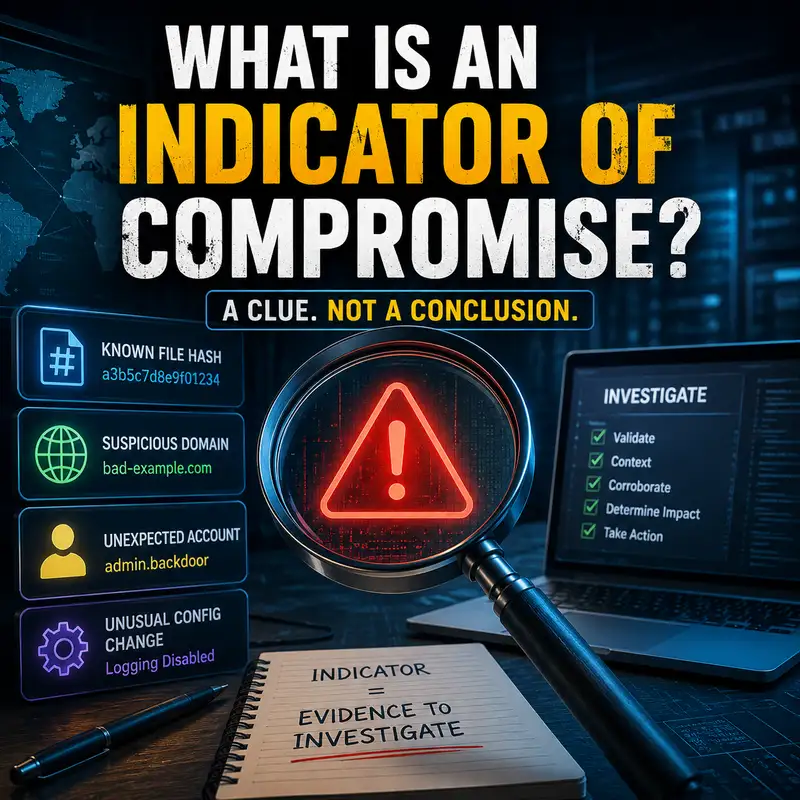
What Is an Indicator of Compromise?
Security teams often make one of two opposite mistakes when they encounter a suspicious clue. They either treat the clue as conclusive proof that an incident has occurred, or they dismiss it because the clue does not explain the entire event by itself. An indicator of compromise is useful precisely because it sits between those extremes. It tells a defender that something deserves attention, but it does not automatically establish what happened, who caused it, how far the activity spread, or whether the activity was malicious at all. In this episode, we will answer the practical question of how to recognize an indicator, how to judge its significance, and how to use it without overstating what the evidence can prove. By the end, you should be able to explain why a known file hash, suspicious domain, unexpected account, or unusual configuration change can guide an investigation while still requiring context and confirmation. An Indicator of Compromise (I O C) is an observable fact that may be associated with malicious activity or with the aftermath of that activity. The observable fact might come from a file, a device, a user account, a network connection, a cloud service, or a configuration record. An alert is different because an alert is a notification generated when a tool or rule decides that certain conditions deserve attention. An incident is also different because an incident is a confirmed or reasonably established security event that requires coordinated response. The relationship is straightforward: an I O C may contribute to an alert, and several related indicators may help an investigator determine that an incident occurred. The distinction people most often miss is that the indicator is evidence to evaluate, not a verdict produced automatically by the presence of one suspicious value. Indicators appear in several forms because malicious activity leaves traces in different parts of an environment. File indicators can include hashes, names, paths, signing information, or unusual file properties. Network indicators can include domains, Internet Protocol addresses, Uniform Resource Locators, connection patterns, or communication with infrastructure previously associated with malicious activity. Identity indicators can include newly created accounts, unexpected privilege changes, impossible access patterns, or authentication from a location or device that does not fit established use. System indicators can include altered services, scheduled tasks, registry values, startup settings, security controls, or logging configurations. None of these categories guarantees compromise on its own. Their value comes from showing where to look, what to compare, which records to preserve, and which questions the investigation should answer before the organization decides how serious the situation is. A known file hash is one of the clearest examples of an indicator, but it also shows why indicators have limits. A hash is a calculated value that acts like a compact fingerprint for the exact contents of a file. When a defender compares a file against a trusted source of known malicious hashes and finds a match, the result strongly suggests that the same file has appeared in the environment. That is useful for finding copies, blocking distribution, and identifying affected devices. The match does not reveal how the file arrived, whether it executed, what actions it performed, or whether another control already prevented it from causing harm. Hashes are also fragile indicators because even a small change to a file usually produces a different value. A defender should therefore treat a hash match as strong evidence about a specific artifact while continuing to investigate execution, delivery, persistence, and impact. A suspicious domain or Internet Protocol address works differently because it describes communication rather than a file stored on a device. A connection to infrastructure associated with phishing, malware delivery, command and control, or data theft may reveal that a user or system reached a dangerous destination. The context determines what the connection means. A blocked lookup may show that a protective control worked, while a successful encrypted session followed by unusual outbound traffic may justify deeper investigation. Shared hosting, cloud platforms, content delivery networks, and reassigned addresses can also make network indicators less precise than they first appear. A domain may be malicious during one period and later become inactive, cleaned, or repurposed. Network indicators are therefore most useful when defenders combine reputation information with timing, direction, frequency, device identity, process information, and the actions that occurred before and after the connection. An unexpected account or unusual configuration change can be especially important because it may reveal persistence, privilege misuse, or an attempt to weaken defenses. A new administrator account, an added authentication method, a disabled logging setting, or a modified startup configuration may all deserve immediate review. The word unexpected is doing important work in that judgment. Authorized maintenance, automated deployment, disaster recovery, and routine administration can produce changes that look suspicious when they are viewed without business context. Investigators should compare the change with approved requests, change records, system ownership, normal administrative patterns, and the identity that performed the action. They should also determine whether the change created new access, removed visibility, or altered a security boundary. The indicator becomes more persuasive when the change lacks a legitimate explanation and aligns with other evidence, such as unfamiliar logins, new processes, or unusual outbound communication. Context turns an isolated clue into useful evidence. The same observable can have very different meaning depending on when it appeared, where it appeared, how often it appeared, and what surrounded it. A domain lookup from a protected research environment may have a different significance from repeated connections by a production server that normally has no reason to reach the Internet. A file hash found in quarantine is different from the same hash associated with successful execution and follow-on activity. An account creation event during an approved onboarding process is different from an account created outside normal administrative channels and granted elevated privileges. Good investigation therefore looks for corroboration, which means independent evidence that supports the same explanation. The goal is not to collect the largest number of indicators. The goal is to determine whether the available evidence forms a consistent, defensible account of what occurred and what risk remains. Before we continue, this episode is brought to you by the Bare Metal Cyber Academy. The Academy provides a place for people who want to keep developing practical cybersecurity knowledge through clear, structured education. It is designed for learners and professionals who value explanations that connect technical evidence to sound security decisions. You can visit Bare Metal Cyber dot com to explore the Academy and review the learning opportunities currently available. Understanding indicators of compromise requires more than memorizing suspicious values, and continued study can help you build the judgment needed to interpret evidence responsibly. Now, let’s return to how defenders separate an indicator from an alert, a finding, and a confirmed incident. Security tools often blur the language by presenting a detection result as though the tool has already established compromise. A rule may generate an alert because a file hash matched a threat-intelligence list, a domain appeared in network logs, or an account changed a protected setting. The alert tells the security team that a defined condition occurred and that the condition met the rule’s threshold. A finding is the investigator’s documented conclusion about what the evidence supports after review. An incident is the larger security event that may include several systems, accounts, actions, and consequences. One indicator can appear in many alerts, and one incident can contain many different indicators. Keeping these terms separate improves communication because leadership needs to know whether the team is discussing a raw clue, an automated warning, an analyst’s conclusion, or a confirmed event that requires containment and recovery. False positives are one reason an indicator cannot be treated as automatic proof. A false positive occurs when a detection suggests malicious activity even though the underlying activity is legitimate or harmless. The indicator itself may be accurate, but the interpretation may still be wrong. A system may connect to a suspicious domain because a security product is checking reputation data, a researcher is analyzing a threat, or a web page loaded third-party content without user intent. An unexpected account may belong to an approved service that was poorly documented. A configuration change may result from a legitimate software update. Indicators can also become stale as attackers change infrastructure, files, and techniques, or as previously suspicious resources return to legitimate use. Defenders should therefore evaluate source reliability, collection time, environmental relevance, and supporting behavior rather than assuming that every match carries the same level of confidence. The age and scope of an indicator affect how it should be used. Some indicators are highly specific but useful for only a short period, while others remain valuable longer but describe a broader pattern. A hash tied to one exact malicious file may provide high confidence when matched, yet it misses modified versions of that file. A domain may remain relevant across several campaigns, but shared services can reduce certainty about which connection was harmful. A configuration pattern may continue to reveal misuse even after individual files and addresses change. Threat intelligence helps by adding information about when an indicator was first seen, when it was last seen, what activity it has been associated with, and how confident the source is in that association. Defenders should preserve those details because an indicator without time, source, and context can become a disconnected value that creates noise instead of insight. A disciplined investigation begins by validating the observable itself. Confirm that the file hash, domain, account, or configuration change was collected correctly and that the record refers to the expected device, user, and time. Next, determine the source of the indicator and whether that source is reliable, current, and relevant to the environment. Then examine nearby evidence, including process execution, authentication activity, network sessions, endpoint events, cloud audit records, and change history. The investigator should ask whether the activity succeeded, whether it affected additional assets, whether access remains available, and whether the evidence supports a benign explanation. Preservation matters because logs and volatile data can disappear while the investigation continues. The final conclusion should state what is known, what is strongly supported, what remains uncertain, and which actions are justified by the current evidence. Indicators influence response decisions, and the way they are communicated can affect those decisions just as much as the technical evidence. A confirmed malicious file hash may justify blocking or quarantining that exact artifact, while a suspicious domain may justify temporary filtering and retrospective searches. An unexpected privileged account may justify disabling access while ownership and authorization are verified, and an unauthorized configuration change may require restoration and credential review. These actions should be proportionate to confidence and potential impact because blocking an indicator does not remove every related threat. Attackers can change files, domains, accounts, and infrastructure. Clear reporting should name the observable, explain why it is suspicious, identify corroborating or conflicting evidence, and separate fact from interpretation. That precision helps responders choose containment steps and gives leaders a defensible basis for deciding whether to escalate, disclose, or continue monitoring. A practical way to evaluate an indicator is to ask five connected questions without turning the process into a mechanical checklist. First, identify exactly what was observed and confirm that the data is trustworthy. Then ask why the observable is considered suspicious and whether the source provides current, relevant context. Examine what happened immediately before, during, and after the observable appeared, because surrounding behavior often carries more meaning than the value alone. Look for independent evidence that supports or contradicts the same explanation, including authorized changes and normal business activity. Finally, decide what action is justified now and what additional evidence would change that decision. This method keeps the investigation focused on evidence rather than labels. It also helps you avoid two costly errors: dismissing a meaningful clue too early and declaring an incident before the facts support that conclusion. An indicator of compromise is a clue that malicious activity may have occurred, not automatic proof that an incident happened. A known file hash, suspicious domain, unexpected account, or unusual configuration change can narrow the search and show defenders where evidence deserves closer attention. Its significance depends on accurate collection, reliable sourcing, timing, environmental context, and corroboration from related activity. The correct response is neither blind trust nor casual dismissal. Treat the indicator as a starting point for validation, investigation, and proportionate action. When the evidence supports compromise, the indicator becomes part of the record that explains the incident and guides containment. When the evidence supports a legitimate explanation, the investigation should document that conclusion as well. The professional practice is to let indicators direct attention while allowing the full body of evidence to determine what the organization can responsibly claim and what it should do next.