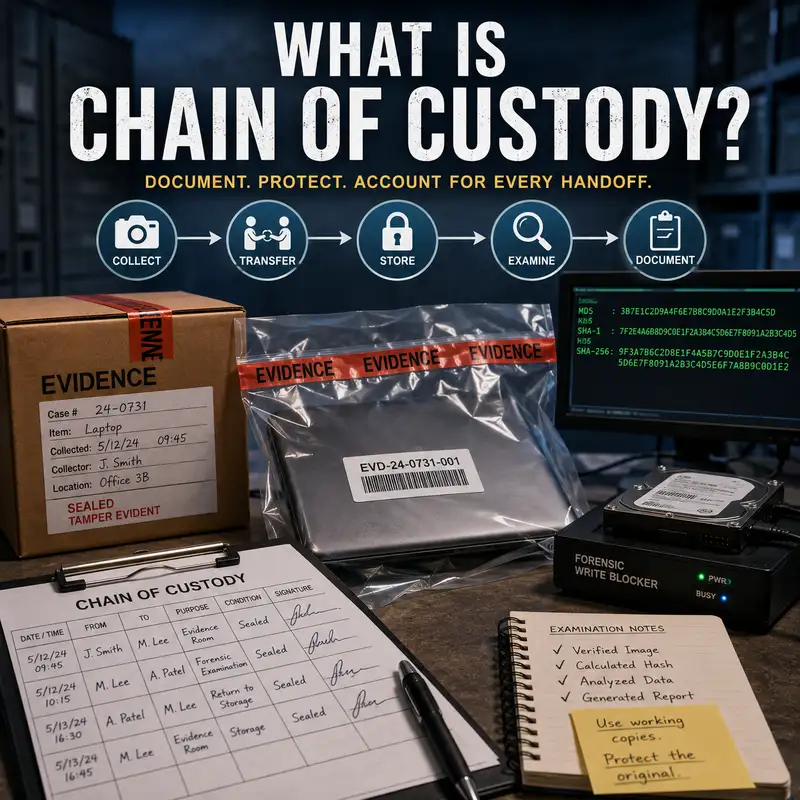
What Is Chain of Custody?
Chain of custody is sometimes treated as paperwork that begins after the important technical work is finished. That misunderstanding creates a serious problem because the record is part of what makes evidence trustworthy. A file, device, log export, photograph, or forensic image may appear convincing, but an investigator still needs to explain where it came from, who handled it, what was done to it, and how it was protected from improper change. The practical question is not only whether the evidence contains useful information. The question is whether another person can follow its history from collection through examination and reasonably trust that the item being discussed is the same item that was originally obtained. By the end of this episode, you should be able to explain what chain of custody records, why gaps weaken confidence, and how careful handling supports defensible investigative conclusions. Chain of custody is the documented history of how evidence was collected, identified, transferred, stored, examined, and protected. It connects the original item to every authorized person and action that followed. The central distinction is that evidence integrity describes whether the evidence remained complete and unaltered in an improper way, while chain of custody describes the record used to demonstrate how that integrity was maintained. The chain does not prove that every interpretation of the evidence is correct. It shows that the organization used controlled handling and can account for the evidence throughout its life. Investigators often confuse possession with custody, but simply knowing where an item is located is not enough. A reliable record must also explain who had responsibility for it, when that responsibility changed, why access occurred, and what safeguards were applied. The chain begins when evidence is recognized and collected, not when it reaches a laboratory or evidence room. At collection, the investigator records enough information to distinguish the item from every other item. That record commonly includes a unique identifier, the date and time, the location or source, the name of the collector, the condition of the item, and the method used to obtain it. Digital evidence may include a computer, mobile device, removable drive, server log, email export, memory capture, cloud record, or network data. The description should be precise enough that another qualified person can understand what was collected without relying on memory. Collection notes also help separate the original evidence from copies created for analysis. When identification is vague or delayed, later documentation may describe an item accurately but still fail to show that it is the same item first encountered. Preservation protects evidence after collection and limits the chance that handling will change it. Physical items may be placed in appropriate packaging, marked with an identifier, sealed, and stored under controlled conditions. Digital evidence often requires additional care because opening a file, starting a device, connecting storage, or running an examination tool can alter metadata or system state. Investigators therefore try to preserve the original and conduct analysis on a verified working copy when the circumstances allow it. A forensic image can capture the contents of storage in a controlled form, while write-protection measures can reduce the chance of accidental modification during acquisition. Preservation does not mean that no changes will ever occur anywhere in the process. It means that expected changes are controlled and documented, while unauthorized or unexplained changes are prevented or detected. Every transfer of evidence creates a point where responsibility changes, so each handoff must be recorded. A transfer record normally identifies the person releasing the evidence, the person receiving it, the date and time, the purpose of the transfer, and the condition of the evidence or its seal. The purpose matters because it explains why access was necessary rather than merely showing that access occurred. Evidence may move from a collector to an evidence custodian, from storage to an examiner, or from an internal investigation to an authorized external party. A chain with several handlers is not automatically weak. It becomes weak when the organization cannot explain those handlers or when a transfer is missing, inconsistent, or unsupported. Good documentation allows another reviewer to reconstruct possession and responsibility without guessing, contacting every participant, or depending on informal messages. Secure storage continues the chain even when nobody is actively examining the evidence. The organization should be able to show where the evidence was kept, who could access it, and what controls protected it. Physical evidence may require locked storage, tamper-evident seals, restricted keys, and access logs. Digital evidence may require controlled repositories, strong authentication, encryption, permissions that limit modification, reliable backups, and logging that records access or copying. Storage conditions should match the nature of the item because heat, moisture, magnetic exposure, power loss, or software synchronization can affect certain forms of evidence. The custodian should also be able to account for checked-out items and overdue returns. An evidence room with a strong lock is not enough if access records are incomplete. A secure repository is not enough if administrators can alter files without detection or documentation. Examination must be documented because analysis can create new files, change working copies, generate reports, and expose evidence to additional people or tools. An examiner should identify the item or verified copy used, the date of examination, the methods applied, and the outputs produced. Tool names, versions, settings, and significant actions may be important when they affect how results were generated or interpreted. The original evidence should remain protected whenever possible, while examination occurs on a controlled copy whose relationship to the original can be demonstrated. Notes should distinguish observations from conclusions so another reviewer can see what the evidence contained and how the examiner interpreted it. Chain of custody does not replace technical competence or peer review. It gives those activities a traceable foundation by showing that the material examined was properly identified, preserved, and accounted for. Before we continue, this episode is brought to you by the Bare Metal Cyber Academy. The Academy provides a place for people who want to continue developing practical cybersecurity knowledge through clear, structured education. Topics such as evidence handling become more useful when you understand both the technical process and the professional responsibility behind it. You can visit Bare Metal Cyber dot com to explore the Academy and see the learning opportunities currently available. The goal is to help you build knowledge that can be applied carefully in real security work, without exaggerated promises or shortcuts. Now, let’s return to how investigators demonstrate that digital evidence remained trustworthy throughout collection, transfer, storage, and examination. Cryptographic hashes are often used to support the integrity portion of a digital chain of custody. A hash function produces a fixed-length value based on the contents of a file, disk image, or other digital object. If the contents change, the resulting value will usually change, which allows an examiner to compare a later copy with the value recorded during acquisition. Matching values provide strong evidence that the compared data is unchanged at the bit level. A hash does not, by itself, prove who collected the data, whether the collection was authorized, or whether the item was already altered before the first value was calculated. It also does not explain every action taken between two comparisons. The hash becomes most useful when it is created at a documented point, preserved with the case record, and connected to controlled handling throughout the rest of the chain. Chain of custody is related to provenance, audit trails, and evidence authentication, but the terms are not interchangeable. Provenance describes the origin and history of an item or data set, often across systems and transformations. An audit trail records events or actions within a system, such as access, modification, export, or deletion. Authentication in an evidentiary sense concerns whether an item is what a person claims it to be. Chain of custody uses elements of all three ideas, but it focuses specifically on accountable handling from collection through final disposition or presentation. It is also different from confidentiality. Evidence can remain confidential yet be altered, or remain unchanged while being viewed by someone who was not authorized. A sound process considers confidentiality, integrity, access, provenance, and accountability together without treating any one control as a complete substitute for the others. Several common misunderstandings make chain of custody seem either stronger or weaker than it really is. One mistake is assuming that a signed form guarantees the evidence is genuine. A form records handling, but it cannot compensate for poor collection, an unidentified source, an unreliable tool, or an unsupported conclusion. Another mistake is assuming that any clerical error automatically destroys the value of the evidence. The effect of an error depends on its nature, whether the history can still be reconstructed, and whether the integrity of the item remains reasonably supported. A third mistake is treating a long chain as suspicious merely because many qualified people participated. The number of handlers matters less than whether each transfer was necessary, authorized, and documented. The strongest record is not the one with the fewest names. It is the one that accounts clearly for every relevant change in responsibility and condition. Digital investigations create special challenges because evidence can be volatile, distributed, and transformed during collection. Memory contents may disappear when a system loses power. Cloud records may be exported through a provider interface that changes formatting or omits metadata. Log data may pass through collection agents, storage platforms, normalization processes, and retention systems before an investigator sees it. Screenshots may preserve visible content but fail to capture underlying metadata or the complete context. Time settings and clock differences can also complicate the relationship between records from separate systems. These conditions do not make reliable custody impossible, but they require investigators to document the source, collection method, time reference, export process, and any transformation applied. When evidence cannot be preserved in its original state, the record should explain why, what was captured, what may have been lost, and how the resulting copy was validated. A dependable chain of custody improves more than courtroom readiness. It helps incident responders coordinate work, supports internal investigations, allows leadership to understand the basis for conclusions, and reduces disputes about what happened to important data. It can also help an organization decide whether evidence is strong enough to support containment, disciplinary action, regulatory reporting, insurance communication, or referral to an external authority. Poor handling can force decision-makers to separate what is known from what is merely suspected. That distinction may change the urgency, scope, and language of the response. Documentation also protects investigators by showing that they followed an approved process rather than acting casually or altering material without explanation. The chain therefore supports both technical confidence and organizational accountability. It turns evidence handling from an informal activity into a repeatable professional practice. A practical way to apply chain of custody is to make every evidence action answer a small set of connected questions. Identify exactly what the item is and where it came from. Record its condition at collection, assign a unique identifier, and preserve the original or the best available representation. Document every person who receives access, the time of access, the purpose, and the condition when responsibility changes. Use controlled copies for examination when possible, and verify digital copies with recorded hash values or another appropriate integrity method. Keep storage access restricted and logged, then reconcile the record before relying on the evidence in a report or decision. If a gap appears, do not hide it or fill it with an assumption. Describe the gap, investigate it, and explain how it affects confidence in the evidence. Chain of custody is the record that connects evidence to its complete handling history. It shows how the item was collected, identified, transferred, stored, examined, and protected, and it identifies the people responsible at each stage. Investigators document those details so another person can evaluate whether the evidence remained the same item and whether any changes were authorized, expected, and traceable. A strong chain does not guarantee that the evidence proves a particular conclusion, and it does not make weak analysis correct. It demonstrates that the evidence reached the analysis through an accountable process rather than an unexplained path. The practical standard is simple to state but demanding to maintain: every material handoff and action should be recorded well enough that the history can be reconstructed without guesswork. That record is how investigators show that evidence was not improperly altered.