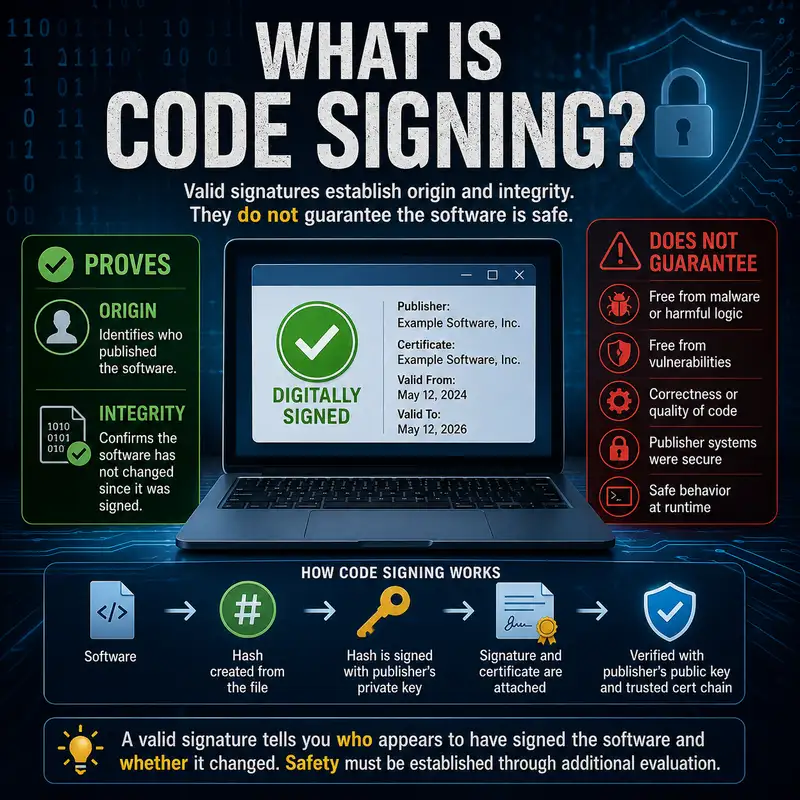
What Is Code Signing?
A valid digital signature on software is often treated as if it were a safety seal, but that is not what code signing proves. The signature can help a computer or a user identify the software publisher and detect whether the signed content changed after the publisher applied the signature. It does not examine every instruction, predict future behavior, or guarantee that the publisher’s systems were secure when the software was created. That distinction affects whether you install an application, approve an update, allow a driver to run, or investigate a security warning. In this episode, we will separate origin, integrity, trust, and safety so that you can interpret a code-signing result correctly. By the end, you should be able to explain what a valid signature establishes, what it leaves unanswered, and what additional evidence is needed before software should be trusted. Code signing is a process in which a publisher applies a digital signature to software or another code-based artifact. The signature is created with a private cryptographic key and checked with the related public key. A digital certificate commonly connects that public key to a named publisher, while a cryptographic hash represents the specific content that was signed. These parts work together to support two central claims. The first is origin, meaning the signed artifact is associated with the holder of the signing key and the identity represented by the certificate. The second is integrity, meaning the signed content has not been altered without detection since the signature was created. Code signing does not directly establish safety, quality, legitimacy of purpose, freedom from vulnerabilities, or freedom from malicious behavior. The main distinction to remember is that a signature answers questions about provenance and change, not every question about what the software will do. The signing process begins by applying a cryptographic hash function to the software. A hash function turns the content into a fixed-length value that changes when the underlying bytes change, even when the visible difference seems small. The publisher’s signing system then uses the private key to create a signature associated with that hash value. The software package carries the signature and usually the certificate information needed for verification. When a device checks the signature, it uses the public key, calculates a new hash from the received software, and compares the result through the signature-verification process. A match indicates that the signed content corresponds to what the key holder signed. A mismatch indicates that the content, the signature, or both cannot be validated as expected. The private key is not sent to users, and code signing does not normally encrypt the entire program. Its purpose is to make unauthorized modification detectable and to connect the artifact to a signing identity. The certificate adds identity information to the cryptographic result. In a conventional Public Key Infrastructure (P K I), a Certificate Authority (C A) issues a certificate that binds a public key to an organization, individual, or other validated identity. The operating system or application may trust the certificate because it can trace the certificate through a chain to a trusted root. That trust chain does not mean the platform personally reviewed the software’s design or approved every action it performs. It means the platform recognizes the certificate path and accepts the identity binding under the applicable trust rules. A self-signed certificate can still support cryptographic verification, but other systems may not trust the asserted identity without a separate reason. Even a publicly trusted certificate identifies the entity represented by the certificate only as strongly as the issuing process and the publisher’s control of the private key. The practical question is therefore not merely whether a signature exists, but whose identity is represented and why that identity should be trusted. Integrity is narrower than many people assume. A valid signature shows that the bytes covered by the signature have not changed since signing, but it does not prove that the original signed content was correct or harmless. Software can contain a programming error, an insecure dependency, an unwanted feature, or intentionally harmful logic before the signature is applied. The signature can preserve the integrity of flawed software just as effectively as it preserves the integrity of well-designed software. It also applies only to the material included in the signing scope. A signed installer may later download additional components, read configuration data, connect to external services, or load plug-ins that require their own evaluation. Runtime behavior can also depend on permissions, environment, user input, and remote instructions. Code signing protects the identity and integrity claims attached to the signed artifact. It does not freeze every condition that can influence what happens after execution begins. Security interfaces commonly distinguish among valid signatures, invalid signatures, unsigned code, and signatures that cannot be fully trusted. A valid signature means the verification checks succeeded under the current rules, including the integrity check and the certificate evaluation available to the platform. An invalid signature may indicate modification, corruption, a damaged signature, an unsupported algorithm, or another verification failure. Unsigned code has no code-signing evidence attached, which does not automatically make it malicious, but it removes an important source of provenance and integrity information. An unknown or untrusted publisher may have signed the software, yet the device cannot connect the certificate to a trust anchor it accepts. These conditions should not be collapsed into one generic warning. An invalid signature raises a different concern from the complete absence of a signature, and an untrusted certificate raises a different question from altered content. Correct interpretation helps determine whether to stop execution, verify the source, inspect the certificate, or escalate the artifact for further analysis. The strongest limitation of code signing is that trust in a signature depends on trust in the signing process. A publisher can knowingly sign harmful software. An attacker can also obtain unauthorized access to a signing key, compromise a build environment, replace code before signing, or abuse an approved release process. In each case, the resulting software may carry a cryptographically valid signature even though the software should not be trusted. The signature still provides useful evidence because it identifies the key and certificate involved, supports investigation, and may help defenders trace affected releases. It simply cannot decide whether the content is safe. Security decisions should combine the signature result with the source of the download, the publisher’s reputation, expected software behavior, vulnerability information, malware analysis, platform protections, and organizational policy. A valid signature increases confidence in provenance and integrity, but confidence is not the same as proof of benign intent. Before we continue, a brief promotional note. This episode is brought to you by the Bare Metal Cyber Academy. The Academy provides a place for people who want to continue developing practical cybersecurity knowledge through clear, structured education. Topics such as digital trust become easier to apply when the underlying concepts are explained without unnecessary complexity or exaggerated promises. You can visit Bare Metal Cyber dot com to explore the Academy and see the learning opportunities currently available. The purpose is to help you build knowledge you can use when evaluating systems, controls, and professional decisions. Now let’s return to code signing and examine how time, certificate status, and organizational policy affect what a valid signature means. Time adds another layer to signature verification. Signing certificates have validity periods, and a certificate may expire after software has already been properly signed and released. A trusted timestamp can provide evidence that the signature existed at a particular time, allowing a platform to evaluate whether the certificate was valid when the publisher signed the artifact. Without an acceptable timestamp, expired certificate status may create uncertainty or cause verification to fail under some policies. Revocation is different from expiration. Revocation indicates that the certificate should no longer be trusted, often because the private key may have been compromised, the certificate was issued incorrectly, or the publisher’s authorization changed. Platforms may check a Certificate Revocation List (C R L) or use the Online Certificate Status Protocol (O C S P) to obtain status information. These checks are valuable, but their availability, timing, and enforcement can vary. A signature result is therefore shaped by cryptography, certificate status, timestamp evidence, and the verification policy of the system performing the check. Attackers value trusted signatures because users and security controls often give signed code more credibility than unsigned code. The defensive concern is not how to misuse a certificate, but how to recognize when a legitimate trust mechanism has been abused. Unexpected software signed by a familiar publisher, a new certificate appearing outside a normal release pattern, or signed code behaving differently from the approved version may justify investigation. Defenders can compare certificate details, hashes, release channels, version information, and observed behavior to determine whether the artifact matches an authorized release. They can also monitor signing activity, protect build systems, and review which identities are permitted to sign production code. Revocation and rapid distribution of updated trust information become important when a key is exposed. A valid signature should reduce uncertainty about the signing identity and artifact integrity, but unusual context can still make the software suspicious. Trust should remain conditional on both technical validation and operational evidence. Organizations often use code signing as an enforcement control, not merely an informational label. Operating systems can require signed drivers, application-control tools can permit only approved publishers, and scripting environments can apply policies based on signature status. These controls can reduce the opportunity for unknown or modified code to execute, especially when the allowed signers and certificate conditions are narrowly defined. The policy becomes weak when every trusted certificate is treated as equally acceptable or when users can easily bypass warnings. Publisher-based allowlisting also creates a larger trust boundary because any qualifying software signed by that publisher may receive permission. Hash-based approval is narrower because it permits one exact artifact, but it requires updates whenever the file changes. Path-based approval is easier to manage, yet it may rely too heavily on where a file is stored. Code signing is therefore one useful policy signal among several. The organization must decide which signer, certificate, product, version, and execution context are actually authorized. A user checking a signed application should look beyond the green check mark or the word valid. The publisher name should match the expected organization, and the certificate path should be trusted by the device under the applicable policy. The file should come from an official or otherwise approved distribution channel, because a signature does not explain how the user obtained it or whether the download page itself was deceptive. Version information should match the release the user intended to acquire. When a vendor publishes a file hash through an independent trusted channel, comparing that hash can provide another integrity check, although a hash alone does not identify the publisher. Warnings about an invalid signature, an unexpected signer, or altered content should not be dismissed merely because the software appears familiar. The useful question is whether the signature, source, version, and expected use all point to the same authorized artifact. Agreement among those signals is stronger than any single indicator viewed alone. Publishers must treat signing keys as high-value security assets because possession of the private key can allow someone to create signatures that appear to come from the publisher. Strong protection may include hardware-backed key storage, tightly limited access, separation of duties, approval requirements, audit logging, and controlled use within the build and release process. The signing operation should occur only after the code has passed the organization’s required reviews and the release artifact has been finalized. Build integrity is essential because protecting the key does little good if unauthorized code can enter the package immediately before signing. Organizations also need plans for certificate renewal, key rotation, revocation, incident response, and communication with customers or platform providers. Logs should make it possible to determine what was signed, when it was signed, which process requested the signature, and who approved the release. Code signing creates trustworthy evidence only when the surrounding key-management and software-development practices are also trustworthy. A practical way to evaluate code signing is to separate four questions that are often blended together. First, ask whether the signature is cryptographically valid for the exact artifact being examined. Then identify the signer and determine whether the certificate chain, timestamp, and certificate status satisfy the relevant trust policy. After that, verify that the signer is the publisher you expected and that the software arrived through an authorized channel in the expected version. Finally, evaluate safety through evidence that code signing cannot provide by itself, including behavior, permissions, vulnerability status, reputation, analysis results, and business need. This sequence prevents a common reasoning error in which a valid signature ends the review too early. It also prevents the opposite mistake of treating every unsigned artifact as confirmed malware. Code signing should change the level and direction of scrutiny, but it should not replace scrutiny. The result becomes most useful when it is interpreted as one piece of a larger trust decision. Code signing uses a digital signature to connect software to a signing identity and to reveal whether the signed content changed after the signature was applied. A valid result supports origin and integrity under the certificate and verification rules being used. It does not prove that the code is free from malicious logic, vulnerabilities, poor design, compromised dependencies, or unsafe runtime behavior. The signature may be valid even when the publisher intentionally signed harmful code or when an attacker compromised the key or release process. For that reason, the correct decision is to treat code signing as strong evidence with a defined scope, not as a universal safety guarantee. Verify the signer, certificate status, timestamp, source, version, and organizational authorization, then use separate security evidence to judge behavior and risk. The most accurate conclusion is specific: a valid signature can tell you who appears to have signed the software and whether the signed artifact remained intact, but safety must be established through additional evaluation.