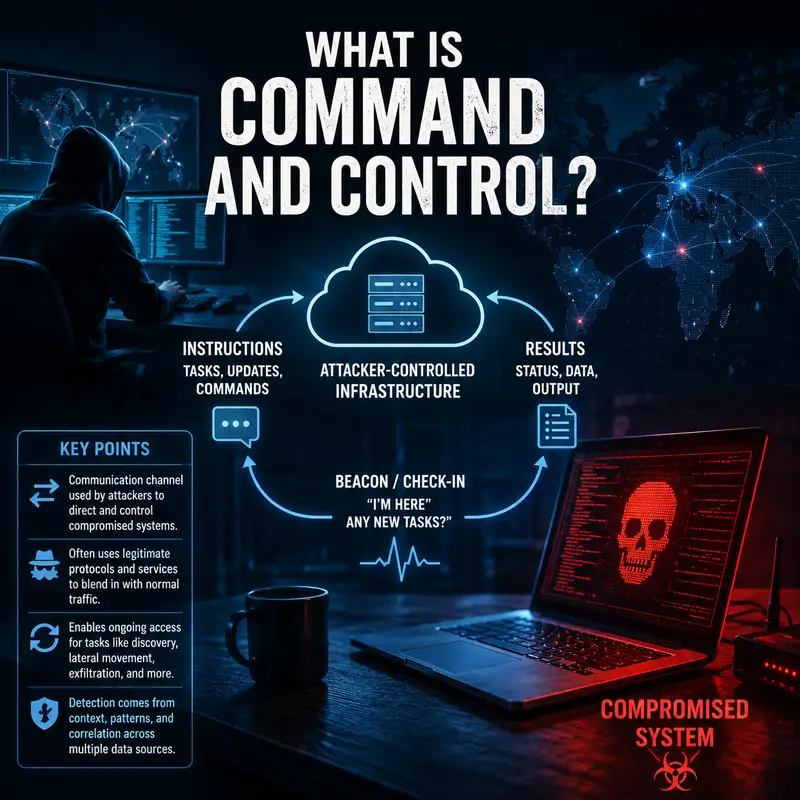
What Is Command and Control?
A compromised system does not automatically know what an attacker wants it to do next. It needs some way to receive instructions, report its condition, and return the results of whatever actions it performs. That communication is commonly described as command and control, and misunderstanding it can lead defenders to focus only on the original infection while missing the continuing connection that makes the intrusion useful. The practical question is not simply whether malicious software reached a device. The more important question is whether that device can still communicate with outside infrastructure that directs its behavior. By the end of this episode, you should be able to explain what command and control does, how it differs from other parts of an intrusion, why the traffic may resemble ordinary activity, and what evidence can help defenders recognize and interrupt it. Command and control, often shortened to C two, is the communication path an attacker uses to direct a compromised system. The compromised device may contact attacker-controlled infrastructure, receive a task, perform an action, and send back status information or results. The term can describe both the communication itself and the supporting infrastructure, such as servers, domains, cloud services, or other systems used to relay instructions. C two is not the same as the original method of entry. A phishing message, stolen password, or vulnerable service may provide initial access, while command and control provides the continuing channel used after access exists. The central distinction is that initial access opens the door, but command and control allows the attacker to keep giving directions through that door. Those ideas are often confused because they can occur close together and may be produced by the same malicious program. A command-and-control arrangement usually includes three functional parts. First, there is the compromised system, sometimes called an implant or agent, that can send and receive communications. Second, there is some form of external controller or relay that accepts check-ins and provides instructions. Third, there is a communication method that defines how messages travel and how the two sides recognize one another. These parts do not always appear as one obvious malicious server talking directly to one infected computer. Traffic may pass through several services, temporary addresses, or compromised systems before reaching its destination. The attacker may also use multiple fallback paths so the loss of one connection does not end access. For defenders, this means command and control should be understood as a function rather than a single device. The function is the attacker’s ability to exchange instructions and results with the compromised environment. Many command-and-control channels depend on the compromised system initiating contact. The device may check in at regular or irregular intervals, a behavior often called beaconing, to ask whether new instructions are available. This design can be useful to an attacker because outbound traffic is often permitted more freely than unsolicited inbound traffic. Other channels may keep a connection open for a period of time or use a service that delivers messages when they become available. The exact method can vary, but the purpose remains the same: the compromised system needs a dependable way to learn what it should do next. A check-in may contain only basic status information, such as whether the system is active, before any larger task is assigned. Defenders therefore should not assume that every command-and-control exchange will contain a large amount of data or an obvious command written in readable language. The return path is just as important as the instruction path. After a compromised system performs a task, it may report success or failure, send command output, provide system information, or return data requested by the attacker. This reporting lets the attacker decide what to do next and whether the access remains valuable. The returned information does not always amount to full data exfiltration. A short status message confirming that a system is online is still part of command and control, even if no sensitive file has left the environment. Exfiltration refers more specifically to the unauthorized removal of data, while command and control refers to the broader communication used to manage the compromised system. The same channel can support both functions, but they describe different purposes. Recognizing that difference helps defenders interpret what observed traffic may mean and how far the intrusion may have progressed. Attackers often try to make command-and-control traffic resemble communication that an organization already expects. Web requests, domain lookups, encrypted sessions, and connections to commonly used online services can blend into large volumes of legitimate activity. The goal is not always to make the traffic invisible. It may be enough to make the communication appear ordinary, infrequent, or too costly to investigate. Standard protocols can carry malicious instructions just as they carry normal business data, because a protocol describes how information is exchanged rather than whether the information is trustworthy. Encryption can further hide the content of the messages, although it does not erase every observable characteristic of the connection. Defenders may still see which process created the traffic, when the connection occurred, how often it repeated, where it went, and how much data moved. Those surrounding details can remain useful even when the message content cannot be read. Command and control can also change over time. An attacker may rotate addresses, replace domain names, move between hosting providers, or shift to a backup communication method when defenders block the original path. Some operations use centralized infrastructure, while others distribute communication across several systems or rely on legitimate platforms as intermediaries. These changes can make a single indicator, such as one Internet Protocol address, useful but temporary. Blocking that address may interrupt one connection without removing the malicious software, stolen credentials, or persistence mechanism that created the access. Effective analysis therefore looks for patterns that survive infrastructure changes. The process making the connection, the timing of repeated check-ins, the destination’s rarity, the relationship between network activity and user behavior, and the sequence of actions on the endpoint may provide a stronger picture than any one address alone. Command and control is a capability, not merely a fixed location. Before continuing, a brief promotional note. This episode is brought to you by the Bare Metal Cyber Academy. The Academy provides a place for people who want to continue developing practical cybersecurity knowledge through clear, structured education. Topics such as command and control become easier to apply when the underlying concepts, evidence, and defensive decisions are taught in a connected way. You can visit Bare Metal Cyber dot com to explore the Academy and see the learning opportunities currently available. There are no promises of instant expertise or guaranteed outcomes, only an invitation to keep building useful knowledge with deliberate instruction. Now, let’s return to how command and control fits into the larger intrusion. Command and control is closely related to persistence, but the two are not interchangeable. Persistence is the method that allows access to survive a restart, password change, software update, or closure of the original entry point. Command and control is the path used to communicate with the access that remains. A malicious scheduled task may provide persistence by launching an implant again, while the implant’s network connection provides command and control. Either function can exist without the other for a period of time. A compromised system may retain persistence but be unable to reach its controller, leaving the attacker with dormant access. A live command-and-control session may also exist temporarily even when no durable persistence has been established. Separating the concepts helps responders decide whether they are merely interrupting communication, removing the mechanism that restores access, or doing both. A complete response must account for each function that the intrusion established. Command and control also differs from lateral movement and privilege escalation. Lateral movement is the process of moving from one account, device, or system to another, while privilege escalation involves gaining permissions beyond those originally available. C two may deliver the instructions that support those actions, but it is not the action itself. The channel can tell a compromised system to collect information, attempt movement, or use a higher level of access, yet the communication remains only the mechanism for direction and reporting. This distinction matters during investigation because one network connection may reveal that an attacker can issue tasks without proving that every possible task occurred. Defenders need endpoint, identity, and network evidence to determine what actually happened. Treating command and control as proof of every later stage can exaggerate findings, while treating it as harmless communication can understate the attacker’s ability to act. Detection usually depends on combining several kinds of evidence. Endpoint tools may show which process opened a connection, what launched that process, and whether the activity matched the system’s normal role. Network, firewall, proxy, cloud-service, and Domain Name System (D N S) records may reveal repeated outbound connections, unusual timing, rare destinations, unexpected data volumes, or behavior that differs from comparable systems. Encrypted traffic requires the same contextual approach. Transport Layer Security (T L S) can protect both legitimate sessions and malicious command-and-control messages, so encryption does not establish that a connection is safe. Even when content cannot be inspected, defenders may still examine timing, destination, certificate characteristics, connection duration, data direction, and the responsible application. No single signal proves C two in every case. Confidence grows when several observations align, such as an unfamiliar process, periodic check-ins, a rare external destination, and related suspicious activity on the endpoint. Responding to suspected command and control requires more than adding one address to a block list. Containment may include isolating affected systems, restricting suspicious destinations, disabling compromised accounts, preserving relevant evidence, and identifying other devices that communicated in the same way. Eradication requires finding the malicious process, persistence mechanism, stolen credentials, or configuration change that allowed the channel to exist. Recovery then involves restoring trusted operation and watching for renewed contact through alternate infrastructure. The order of these actions may depend on the incident and the need to preserve evidence, so defenders should coordinate rather than act from a single alert alone. A block can be valuable because it interrupts communication, but it should be treated as one control within a broader response. The goal is not merely to make the current connection fail. It is to remove the attacker’s ability to reestablish direction over the environment. Several misunderstandings repeatedly weaken command-and-control analysis. One is the belief that C two always looks like an attacker typing commands into a live terminal. In reality, many channels are automated, delayed, or limited to short check-ins that retrieve queued tasks. Another mistake is assuming that every external connection from a suspicious process must be command and control. Some software contacts update servers, licensing services, storage platforms, or other legitimate resources, so context still matters. A third mistake is treating a blocked destination as proof that the incident is over. The compromised system may use a backup path, wait before trying again, or remain accessible through another mechanism. Finally, defenders sometimes label all outbound data as exfiltration even when the traffic only reports status. Precise labels improve both technical response and leadership communication because they describe what the evidence actually supports. A practical way to evaluate possible command and control is to follow the communication from the system outward and then back to the system’s purpose. Identify the process that created the connection and determine whether that process should communicate externally at all. Examine the destination, the timing, the frequency, the amount and direction of data, and whether similar systems behave the same way. Compare the activity with user actions, scheduled operations, software updates, and known business services. Then look for supporting endpoint or identity evidence that shows execution, persistence, privilege changes, or other suspicious behavior near the same time. The strongest conclusion usually comes from correlation, not from one dramatic indicator. If the evidence suggests command and control, ask whether containment has interrupted only the current route or has removed the underlying access. That question keeps the response focused on both communication and control. Command and control is the communication capability that allows an attacker to direct a compromised system, receive status information, and collect the results of assigned actions. It begins after access has been obtained, although it may support persistence, lateral movement, privilege escalation, collection, and exfiltration as the intrusion continues. The traffic may look ordinary because it can use familiar protocols, encryption, cloud services, and outbound connections that resemble legitimate activity. Defenders recognize it by connecting network behavior with endpoint, identity, and business context, then judging whether the communication fits the system’s expected role. Disrupting one destination can reduce immediate risk, but a complete response also removes the software, credentials, persistence, and alternate paths that preserve the attacker’s control. The essential practice is to treat C two as an ongoing capability that must be detected, interrupted, and eliminated, not as a single suspicious address that can be blocked and forgotten.