What Is Credential Stuffing?
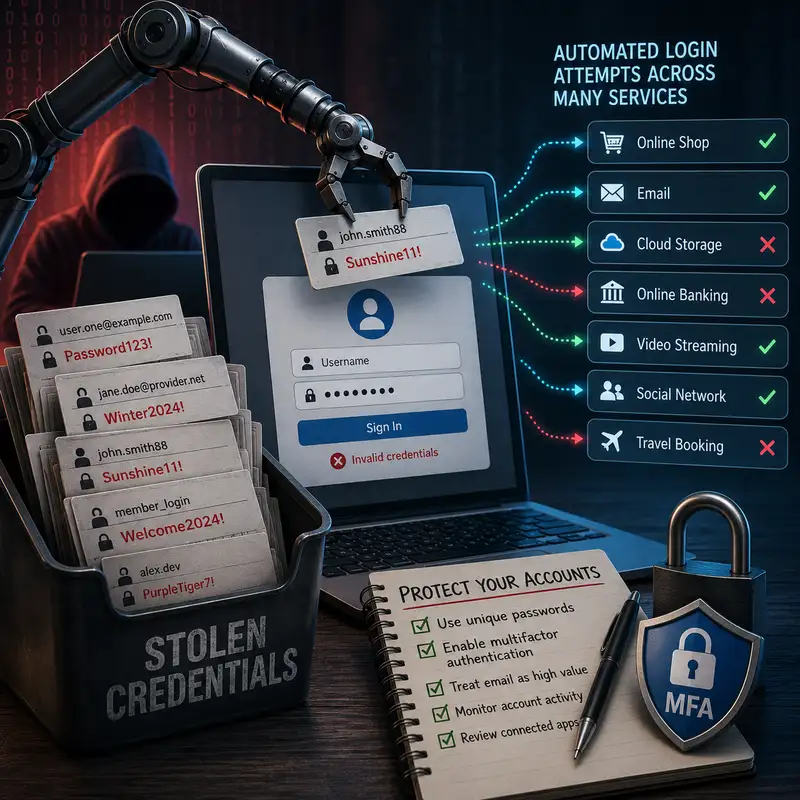
Credential stuffing is often mistaken for ordinary password guessing, but the important difference is that the attacker may already possess a username and password that worked somewhere else. The login attempt can therefore look technically correct even though the person using the credentials has no right to the account. That creates a practical question for users and defenders: how can a password stolen from one service become a threat to accounts on completely unrelated services? The answer depends mainly on password reuse, because one exposed secret can become a key that fits several doors. By the end of this episode, you should be able to explain what credential stuffing is, how it differs from other login attacks, why normal password controls may not stop it, and which protective decisions reduce the chance that one breach will spread into several account takeovers. Credential stuffing is the automated use of stolen username and password combinations to attempt access to other services. A username and password used together are often called a credential pair, and the attack relies on the possibility that the same pair has been reused. The stolen credentials usually came from an earlier breach, theft, or exposure involving another system, while the new target may have no connection to that original event. When a reused pair succeeds, the result may be an account takeover, which means an unauthorized person gains control of a legitimate account. The main distinction to remember is that credential stuffing does not begin by inventing a password. It begins with credentials that were already known to work somewhere and tests whether they also work elsewhere. The credentials used in these attacks can originate from many kinds of exposure, including compromised services, phishing, malware, insecure storage, or accidental disclosure. Once a credential pair has been exposed, changing the password only on the service that reported the incident may leave other accounts vulnerable if the same password was reused. The original breach therefore matters less than the continuing value of the exposed combination. An organization can protect its own password database well and still receive login attempts built from credentials stolen somewhere else. This is one reason identity security cannot be viewed only as a boundary around a single application. A weakness in one service can create risk for many others because users carry the same identity habits across personal, professional, financial, and cloud accounts. Credential stuffing usually operates through normal sign-in pages and authentication services rather than through a special technical flaw in the target application. Automated tools can submit many previously stolen combinations and separate unsuccessful attempts from the smaller number that produce valid access. The target system may simply see a series of login requests, some of which contain the correct username and password. That makes the attack difficult to judge by password correctness alone, because the authentication system is designed to accept those exact values. The abuse is not that the login process fails to verify the password. The abuse is that the system cannot automatically know whether the person presenting a valid credential pair is the rightful account holder. Defenses therefore need to evaluate more than the secret itself. Password reuse makes credential stuffing effective because it removes the separation that should exist between accounts. A unique password limits the effect of a breach to the service where that password was used, while a reused password allows the exposure to travel. Usernames are also frequently predictable or stable, especially when an email address is used as the account name across many services. That combination gives an attacker both parts needed for another login attempt without requiring new discovery. Reuse can also create chains of access. Control of an email account may support password resets elsewhere, while access to a work-related service may expose information that helps target additional accounts. The risk grows not because the stolen password becomes more powerful, but because the same secret was trusted in too many places. Credential stuffing is related to brute-force attacks, password spraying, and phishing, but those terms describe different methods. A traditional brute-force attack repeatedly guesses many passwords against one account or a small group of accounts. Password spraying tests a small number of common passwords against many accounts, often to reduce the chance of triggering simple lockout rules. Phishing tries to persuade a person to reveal credentials or approve access. Credential stuffing instead starts with stolen username and password pairs and checks whether those exact pairs work on another service. The distinction affects the response. Stronger password complexity rules may frustrate guessing, but they do not change the fact that a complex password can still be reused and later exposed. A control must match the method being used. Defenders may recognize credential stuffing through patterns that are broader than a single failed login. Indicators can include many authentication attempts across numerous accounts, repeated use of credentials known to have appeared in breaches, unusual device characteristics, unexpected geographic changes, or a burst of successful access following many failures. None of these signals proves the attack by itself, because legitimate users also mistype passwords, travel, change devices, and use privacy services. Attackers may also distribute attempts across different network sources, which can reduce the value of simple address-based blocking. Account lockout alone is therefore an incomplete defense and may even create disruption when many users are targeted. Effective detection combines authentication events with account history, device information, known exposure data, and the consequences that follow a successful login. We will pause briefly for a transparent promotional message. This episode is brought to you by the Bare Metal Cyber Academy. The Academy is a place for people who want to continue developing practical cybersecurity knowledge through clear, structured education that explains both technical concepts and the decisions surrounding them. Topics such as credential security become more useful when you understand how user behavior, authentication controls, monitoring, and risk fit together rather than treating each one as an isolated definition. You can visit Bare Metal Cyber dot com to explore the Academy and see the learning opportunities currently available. Now, let’s return to credential stuffing and examine what successful access can allow an attacker to do. A successful credential-stuffing login can produce more harm than simply revealing that a password was reused. The attacker may view private information, change account settings, make unauthorized transactions, impersonate the account holder, or use stored relationships to target other people. Access to one account can also strengthen attempts against another account by revealing contact details, billing information, employer names, or recovery options. The seriousness of the event depends on what the account can reach and what actions it permits. A compromised discussion account and a compromised primary email account do not create the same consequence, even when the login method was identical. Defenders should therefore evaluate both the authentication event and the business or personal capability gained after access. The method explains entry, while the account’s privileges explain the possible damage. Unique passwords are the most direct way to prevent one exposed password from unlocking several unrelated accounts. Unique does not mean making a small variation such as adding a different number or service name to the same base word, because predictable patterns can still connect the secrets. It means that each account receives a genuinely separate password that is not used anywhere else. A reputable password manager can help create and store these passwords so the user does not have to memorize every one. Length and resistance to guessing remain valuable, but uniqueness provides the containment that specifically addresses credential stuffing. When a service reports a breach, the exposed password should be changed there, and any account that reused it should be treated as potentially exposed until it receives a different password. Multifactor authentication (M F A) reduces credential-stuffing risk by requiring evidence beyond the username and password. A stolen credential pair may pass the first check, but the login can still fail when the attacker cannot provide the additional factor. Stronger methods that bind authentication to a trusted device or cryptographic key generally resist remote reuse better than methods based only on easily redirected messages. M F A is not a promise that account takeover is impossible. Attackers may target recovery procedures, steal active sessions, pressure users into approving prompts, or exploit weaknesses in how a service implements authentication. Even with those limits, M F A removes the assumption that possession of the password is enough. It should protect not only primary login, but also sensitive actions and account recovery wherever the service supports it. Users can reduce their exposure by treating the primary email account as a high-value security asset, because it often supports password resets and account notifications. That account should have a unique password, strong M F A, current recovery information, and regular review of active sessions and connected applications. Security alerts should not be ignored simply because the user can still sign in. An unexpected login notice, reset message, or change to account settings may show that someone has valid credentials or an active session. When reuse is discovered, changing only the most important password is not enough. Every account sharing that password should receive a new and unique secret. Reviewing saved passwords through a password manager can turn an uncertain memory problem into a manageable inventory of accounts that need attention. Organizations need layered controls because no single setting can reliably distinguish every unauthorized use of a valid password. Useful protections include M F A, rate controls, automated abuse detection, breached-password screening, device and session analysis, and additional verification when behavior differs sharply from the account’s normal pattern. Login monitoring should look across accounts so a broad campaign is not mistaken for unrelated mistakes by individual users. Password-reset and recovery processes also deserve the same protection as the primary login, because a weak recovery path can bypass a stronger front door. Response procedures should be ready to invalidate sessions, reset exposed credentials, review account changes, and notify affected users. The objective is not merely to block attempts. It is to limit successful access, detect it quickly, and reduce what an unauthorized session can accomplish. A practical way to apply this lesson is to examine an account or service through four connected questions. Ask whether credentials exposed elsewhere could be accepted here, whether users are likely to reuse passwords, whether a second factor protects both login and recovery, and whether monitoring can recognize unusual access after a correct password is entered. Then consider what the account controls, because the same successful login can create very different consequences depending on privileges and stored information. For a suspected incident, determine whether the credentials were guessed, sprayed, phished, or reused from an earlier exposure, since that distinction changes the scope of the response. Credential stuffing should prompt a search for reuse across other accounts, not just a reset of the one account where suspicious activity was observed. The method points directly to the containment decision. Credential stuffing is the use of stolen username and password combinations from one source to attempt access to other services. It succeeds when identity habits allow a credential pair to remain useful beyond the place where it was first exposed, especially when the same password protects several accounts. Unique passwords break that connection by containing each secret to one service, while M F A adds another requirement that a stolen password alone should not satisfy. Defenders must also monitor the context of authentication because correct credentials do not prove that the rightful user is present. The central decision is therefore not simply whether a password is strong enough. It is whether the organization and the user have prevented one exposed password from becoming reusable access across multiple accounts. That is the practice that most directly reduces the risk described by credential stuffing.