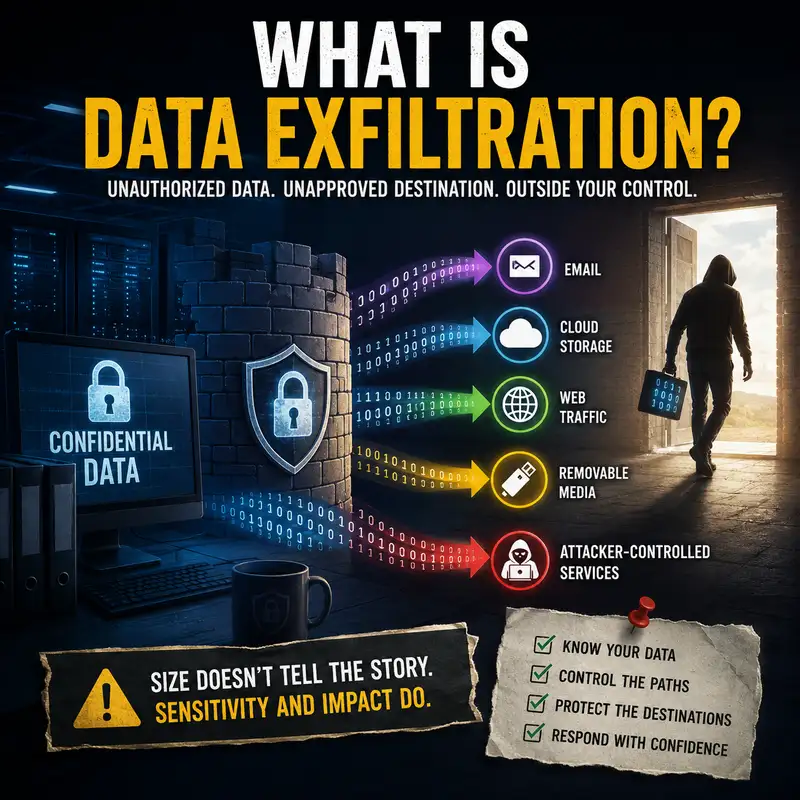
What Is Data Exfiltration?
Data exfiltration is often confused with several nearby ideas, including unauthorized access, data loss, data leakage, and ordinary file transfer. Those events may be related, but they do not describe the same security problem. A person can gain access to sensitive information without moving it anywhere, and information can be lost through deletion or equipment failure without anyone removing a copy. The practical question is whether information has been transferred from an approved environment to a destination, person, service, or device that is not authorized to receive it. That distinction affects which evidence defenders examine, which controls may have failed, and how urgently the organization must respond. By the end of this episode, you should be able to explain what makes a transfer an exfiltration event, recognize the major routes it may take, and understand why a very small transfer can sometimes create more serious harm than a much larger one. Data exfiltration is the unauthorized removal or transfer of information from an environment. The word removal can be misleading because the original data does not have to disappear. An unauthorized copy sent to an external account, uploaded to an unapproved service, written to removable media, or transmitted to an attacker-controlled system can qualify even when the source file remains untouched. Exfiltration is therefore different from simple access, which means someone reached the information, and different from collection, which means information was gathered or prepared for possible use. It is also different from accidental loss, although an accidental transfer can still create a serious exposure. The central distinction is authorization. A normal business process moves information according to approved purposes, destinations, identities, and protections. Exfiltration moves information beyond those approved boundaries or places it under the control of someone who should not have it. The boundary involved in exfiltration is not always a physical wall or a single network perimeter. An environment may be defined by technical controls, cloud accounts, business ownership, contractual limits, data-handling rules, or the identities permitted to use the information. Moving a file from one internal server to another may be ordinary administration, or it may be unauthorized movement if the receiving location is not approved for that data. Sending the same file to a personal email account may cross both a technical and an administrative boundary. Uploading it to an approved cloud platform may be legitimate when the user, purpose, and storage location are authorized, while uploading it to a personal account on that same platform may be exfiltration. Defenders therefore cannot classify the event from the protocol or product name alone. They must understand who moved the data, what the data was, where it went, and whether that transfer was permitted. Email is one common route because it provides a familiar way to attach documents, forward messages, or send information outside an organization. Cloud storage can serve the same function when information is copied into personal accounts, unsanctioned collaboration tools, or external sharing locations. Web traffic is another broad route because browsers and applications routinely send information to internet services, making harmful transfers difficult to judge from connection activity alone. Attacker-controlled services may receive data through ordinary encrypted connections that resemble legitimate business traffic at a basic network level. None of these routes is automatically malicious. Organizations depend on email, cloud platforms, web applications, and external services every day. The security problem appears when approved channels are used for an unapproved purpose, or when an unapproved destination receives protected information. Detection therefore requires context about identity, destination, data sensitivity, expected behavior, and the business reason for the transfer. Removable media creates a different kind of exfiltration path because the transfer may leave the network entirely after the data is copied. A portable drive, memory card, phone, or other storage-capable device can hold large amounts of information and physically carry it beyond monitored systems. Yet copying data to removable media is not automatically exfiltration. Some organizations use approved encrypted devices for maintenance, evidence collection, backup, or work in disconnected environments. The deciding questions remain authorization, purpose, protection, and destination. Endpoint records may show that a device was connected and files were written, but those facts alone may not prove unauthorized removal. Defenders need to connect the device event to the user, the files involved, the applicable policy, and what happened next. This is why broad prohibitions and simple alerts may be insufficient unless they are supported by clear handling rules and meaningful investigation. Large transfers attract attention because unusual bandwidth, long uploads, or sudden movement of many files can be easier to notice. Small transfers can be just as important because harm depends on the value and usefulness of the information, not only its size. A short document may contain a strategic decision, a set of privileged credentials, a private key, a customer record, a sensitive design, or instructions that reveal how an important system operates. A series of small transfers may also represent a meaningful loss when viewed together, even if no individual event looks dramatic. Volume is therefore only one detection signal. Defenders should also consider the sensitivity of the data, the destination, the user’s normal duties, the timing, the method, and whether the transfer has a legitimate explanation. Measuring only bytes can cause an organization to miss the information that creates the greatest consequence. Exfiltration usually appears within a larger sequence of activity, but it should not be treated as a synonym for the entire intrusion. An attacker may first obtain access, discover where valuable information is stored, collect selected material, prepare it for transfer, and then send it away. An insider may already have legitimate access and misuse that access without exploiting a technical vulnerability. A compromised application may transmit information because its permissions or integration settings allow more access than intended. These paths differ, yet the exfiltration question remains focused on the unauthorized transfer. Evidence of collection or preparation may indicate that exfiltration is possible, but it does not prove that the data left the environment. Likewise, a suspicious outbound connection may indicate a transfer, but defenders still need evidence about what was sent. Separating the stages helps the response team avoid overstating conclusions while still acting quickly enough to limit harm. Before we continue, this is a brief promotional message. This episode is brought to you by the Bare Metal Cyber Academy. The Academy provides a place for people who want to continue developing practical cybersecurity knowledge through clear, structured education. It supports steady learning about the concepts, decisions, and responsibilities that shape real security work, without promising shortcuts or guaranteed outcomes. The instruction is clear, practical, and professionally focused. You can visit Bare Metal Cyber dot com to explore the Academy and review the learning opportunities currently available. Now, let’s return to data exfiltration and examine how defenders recognize and respond to it. Evidence of exfiltration may appear across several systems rather than in one decisive alert. Network records can show unusual outbound destinations, changes in transfer volume, repeated connections, or activity at unexpected times. Email and cloud audit logs can show external sharing, new forwarding behavior, downloads followed by uploads, or access from identities that do not normally handle the data. Endpoint records may show removable devices, file access, archive creation, or applications handling an unusual number of sensitive files. Encryption can prevent defenders from reading the content in transit, but connection metadata, destination reputation, identity records, file events, and service logs may still provide useful context. No single indicator automatically proves exfiltration. A strong investigation combines signals and asks whether the observed behavior matches an approved task, an established pattern, and the user’s legitimate need. Controls against exfiltration work best when they address the data source, the transfer path, and the receiving destination together. Least privilege limits who and what can reach sensitive information in the first place. Data classification and handling rules help systems and people distinguish ordinary information from material that requires stronger restrictions. Data Loss Prevention (D L P) tools can inspect or control selected transfers based on content, labels, destinations, or policy, while email, web, cloud, and endpoint controls can block or challenge risky actions. Egress filtering can restrict which external services systems are allowed to contact. These controls have limits. D L P can generate false positives, encrypted or transformed content may be difficult to inspect, and legitimate work can resemble harmful movement. Effective protection therefore combines technical enforcement with clear authorization, logging, review, and a process for resolving exceptions. Encryption and identity controls both reduce exfiltration risk, but neither one answers the entire problem. Encryption at rest can protect stored information when someone lacks the required keys, and encryption in transit can protect information from interception while it moves between approved systems. Those protections may not stop an authorized user, a compromised account, or an approved application from reading the data and sending it somewhere else. A valid login also does not prove that the person or process using it is authorized for the specific transfer. Stolen sessions, excessive permissions, and poorly controlled service identities can make harmful movement look technically legitimate. Defenders need to know which identity acted, how it was verified, what permissions it held, whether those permissions were appropriate, and whether the destination matched an approved purpose. Access restrictions, careful key management, destination limits, and detailed audit records work together to reduce opportunity and support investigation. Responding to suspected exfiltration requires careful language because an alert is not the same as a confirmed loss. The first task is to determine what information may have moved, from which source, through which route, under which identity, and to what destination. Investigators also need to establish the time window, whether the transfer succeeded, whether copies remain accessible, and whether the same method could still be used. Containment may involve disabling a session, restricting an account, blocking a destination, isolating a device, or suspending a sharing link, but the action should preserve evidence when possible. The organization may also need legal, privacy, contractual, communications, or leadership review depending on the information involved. Precise conclusions matter. Saying that data was accessed, staged, attempted, transferred, or confirmed received describes different levels of evidence and leads to different decisions. The business impact of exfiltration cannot be measured by file count alone. Personal information may create privacy obligations and harm to individuals. Credentials and keys may enable later access to systems that were not involved in the original transfer. Source code, designs, research, pricing, or strategy may affect competition and future operations. Operational data may reveal dependencies, weaknesses, or procedures that increase other risks. Even information that appears old can remain useful when it explains identities, relationships, architecture, or decision-making. Leadership therefore needs more than a statement that a certain number of megabytes left the network. A useful report explains the type of information, its sensitivity, the confidence in the evidence, the likely recipient, the period of exposure, the controls affected, and the actions still required. That framing connects the technical event to the consequence the organization must manage. A practical way to evaluate a suspected event is to examine five connected facts without assuming the conclusion in advance. Identify the information and determine why it matters. Establish who or what moved it, then compare that identity’s action with approved duties and permissions. Determine the destination and whether the organization retained meaningful control over access, sharing, deletion, and further distribution. Examine the route and supporting evidence to distinguish an attempted transfer from a completed one. Finally, judge the event by sensitivity and consequence rather than volume alone. This approach works for email, cloud storage, web traffic, removable media, and attacker-controlled services because it focuses on authorization and control rather than on one technology. It also helps investigators communicate accurately, select containment measures, and avoid calling every unusual transfer exfiltration before the evidence supports that conclusion. Data exfiltration is the unauthorized transfer of information from an approved environment to a person, device, account, service, or destination that is not authorized to receive or control it. It can occur through familiar business tools such as email, cloud storage, and web applications, through removable media, or through services operated by an attacker. The original data may remain in place, and the transfer may be large, small, sudden, or spread across multiple events. What makes the event significant is not the number of bytes alone, but the sensitivity and usefulness of the information, the loss of authorized control, and the consequence that may follow. Defenders should distinguish access, collection, attempted transfer, completed transfer, and confirmed receipt so that their response matches the evidence. The most reliable judgment comes from connecting the data, identity, destination, authorization, route, and business impact into one clear finding.