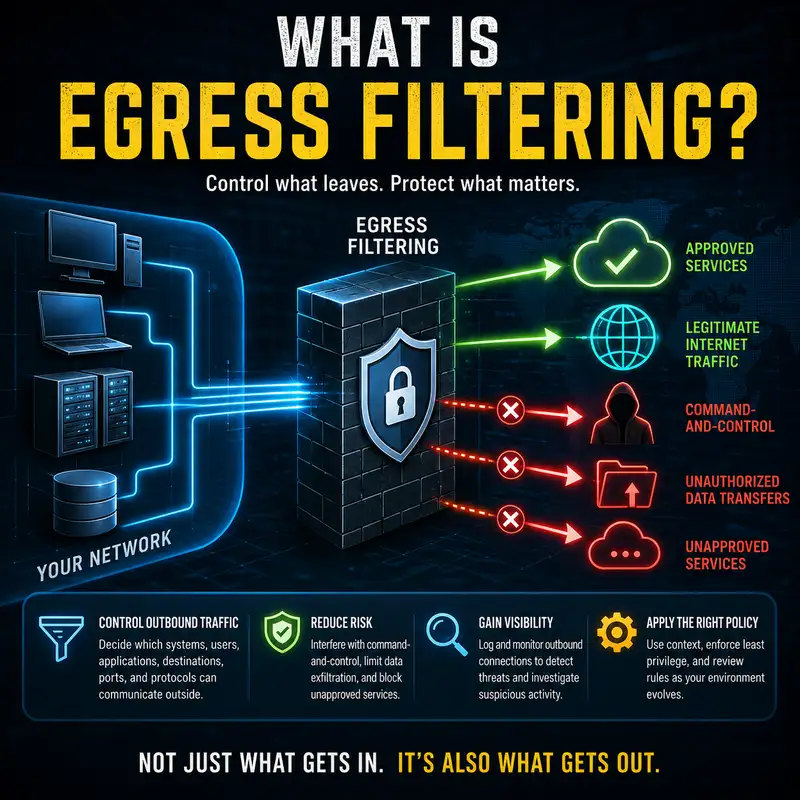
What Is Egress Filtering?
Security teams often spend more time discussing what is allowed into a network than what is allowed to leave it. That emphasis can create a blind spot because a compromised device usually needs to communicate outward before an attacker can control it, move stolen information, or reach an unapproved service. Egress filtering addresses that outbound side of the problem. It asks a practical question: which systems, users, applications, destinations, ports, and protocols should be permitted to send traffic beyond their approved boundaries? The answer affects firewall policy, incident detection, cloud access, remote administration, and data protection. By the end of this episode, you should be able to explain what egress filtering controls, how it differs from inbound filtering, why it can interrupt malicious activity, and why an outbound rule must be designed around legitimate business communication rather than applied as a careless block. Egress filtering is the practice of controlling network traffic as it leaves a device, network segment, cloud environment, or other defined security boundary. Egress means outbound, so the control focuses on communication traveling from an internal or managed source toward an external or less-trusted destination. The filtering policy decides which outbound connections are allowed, denied, inspected, logged, or redirected for additional review. Inbound filtering performs the opposite role by controlling traffic attempting to enter the protected environment. The two controls support each other, but they answer different questions. Inbound filtering asks what may come in. Egress filtering asks what may go out, where it may go, and under what conditions. That distinction matters because a malicious connection can begin from inside the environment, even when the original compromise entered through another route. Egress controls can operate at several points, and the chosen location changes what the defender can see and enforce. A perimeter firewall may control traffic leaving the organization for the public internet. An internal firewall may restrict communication between network segments, which is useful when one segment should not freely reach another. A host-based firewall can apply outbound rules directly to an individual workstation or server. Cloud security controls can limit which external services, addresses, or application interfaces a cloud workload may contact. Secure web gateways and proxy services can make decisions about web requests using destination categories, user identity, and application context. None of these locations is automatically sufficient by itself. Effective egress filtering usually depends on placing controls where outbound communication crosses a meaningful boundary and where policy can distinguish approved activity from traffic that deserves denial or closer inspection. One major purpose of egress filtering is to interfere with command-and-control communication. After a system is compromised, malicious code or an unauthorized remote session may attempt to contact infrastructure controlled by an attacker. That outbound connection can be used to receive instructions, return results, download additional components, or maintain continued access. Egress filtering can block the communication when the destination, protocol, port, application, or connection pattern falls outside approved policy. This does not require the defender to understand every detail of the compromise before taking useful action. A workstation that has no business reason to connect directly to an unfamiliar external address may be prevented from doing so. The important point is that blocking the outbound channel can reduce an attacker’s ability to operate, even when the compromised device has not yet been fully identified or cleaned. Egress filtering also helps reduce unauthorized data transfers, often called data exfiltration when information is deliberately removed without permission. Outbound controls can restrict destinations, transfer methods, file-sharing services, remote storage platforms, email routes, and other channels through which data might leave an environment. The filter may block the transfer outright, require traffic to pass through an approved inspection point, or generate a record for investigation. This capability is most effective when it is combined with knowledge of what normal communication should look like. A database server may need to send backups to one approved repository, but it may have no legitimate reason to upload files to a public storage service. Egress filtering does not determine the sensitivity of every piece of data by itself, yet it can limit the paths available for unauthorized movement and make unusual transfers easier to notice. Connections to unapproved services are another important concern. Users and applications can reach external tools that have not been reviewed for security, privacy, reliability, licensing, or regulatory requirements. These may include personal storage accounts, unapproved messaging platforms, remote administration utilities, software repositories, artificial intelligence services, or temporary file-transfer sites. Egress filtering can enforce the organization’s decision about which external services are permitted rather than relying only on written policy. It can also reduce accidental exposure by preventing applications from sending information to destinations that have not been authorized. The control should not be treated as a substitute for governance, because someone still has to decide what is approved and why. Its role is enforcement. It turns an organizational decision about acceptable outbound communication into a technical rule that can be monitored, tested, and revised. A central design choice is whether outbound traffic is allowed by default or denied by default. A broad allow policy is easier to operate because most applications can connect without prior review, but it leaves many outbound paths available to both legitimate and malicious activity. A default-deny approach permits only communication that has been explicitly approved. That model can provide stronger control, especially for servers, sensitive systems, and tightly managed workloads whose communication needs are predictable. It also requires accurate inventories, application knowledge, testing, and a reliable process for handling changes. Many organizations therefore apply stricter egress rules to high-value systems and more flexible controls to general user networks. The objective is not to block the internet indiscriminately. It is to reduce unnecessary outbound access while preserving the specific connections that business operations, updates, authentication, and support processes genuinely require. We’ll pause briefly for a promotional message. This episode is brought to you by the Bare Metal Cyber Academy. The Academy provides a place for people who want to continue building practical cybersecurity knowledge through clear, structured education that connects technical concepts to real decisions. You can visit Bare Metal Cyber dot com to explore the Academy and see the learning opportunities currently available. Understanding controls such as egress filtering becomes more useful when you can place them within a broader view of networks, systems, risk, and defensive operations. Now let’s return to how outbound policy becomes more precise than a simple list of blocked destinations. Modern egress filtering can evaluate more than a destination address and a port number. A rule may consider the user, device, application, process, network segment, destination category, protocol, time, and the security state of the source. This context helps distinguish approved use from traffic that only appears similar at a basic network level. For example, a browser reaching an approved business service is different from an unknown background process attempting the same connection. A managed server may be allowed to contact a specific update repository while other systems are denied. Application-aware controls can identify some services even when they use common web ports. Identity-aware controls can apply different policies to administrators, contractors, general users, and service accounts. Greater context improves precision, but it also increases policy complexity and creates a stronger need for accurate asset, identity, and application information. Encrypted traffic creates an important limitation because a filter may see that a connection exists without seeing the complete content carried inside it. Transport Layer Security (T L S) protects many legitimate web sessions, but the same encryption can also conceal malicious instructions or unauthorized transfers from basic inspection. Organizations may use approved proxy services, certificate-based inspection, destination reputation, application identification, and behavioral analysis to make better decisions. Each method has technical, privacy, operational, and legal considerations. Domain Name System (D N S) traffic also requires attention because systems use it to locate services, and malicious activity may misuse it as a communication path. Blocking every encrypted or D N S connection would break normal operations. The practical goal is to force traffic through approved paths, restrict unnecessary direct communication, and investigate patterns that do not match the expected role of the source system. Logging is one of the most valuable results of well-designed egress filtering. A denied outbound attempt can reveal a misconfigured application, an unauthorized tool, a compromised host, or a user attempting to reach a prohibited service. Allowed connections also matter because investigators may need to determine which external destinations a system contacted before, during, or after an incident. Useful logs should identify the source, destination, time, action, protocol, rule, and enough context to support analysis. Logs that record only a denied address without identifying the originating device or user may slow the investigation. Excessive logging can also create noise and storage problems, so teams should prioritize events that support detection and response. The filter is therefore not only a gate. It is also a source of evidence that can help defenders understand outbound behavior and decide whether an event requires escalation. A common misunderstanding is that egress filtering will prevent every command-and-control channel or every form of data loss. It will not. Attackers may attempt to use destinations and services that are already permitted, including widely used cloud platforms, web services, and collaboration tools. They may also generate traffic that resembles normal application behavior. Authorized users can send sensitive information through legitimate channels if other controls do not recognize the content or the misuse. Egress filtering reduces opportunity by narrowing outbound paths, but it cannot determine intent with perfect accuracy. It works best alongside endpoint monitoring, identity controls, data classification, data loss prevention, secure configuration, network segmentation, and incident response. The correct expectation is risk reduction and increased visibility, not complete prevention. Overstating the control’s capability can lead teams to ignore weaknesses that outbound rules were never designed to solve. Operational discipline determines whether an egress policy remains useful after deployment. Applications change destinations, vendors introduce new services, certificates expire, cloud workloads scale, and update mechanisms evolve. A rule that was correct six months ago may now block an essential function or permit a connection that is no longer required. Changes should therefore have an owner, a documented business reason, a defined scope, and a review date. Temporary exceptions should not become permanent simply because they were convenient during troubleshooting. Teams should test rules before broad enforcement, monitor the effect, and maintain a rapid method for correcting harmful blocks. They should also remove obsolete permissions instead of allowing the rule set to grow indefinitely. Egress filtering is not a one-time firewall project. It is a continuing policy process tied to asset management, application ownership, change control, and evidence from actual network behavior. A practical way to evaluate egress filtering is to begin with the communication needs of a specific system or group of systems. Identify which external services are required, which protocols support them, which source applications should initiate the traffic, and who owns the business need. Then compare that approved model with actual outbound logs. Connections that cannot be explained should be investigated, while approved connections should be translated into rules that are as narrow as operations reasonably allow. Test the policy in a monitoring or alerting mode before enforcing denials when disruption would be costly. Review denied traffic for both threats and legitimate gaps. Finally, schedule recurring review so stale permissions are removed and new requirements are evaluated deliberately. This method turns egress filtering from a vague instruction to block bad traffic into a documented, testable, and maintainable control. Egress filtering controls traffic leaving a network, system, or other security boundary by deciding which outbound connections are permitted, denied, inspected, or recorded. Its value comes from limiting unnecessary communication paths. That can interfere with command-and-control activity, reduce opportunities for unauthorized data transfer, and prevent access to services the organization has not approved. The control is strongest when policy reflects the real communication needs of systems and when logs are used to investigate exceptions and suspicious behavior. It is weaker when every outbound connection is allowed, when rules are based only on ports, or when teams assume encryption and trusted services cannot be misused. The practical decision is to define where each system is allowed to communicate, enforce that decision with appropriate context, and treat unexpected outbound activity as evidence that deserves explanation rather than as harmless background traffic.