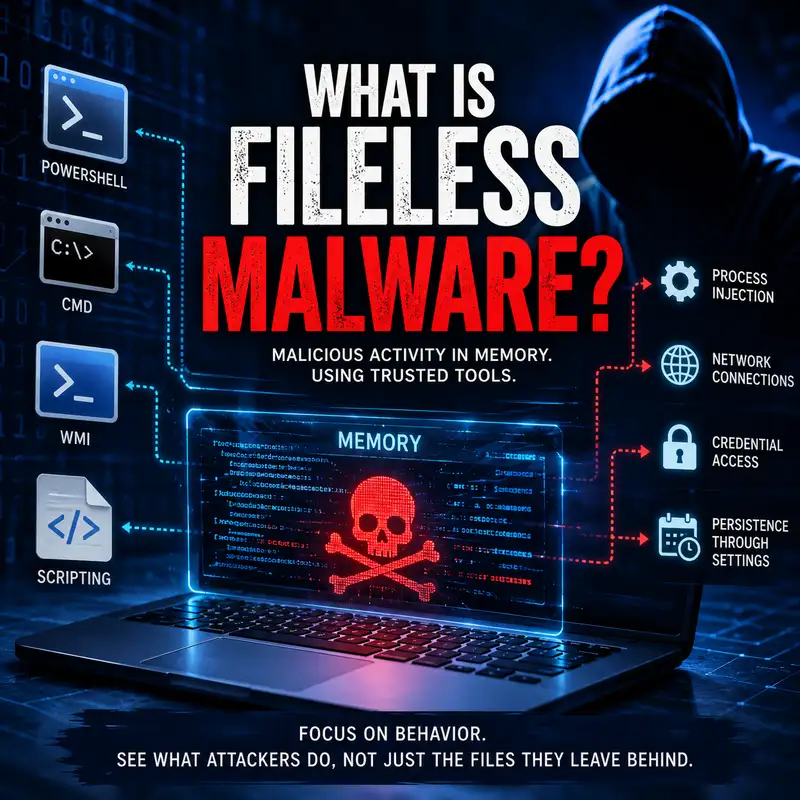
What Is Fileless Malware?
The term fileless malware creates an immediate misunderstanding because it sounds as though no file exists anywhere in the attack. That interpretation can lead defenders to ask the wrong question. They may focus only on whether antivirus software found a malicious executable, then treat the absence of that file as evidence that the system is clean. The practical question is broader: what code or commands ran, where did they run, which legitimate capabilities did they use, and what harmful behavior followed? Fileless malware matters because much of its activity may occur in memory or through tools that already belong on the system. By the end of this episode, you should be able to explain why the name is imperfect, how this activity differs from conventional file-based malware, and why behavioral evidence often matters more than a simple search for a suspicious file. Fileless malware is malicious activity that performs much of its execution in memory or through legitimate system tools instead of depending on a conventional malicious program stored and launched from disk. The word much is important. Fileless does not always mean that the entire intrusion contains no files at any stage. A malicious document, downloaded script, shortcut, configuration change, or temporary artifact may still appear before or during the activity. The label usually describes the main execution method, not an absolute property of every component. It also helps to separate malware from technique. Malware refers to code or instructions used for a harmful purpose, while fileless describes how that activity operates. The central distinction is that defenders cannot rely only on identifying a known malicious file. They must also examine what trusted processes, scripts, memory regions, accounts, and network connections are doing. Conventional file-based malware usually gives defenders a relatively stable object to inspect. An executable, library, document, archive, or other file may be written to storage, assigned a name, hashed, scanned, quarantined, and compared with known signatures. Those methods remain valuable, but they work best when the harmful component is present in a form the scanner can recognize. Fileless activity reduces that dependency. Instructions may be interpreted by a scripting engine, loaded directly into a running process, retrieved only when needed, or assembled in memory from smaller pieces of data. The malicious purpose is still real even when the operating system is using ordinary mechanisms to carry it out. This changes the evidence available to defenders. A disk scan may find little, while process activity, script content, memory behavior, account use, and outbound communication reveal that something harmful occurred. Memory is central to the idea because every running program eventually uses memory, but fileless activity relies on it more heavily as an operating location. Code placed in memory can execute without remaining as a traditional standalone program on disk. That does not make memory mysterious or outside the operating system. Processes still request resources, create threads, access data, communicate over the network, and interact with security controls. The difference is that the most revealing evidence may be temporary. When a system shuts down, a process ends, or memory is overwritten, some of that evidence can disappear. Defenders therefore need telemetry that records activity while it happens. Memory-focused investigation can also be useful after an alert, especially when the process on disk appears legitimate but its behavior is not. The location of execution changes the evidence, but it does not remove the activity from observation. Legitimate system tools are the other major part of the definition. Operating systems include scripting engines, command interpreters, management utilities, remote administration features, and tools for loading software or changing configuration. Administrators depend on these capabilities, so organizations cannot simply classify every use as malicious. Attackers may abuse the same tools because they are already installed, often trusted, and capable of performing powerful actions. This is sometimes described as living off the land, meaning that the attacker uses resources already present in the environment rather than bringing every capability from outside. Fileless malware and living off the land overlap, but they are not identical. A legitimate tool can be abused to launch a conventional file, and memory-resident code can execute without extensive use of built-in utilities. The useful question is not whether the tool is legitimate. It is whether the way it is being used is authorized and consistent with the system’s purpose. The name fileless is misleading for another reason: an intrusion can move between file-based and fileless methods. Initial access may involve a document or downloaded item, while later execution occurs mainly through memory and trusted tools. Persistence may rely on a configuration location, scheduled action, service setting, or account change rather than a visible malicious executable. Data collected during the intrusion may also be written temporarily before it is transmitted. Calling the entire event fileless can hide those details if the label is treated too literally. It is better to use the term as a description of dominant behavior. Ask which stages avoided conventional files, which artifacts still existed, and which evidence remains available. This more precise language helps investigators avoid false conclusions. Finding one file does not prove the activity was entirely file-based, and failing to find one does not prove that no malicious execution occurred. Fileless malware is not invisible malware. It can leave evidence in process creation records, command-line history, script logs, authentication events, memory, network traffic, configuration changes, scheduled activity, and security alerts. The challenge is that these signals may be distributed across several sources and may resemble normal administration when viewed alone. A scripting engine starting is not automatically malicious. A management tool connecting to another system is not automatically malicious. Suspicion grows when the context, sequence, account, destination, timing, or resulting actions do not fit the expected purpose. This is why fileless detection is often a correlation problem rather than a single-signature problem. Defenders need to connect small observations into a meaningful chain of behavior. The absence of a known bad file removes one convenient indicator, but it does not remove the attacker’s need to execute, communicate, access information, and maintain control. We will pause briefly for a promotional message. This episode is brought to you by the Bare Metal Cyber Academy. The Academy is a place for people who want to continue developing practical cybersecurity knowledge through clear, structured education. It is designed to help learners and working professionals build stronger understanding without relying on hype or unsupported promises. You can visit Bare Metal Cyber dot com and explore the Academy to see the learning opportunities currently available. Topics such as malware behavior, defensive visibility, and careful technical reasoning become more useful when they are studied as connected parts of security practice. Now, let’s return to how defenders recognize fileless activity. Behavior-based detection begins with an expected model of normal use. Security teams need to know which scripting engines, administrative tools, remote-management features, and automation processes are normally used, by whom, and on which systems. An action becomes more meaningful when it is compared with that baseline. A trusted tool launched by an unusual parent process, used by an account that does not normally administer systems, or followed by unexpected network communication deserves closer examination. The same is true when a process accesses credentials, changes security settings, creates persistence, or reaches systems outside its normal role. No single observation proves malware, and overly broad rules can flood analysts with false alarms. Strong detection combines several signals and asks whether the sequence makes operational sense. Behavioral analysis therefore depends on context, not merely on a list of tools that attackers have used before. Endpoint telemetry is especially valuable because it can record process relationships, command activity, script execution, memory-related alerts, module loading, file changes, registry or configuration changes, and network connections from the affected host. Centralized logging helps investigators compare those observations with identity, network, cloud, and application records. The goal is not to collect every possible event without purpose. The goal is to retain enough relevant evidence to reconstruct what happened and to alert on patterns that carry meaningful risk. Logging must also be protected, synchronized, and reviewed. A detailed record that is overwritten too quickly or never examined provides little defensive value. Fileless activity exposes gaps in visibility because traditional scanning may report no malicious file while other telemetry shows a harmful chain. Good coverage allows defenders to see the execution path even when the code itself is temporary. Prevention still matters, even though no single control can eliminate fileless malware. Limiting unnecessary scripting and administrative capabilities reduces opportunities for abuse. Application control can restrict which tools and code are allowed to run, while least privilege reduces what a compromised account or process can accomplish. Strong authentication, timely patching, protected administrative access, network segmentation, and careful control of remote-management features can interrupt different stages of an intrusion. Script scanning and content inspection may identify suspicious instructions before or during execution. Attack-surface reduction settings can also block behaviors that are rarely needed in ordinary work. These controls must be tested against legitimate operations because excessive restriction can break administration and automation. The objective is not to ban every powerful tool. It is to make authorized use deliberate, observable, and limited while making unauthorized use harder to start and easier to detect. Incident response changes when investigators cannot depend on locating and deleting one malicious file. The response must preserve volatile evidence before it disappears, identify the affected accounts and processes, trace the activity across systems, and determine whether persistence or remote access remains. Isolating a host may stop communication, but it does not automatically remove stolen credentials or changes made elsewhere. Rebooting may clear some memory-resident activity, yet it can also destroy evidence needed to understand the intrusion. Investigators should examine process trees, security logs, authentication records, network connections, configuration changes, and any available memory data. They also need to establish the time range and scope of the activity. A clean disk scan after containment is not the same as a clean environment. Recovery depends on removing the attacker’s access and correcting the conditions that allowed the behavior. Several common mistakes make fileless malware harder to discuss accurately. One is treating every use of a scripting tool as malicious, which ignores normal administration and creates unmanageable alert volume. Another is assuming that any malware running in memory is fileless, even though ordinary file-based programs also execute in memory after being launched. A third is believing that fileless activity cannot persist. Persistence may be established through settings, accounts, scheduled actions, or other mechanisms even when no conventional malware file remains. A fourth mistake is using fileless as a synonym for advanced. The technique can be effective, but effectiveness depends on access, configuration, monitoring, and the defender’s visibility. Precise language improves response. Describe the observed execution method, the legitimate tools involved, the evidence found, and the harmful actions instead of allowing one broad label to replace the investigation. A practical way to evaluate suspected fileless activity is to ask a focused series of questions. What initiated the execution, and was that starting point authorized? Which process or tool carried out the action, and does that use match its normal role? Did the activity depend on a conventional file, a script, memory-loaded code, a remote command, or a combination of methods? What changes, communications, credential access, or persistence followed? Which records can confirm the sequence across the endpoint, identity system, and network? Finally, what control could prevent, limit, or reveal the same behavior in the future? These questions keep the analysis tied to evidence. They also prevent the term fileless from becoming a dramatic label with little operational value. The classification is useful only when it leads to better detection, containment, and control decisions. Fileless malware is malicious activity that carries out much of its work in memory or through legitimate system capabilities instead of relying mainly on a conventional malicious file. The name should not be interpreted as a guarantee that no file, artifact, or persistent change exists anywhere in the intrusion. Its practical importance is that file-focused scanning may see only part of the event or may miss the most revealing activity altogether. Defenders therefore need to examine behavior: which processes ran, which accounts acted, which tools were used, what systems communicated, what changed, and whether the sequence matched an authorized purpose. File scanning remains useful, but it is one source of evidence rather than the final answer. The correct defensive practice is to combine file inspection with endpoint, identity, memory, configuration, and network visibility so malicious behavior can be recognized even when the attacker avoids leaving a familiar executable behind.