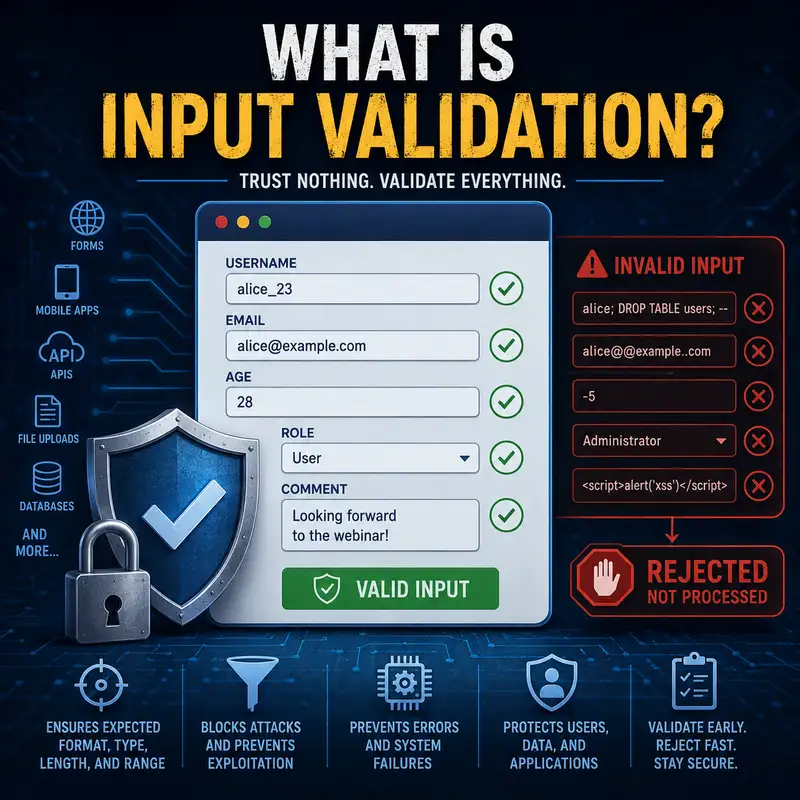
What Is Input Validation?
Input validation is often mistaken for a small form-checking feature, such as making sure an email field contains an at sign or a password reaches a minimum length. The security question is much broader. An application receives information through web forms, mobile clients, application programming interfaces, uploaded files, cookies, headers, command-line arguments, connected devices, and other systems. Any of those inputs can be missing, malformed, unexpectedly large, incorrectly encoded, or deliberately crafted to trigger behavior the developer did not intend. The practical decision is therefore not whether a screen looks correct, but whether the application has confirmed that each value is acceptable before using it. By the end of this episode, you should be able to explain what input validation checks, where it belongs, how it differs from related safeguards, and why rejecting invalid data early can prevent both security problems and ordinary application failures. Input validation is the process of checking supplied information against clearly defined rules before the application processes, stores, forwards, or acts on it. Those rules may describe the expected data type, format, length, numerical range, character set, structure, or permitted set of values. User-controlled input means more than text typed by a person. It includes any data that crosses into the application from a source the application cannot safely assume is correct, complete, or trustworthy. Validation answers a direct question: does this value conform to what this field or operation is designed to accept? If the answer is no, the application should normally reject the value rather than continue and hope a later component handles it safely. Validation is often confused with sanitization, output encoding, and secure query construction, but those controls solve different problems and should not be treated as interchangeable. The idea of untrusted input begins with the trust boundary. A trust boundary is the point where data moves from one level of control or confidence into another. Information coming from a public browser clearly crosses such a boundary, but so can data from a partner service, an internal application, a message queue, an imported spreadsheet, or a database that stores values originally supplied by users. Calling a network internal does not make every value on it trustworthy. A compromised account, faulty integration, outdated client, or simple programming error can still produce invalid data. Validation should therefore occur where the receiving component can enforce its own expectations, rather than depending entirely on the sender. In layered systems, the same data may need to be checked again when it enters a new service with different assumptions. Trust should be based on enforced controls and known contracts, not on where the data appears to come from. A useful validation rule describes the exact shape of acceptable input. Type asks whether the value is text, an integer, a decimal number, a date, a Boolean value, or another defined kind of data. Format asks whether the value follows an expected pattern, such as a properly structured identifier or date representation. Length limits prevent empty values where content is required and prevent excessively large values where only a small field is appropriate. Range checks establish acceptable minimums and maximums, while enumerations restrict a field to a known set of choices. Structure matters when the input contains several fields, nested objects, lists, or records that must appear in a specific arrangement. These checks are related, but one does not replace another. A value can have the correct type and still be too long, correctly formatted and still outside the allowed range, or structurally valid and still unacceptable under the application’s business rules. Allowlisting is usually the clearest way to express validation. An allowlist defines what is permitted and rejects everything else, which is more reliable than trying to predict every unacceptable character, pattern, or value. A denylist can block known bad input, but it tends to fail when the same meaning can be represented through different encodings, character combinations, or unexpected syntax. Good validation rules are also specific to context. A name field, a search field, a product code, and a network address do not need the same character rules. Overly narrow validation can reject legitimate information, while overly broad validation may accept values the application cannot safely handle. Normalization may be needed before validation so equivalent representations are interpreted consistently, but the order must be deliberate. The application should not validate one representation and then transform it into a different, less restricted value after the check has already passed. Client-side validation can improve usability, but it cannot be the final security control. A browser or mobile application may warn that a required field is empty, prevent obviously incorrect characters, or display an immediate message when a value exceeds a limit. Those checks help honest users correct mistakes quickly. They do not prevent a person or automated tool from sending a request directly to the server, changing the client code, disabling a script, or altering the message in transit through a system they control. The server must independently validate every security-relevant value before it is used. The same principle applies to an Application Programming Interface (A P I), where a published schema can describe expected input but the receiving service must still enforce it. Client checks are a convenience. Server-side validation is the authoritative decision about whether the application will accept the data. Input validation is one layer of defense, not a replacement for every other secure coding practice. Sanitization attempts to remove or transform unwanted content, while validation decides whether the original or normalized value is acceptable. Output encoding converts data into a safe representation for a particular destination, such as displaying text in a web page. Parameterized queries separate data from database instructions so supplied values are not interpreted as part of a command. These safeguards address different stages of data handling. Validating a field does not automatically make it safe for every later use, because a value accepted as ordinary text may still require proper encoding when inserted into Hypertext Markup Language (H T M L) or another output context. Likewise, parameterized queries remain necessary even when an identifier or search term has passed validation. Strong security comes from using each control for the problem it is designed to solve. Before we continue, this episode is brought to you by the Bare Metal Cyber Academy. The Academy provides a place for people who want to keep developing practical cybersecurity knowledge through clear, structured education. Topics such as secure application design become easier to apply when the underlying ideas are explained carefully and connected to real professional decisions. You can visit Bare Metal Cyber dot com to explore the Academy and see the learning opportunities currently available. There are no promises of guaranteed results, only an invitation to continue building useful knowledge at a steady pace. Now let’s return to input validation and examine what should happen when an application receives a value that does not meet its rules. Rejecting invalid input is only part of the design. The application also needs predictable failure behavior. It should stop the affected operation before the invalid value reaches a parser, database operation, file handler, command interpreter, or business process that assumes the data is safe. The response to the user should explain enough to correct an ordinary mistake without revealing internal code, database details, security rules, or stack information that could help someone map the system. At the same time, security and development teams may need richer internal logs showing which field failed, which rule was violated, where the request originated, and whether similar failures are occurring repeatedly. A validation failure is not automatically proof of an attack, because users and integrations make mistakes. Patterns of unusual failures can still provide useful evidence of probing, abuse, broken clients, or a newly introduced software defect. Structured data requires validation at more than one level. A JavaScript Object Notation (J S O N) message may be valid J S O N while containing missing fields, unexpected properties, incorrect types, oversized arrays, or values outside the permitted range. An Extensible Markup Language (X M L) document may be well formed but still violate the application’s schema or include structures the receiving parser should not accept. File uploads need checks for size, allowed content type, internal structure, and the way the file will be handled after acceptance. A filename extension alone does not prove what a file contains. Compressed content can also expand far beyond its uploaded size, so limits may be needed both before and during processing. The receiving component should validate the complete object it relies on, including nested elements, repetition counts, relationships between fields, and any metadata that influences how the content will be interpreted. Some of the most important validation rules concern meaning rather than appearance. A number can be a valid integer but still be negative when only positive quantities make sense, larger than the application can safely process, or outside the range permitted for that operation. A date can follow the correct format but refer to an impossible day, an unacceptable time period, or a sequence that conflicts with another date. A requested action can use a recognized command name but still be invalid for the current state of the resource. These are semantic and business-rule checks. They confirm that the value makes sense in the context where it will be used. Validation still does not replace authorization. A request may contain perfectly valid data and remain unauthorized because the requester lacks permission to perform the action. Correct input and permitted action are separate decisions, and both must be enforced before the application changes protected information or system state. Common implementation mistakes often come from treating validation as a single reusable pattern rather than a field-specific decision. One regular expression cannot safely define every kind of text, and a complicated expression may be difficult to review, test, or maintain. Silently truncating an oversized value can change its meaning and create collisions instead of clearly rejecting it. Automatic type conversion can turn malformed input into a default value that the application then accepts without noticing the original error. Different entry points may enforce different rules, allowing a value rejected by the web interface to enter through an A P I, import function, background job, or administrative tool. Validation performed after data has already influenced a query, file path, allocation, or calculation is too late. The safest approach is consistent enforcement at the earliest trustworthy point, supported by shared rules that remain specific enough for each field and operation. Validation rules need testing because boundary errors are easy to miss. Tests should include accepted values, clearly invalid values, empty and missing fields, minimum and maximum lengths, values immediately inside and outside permitted ranges, unexpected encodings, duplicate fields, additional properties, and deeply nested structures where those structures are supported. Automated unit tests can confirm individual rules, while integration tests can verify that every entry point applies the same expectations before processing. Defensive fuzz testing can supply varied malformed inputs to reveal crashes, excessive resource use, parser inconsistencies, and assumptions that ordinary examples do not expose. Schemas and validation libraries can improve consistency, but they still require secure configuration and review. When the application changes, the validation contract may also need to change. A new field, data type, client version, or workflow should not quietly bypass the rules that protected the earlier design. A practical way to design input validation is to begin with the operation rather than with a list of dangerous characters. Identify every value the operation accepts and the trust boundary each value crosses. For every field, define whether it is required, its exact type, acceptable format, minimum and maximum length, allowed range, permitted values, encoding, and relationships to other fields. Decide whether normalization is necessary, then perform it in a controlled and consistent way before applying the final validation rules. Enforce the decision on the server or receiving service before the data reaches sensitive processing. Reject failures clearly, record useful but limited diagnostic information, and test both normal values and boundary conditions. Finally, keep other controls in place, including authorization, parameterized queries, output encoding, safe parser configuration, and resource limits. This method turns validation from an improvised filter into an explicit contract the application can enforce and the development team can review. Input validation checks whether supplied information matches the exact rules an application has established for acceptable data before that information is processed. It examines properties such as type, format, length, range, permitted values, structure, and contextual meaning. The reason applications should treat user-controlled input as untrusted is not that every user is malicious, but that the application cannot safely assume outside data is correct, complete, current, or harmless. Invalid values should normally be rejected at the receiving boundary before they influence a query, parser, file operation, calculation, state change, or other sensitive behavior. Client-side checks can improve the experience, but server-side enforcement makes the security decision. Validation also works alongside authorization, parameterized queries, output encoding, safe parsing, and monitoring rather than replacing them. The practical rule is direct: define what acceptable input looks like, enforce that definition before use, and do not let unexpected data become an instruction to the system.