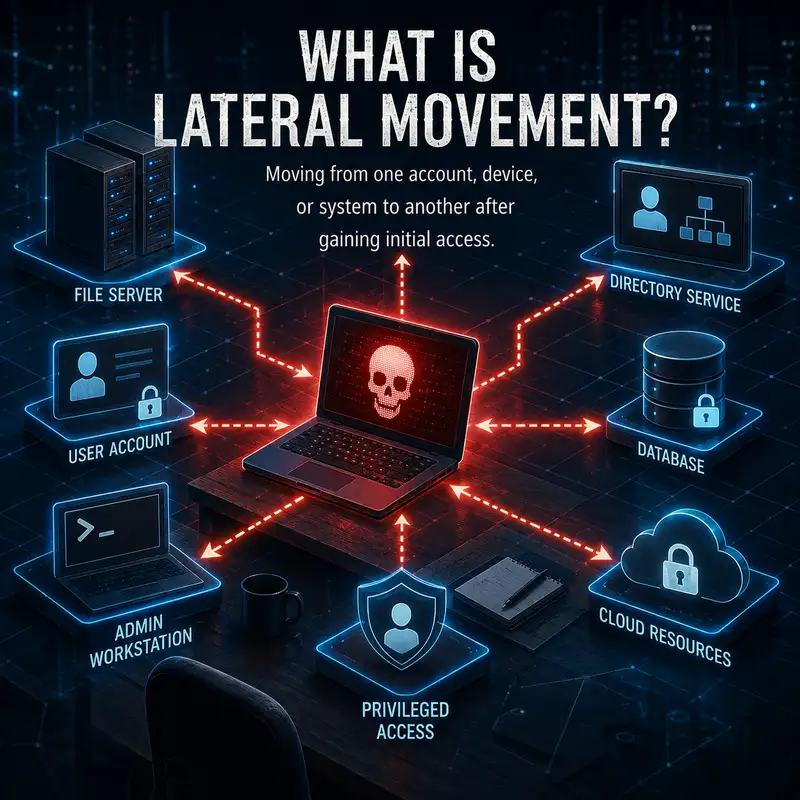
What Is Lateral Movement?
A security incident is often described as though the attacker either got in or stayed out, but that framing misses one of the most important parts of an intrusion. Initial access may place an attacker on only one account, one workstation, or one service, while the information or capability they actually want may exist somewhere else. The practical question is therefore not only how access began, but how far that access could spread after the first compromise. Lateral movement describes that spreading process inside an environment. Understanding it changes how defenders investigate alerts, design access controls, separate systems, and decide whether an apparently isolated compromise is truly contained. By the end of this episode, you should be able to explain what lateral movement is, why attackers use it, how it differs from related activities, and why one compromised computer can become a route to systems that are far more valuable. Lateral movement is the process of moving from one account, device, application, or system to another after initial access has already been gained. The initial foothold is the first point of unauthorized access, while lateral movement is the activity that expands that access across the environment. The word lateral can sound as though the attacker is moving only between systems of equal importance, but the term is broader than that. The movement may cross user accounts, servers, cloud resources, administrative tools, network segments, or trusted relationships. The central distinction is that initial access gets the attacker into some part of the environment, while lateral movement helps the attacker reach additional parts of it. These ideas are often confused because the same incident may include both, but they describe different stages and require different defensive questions. Lateral movement usually depends on three connected conditions. First, the attacker needs some usable foothold, such as control of an account, an active session, a compromised endpoint, or access to an exposed service. Second, the attacker needs a path from that foothold to something else, which may be created by network connectivity, shared credentials, administrative permissions, trusted applications, or weak separation between systems. Third, the attacker needs a way to use that path without being blocked or quickly detected. The exact sequence can vary, and movement does not always follow a straight line from one machine to the next. An attacker may move through identities, remote access services, management platforms, or cloud permissions instead of physically hopping across computers. The useful defensive question is not whether the movement looks dramatic, but whether one compromised point can authorize, reach, or influence another. Accounts are often the most important part of lateral movement because modern environments are built around identity. A stolen or misused account may provide access to email, file storage, business applications, remote services, or administrative interfaces without requiring the attacker to compromise each system separately. The account may also belong to a service rather than a person, which can make its activity look routine and allow it to operate across many systems. Permissions determine what the account can reach, but trust relationships determine where those permissions are accepted. A credential that appears limited in one location may become powerful when the same account is reused, synchronized, or recognized elsewhere. This is why identity protection is not only about preventing login theft. It is also about limiting how much additional access a single identity can provide after that identity has already been compromised. Devices create another path for movement because a compromised endpoint may contain connections, tokens, cached credentials, management software, or access to internal resources. The attacker does not need every device to be equally vulnerable. One device may simply provide the visibility or trust needed to reach the next target. Administrative workstations are especially sensitive because they often communicate with important systems and may hold privileges that ordinary user devices do not possess. Shared tools can also create broad paths when the same management process is authorized across many endpoints. The security problem is therefore not limited to the condition of the compromised computer itself. Defenders must examine what that computer can reach, which identities have used it, what trusted services it can call, and whether its normal position in the environment gives it access that an outside system would never receive. One compromised computer can become an entry point to more valuable systems because organizations rarely operate machines as isolated islands. Workstations connect to file shares, directory services, application servers, update systems, remote management platforms, cloud services, and other internal resources. Those connections exist for legitimate business reasons, but they can also create routes that an attacker may try to abuse. The value of the first machine may be low, yet its relationships can be highly valuable. A user laptop may not contain sensitive records, but it may have access to a portal that does. A server may not hold the final target, but it may be trusted by systems that do. Lateral movement turns ordinary connectivity into a security concern by showing that the importance of a compromised asset depends partly on what it can help someone reach. Lateral movement is related to several other attack concepts, but it is not identical to them. Privilege escalation is the process of gaining more authority than the attacker currently has, while lateral movement is the process of reaching additional accounts, devices, or systems. The two often support each other, because greater privilege may open new paths and a new system may provide a route to greater privilege. Persistence is the effort to maintain access over time, which may help movement continue but is a separate objective. Data collection and exfiltration concern finding and removing information, while lateral movement may be used to reach the place where that information resides. Command and control concerns how an attacker communicates with compromised resources. Keeping these concepts separate helps defenders identify what has happened, what may happen next, and which control should address the specific part of the intrusion. Before we continue, this is a brief promotional message. This episode is brought to you by the Bare Metal Cyber Academy. The Academy is a place for people who want to continue developing practical cybersecurity knowledge through clear, structured education. It supports learners who want careful explanations of security concepts, professional decisions, and the connections between technology and risk. You can visit Bare Metal Cyber dot com to explore the Academy and see the learning opportunities currently available. Building a strong understanding of concepts such as access paths, trust, identity, and system relationships makes it easier to evaluate real security problems without relying on memorized phrases. Now, let’s return to how lateral movement appears and how defenders can reduce it. Lateral movement can use ordinary technology because attackers often prefer capabilities that already exist in the environment. Remote administration tools, shared services, directory-based authentication, management consoles, application connections, and cloud control interfaces can all support legitimate work and still become paths for unauthorized movement. The defensive issue is not that these tools exist, but that their use may be accepted too broadly or monitored too weakly. A valid account using an approved service may not immediately look malicious, especially when the action resembles normal administrative activity. Movement may also occur without installing new malware on every system. An attacker can sometimes rely on stolen sessions, reused credentials, delegated permissions, or trusted automation. This is why prevention and detection must consider how legitimate access mechanisms could be misused after one part of the environment is no longer trustworthy. Detecting lateral movement requires attention to relationships and sequences, not just isolated events. One successful login may be normal, but a series of logins across systems that the account does not usually access can indicate expansion. Authentication from an unusual device, access to a new administrative service, sudden use of remote management, or connections between systems that rarely communicate may deserve investigation. Defenders should also compare identity activity with endpoint and network evidence. A login record may show who was accepted, endpoint telemetry may show what process initiated the connection, and network data may show where the connection traveled. No single signal proves lateral movement in every case. The stronger approach is to ask whether the activity forms a credible path from the known or suspected foothold toward additional resources, especially resources with greater privilege, sensitivity, or operational importance. Reducing lateral movement begins by limiting the number and strength of paths available after a compromise. Network segmentation can restrict which systems are allowed to communicate, but segmentation must reflect actual business needs and must be enforced consistently. Least privilege reduces the resources an account can access, while separate administrative accounts can prevent ordinary user activity from carrying powerful rights into less trusted systems. Multi-factor authentication (M F A) can make some stolen credentials less useful, although it does not protect every session, token, or already approved connection. Strong endpoint protection, secure configuration, timely updates, and controlled remote administration reduce opportunities to turn one device into a bridge. Service accounts should have narrow permissions, protected credentials, and clear ownership. The objective is not to claim that movement is impossible, but to make each attempted step harder, more visible, and less likely to reach critical systems. Containment decisions must account for the possibility that the first detected system is not the only affected system. Isolating one endpoint may stop immediate communication, but it does not automatically revoke stolen credentials, invalidate active sessions, or remove access already established elsewhere. A password reset may help, but it may be insufficient when other accounts, tokens, service credentials, or trusted connections were involved. Investigators should identify the earliest known foothold, map the accounts and systems touched afterward, and determine whether privileges or trust relationships changed along the way. They should also consider whether the attacker reached management infrastructure that can influence many devices at once. Effective containment follows the path of movement. It removes or blocks the access mechanisms that connect affected resources rather than treating every compromised asset as an unrelated event. A common misunderstanding is that lateral movement always produces loud or obviously malicious traffic. In reality, it may look like normal administration because the attacker is using accepted accounts, approved protocols, and familiar tools. Another mistake is assuming that internal traffic is trustworthy simply because it originated inside the network. Once a device or identity is compromised, its location does not prove that its actions are legitimate. Defenders may also focus only on malware and overlook movement that relies on sessions, permissions, or cloud identities. A final mistake is treating the absence of movement evidence as proof that movement did not occur. Logging gaps, short retention periods, and incomplete endpoint coverage can hide parts of the path. Good analysis distinguishes between evidence that movement was not observed and evidence strong enough to show that movement did not happen. A practical way to evaluate lateral movement is to trace access outward from the suspected foothold. Start by identifying the account, device, session, or service that was first compromised. Then ask what that point could authenticate to, what it could communicate with, what permissions it carried, and which systems trusted it. Look for changes in identity use, remote connections, administrative actions, and access to resources that were not part of the account’s normal pattern. Give special attention to paths leading toward identity infrastructure, management platforms, sensitive data, backups, security tools, and critical business services. Record both confirmed movement and plausible but unverified paths, because the difference affects containment and evidence collection. This method turns a vague concern about spread into a structured question about reachability, authority, trust, and observed behavior. Lateral movement is the process of expanding unauthorized access from an initial foothold to additional accounts, devices, applications, or systems. It explains why a compromise that begins on an ordinary computer can become a much larger incident when that computer is connected to trusted services, powerful identities, or valuable resources. The defender’s task is to understand the paths that make movement possible, watch for activity that follows those paths, and reduce the amount of access any single compromised point can provide. Correctly identifying lateral movement also improves incident response because it prevents teams from stopping at the first visible symptom. A compromised system should be evaluated not only for what it contains, but for what it can reach and what trusts it. That is the practical meaning of lateral movement and the reason containment must follow the connections, not just the first alert.