What Is Least Privilege?
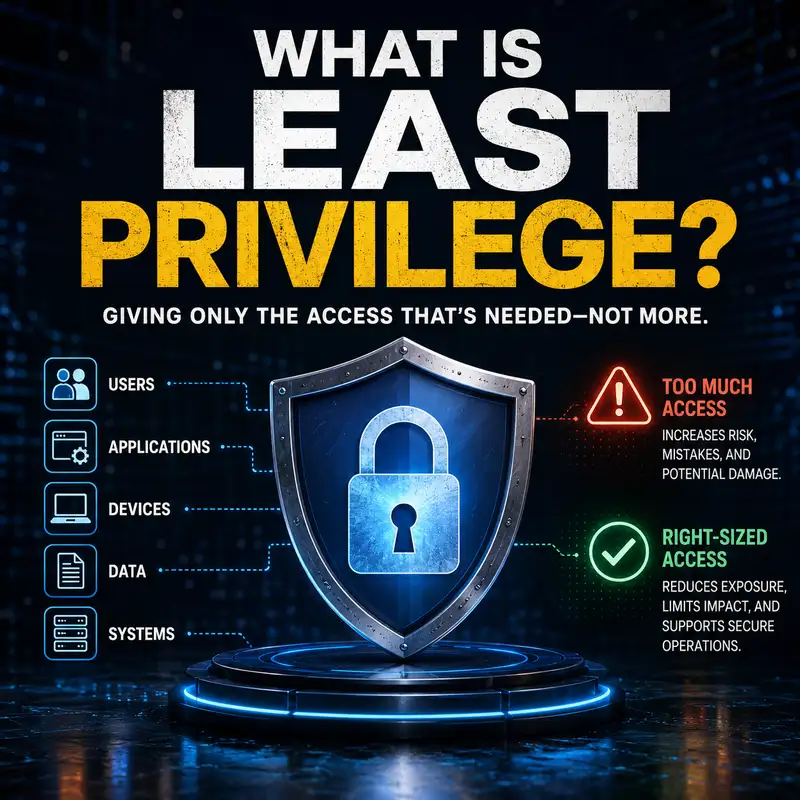
Least privilege is often misunderstood as a rule that simply tells security teams to remove access. That interpretation is too narrow, and it can lead to either excessive restriction or careless exceptions. The real professional question is how to give a person, application, or device enough authority to perform an assigned function without granting access that is unrelated, broader than necessary, or available longer than needed. That decision affects productivity, system reliability, and security at the same time. Too little access can prevent legitimate work, while too much access increases the number of ways a mistake, compromised account, malicious program, or faulty process can cause harm. In this episode, we will define least privilege directly, examine why unnecessary permissions accumulate, and explain how to reduce excessive access without treating every user or system as though it should have no authority at all. By the end, you should be able to explain what least privilege requires and how to apply it as an ongoing access decision. Least privilege means giving a user, application, service, or device only the access required to perform its assigned function. Access includes more than the ability to sign in. It includes which systems can be reached, which information can be viewed, which records can be changed, which commands can be executed, and which administrative actions can be performed. A privilege is authority to take an action, while a permission is a specific grant that allows that authority in a particular system or resource. Least privilege connects those grants to a legitimate need. It does not mean no access, and it does not mean that everyone receives the same small set of permissions. The required access depends on the function being performed. The main distinction to remember is that authorization should follow demonstrated need rather than convenience, status, or past access. The concept is often confused because organizations tend to think in broad roles, while real work depends on narrower tasks, resources, and time periods. The word least can also create the wrong impression if it is treated as an absolute measurement. Least privilege is not a contest to produce the smallest possible permission set regardless of whether the assigned function can still be completed. It is a contextual standard. The correct level of access depends on what the subject must do, which resource is involved, what action is required, where the action may occur, and how long the authority should remain available. Read access may be enough for one task, while another task may require the ability to create or modify records. Administrative access may be justified for maintenance but unnecessary for routine communication or web browsing. Time matters as well. A temporary task may justify temporary elevation rather than a permanent administrative role. Least privilege therefore asks whether every granted capability has a current purpose. A permission without a clear connection to an assigned function is not harmless just because it has never been misused. Unnecessary access accumulates because permissions are usually easier to add than to remove. A new responsibility may require another group membership, another shared folder, or another application role. When the responsibility ends, the new access often remains because no process identifies it as temporary or reviews whether it is still needed. Role changes create the same problem. People may carry permissions from earlier positions, while service accounts and integrations retain scopes that were granted for projects that no longer operate. Inherited permissions can spread access through nested groups, copied templates, broad cloud roles, and default configurations. Convenience also encourages overgranting. A broad role may solve an immediate access problem faster than identifying the specific missing permission. Each individual decision may appear minor, but the combined result is permission creep. Over time, the account reflects its history rather than its current purpose, and that historical access becomes part of the organization’s exposure. Excessive privilege increases damage because it expands what an account or process can affect when something goes wrong. A mistaken command issued from a standard account may affect only the files and settings available to that account. The same mistake made with administrative authority may alter system configurations, remove protections, or disrupt many users. A compromised credential creates a similar difference. The attacker gains the authority of the account that was taken, so unnecessary privileges increase the range of reachable systems and available actions. Malicious software running in a user context may also inherit that user’s access. This relationship is often described as limiting the blast radius, which means reducing how far the consequences can spread from one failure or compromise. Least privilege does not prevent every incident, and it does not guarantee that an approved action will be safe. It reduces the amount of authority available to be abused, misapplied, or inherited when another control fails. User access is the most familiar part of least privilege, but the principle becomes especially important around administrative authority. Administrative privileges allow changes that ordinary work usually does not require, such as installing software, modifying security settings, managing accounts, or changing system-wide configurations. Giving that authority to a person’s everyday account means those capabilities are present during routine email, browsing, document work, and other activities that do not need them. A stronger design separates normal activity from privileged activity. The user works through a standard account and elevates or switches to a privileged account only when an approved administrative task requires it. The privileged session should be limited to the necessary system, action, and time period. This separation is not based on distrust of the administrator. It recognizes that skilled and trusted people can make mistakes, encounter malicious content, or have credentials stolen. Privilege should follow the task, not remain continuously attached to the person. Applications, services, and devices also need carefully bounded authority. A software service may need to read from one data store but not modify every database in the environment. An application programming interface (A P I) token may need permission to retrieve selected records but not create users or change security settings. A device may need to communicate with specific management, update, and business services without being able to reach unrelated administrative networks. Machine identities are often overlooked because they do not behave like human users, yet they can hold powerful and long-lived credentials. Broad service permissions are especially risky when the same identity is used by several processes, because it becomes difficult to determine which process needed which capability. Least privilege for nonhuman access means identifying the exact operation the system must perform, narrowing the reachable resources, limiting credential lifetime where practical, and avoiding shared identities when separate accountability is needed. Automation should be efficient, but efficiency does not require unlimited authority. Before we continue, this episode is brought to you by the Bare Metal Cyber Academy. The Academy is a place for people who want to keep developing practical cybersecurity knowledge through clear, structured education. Topics such as access control become easier to apply when the underlying ideas are explained carefully and connected to real decisions. You can visit Bare Metal Cyber dot com to explore the Academy and see the learning opportunities currently available. The goal is straightforward education that helps you build understanding over time without exaggerated promises or shortcuts. Now, let’s return to least privilege and examine the mistakes that often weaken it in practice. One common mistake is treating least privilege as a one-time configuration project. Access needs change whenever responsibilities, systems, data, vendors, or business processes change, so a permission set that was appropriate last year may be excessive today. Another mistake is equating least privilege with low trust. Trust concerns confidence in a person or system, while privilege concerns the authority available during a specific function. A trusted administrator still does not need permanent access to every system. Organizations also confuse least privilege with denying requests by default without understanding the work. Default deny is a useful starting position because access is blocked until approved, but the approval process still has to identify legitimate requirements and grant them accurately. Least privilege is also different from separation of duties. Separation of duties divides sensitive actions among multiple parties, while least privilege limits each party to the authority needed for its portion. The concepts support one another, but they solve different access problems. Applying least privilege begins with understanding the assigned function in enough detail to translate it into access. A job title or system label is usually too broad. The better questions concern the actual tasks being performed, the resources involved, and the actions required on those resources. Viewing information, changing information, approving a transaction, creating an account, and altering a configuration are different authorities even when they occur in the same application. Start from no assumed access, then add the specific capabilities that the function requires. Test whether the work can be completed, and distinguish a genuine requirement from a request based on habit or convenience. Document unusual grants so later reviewers understand why they exist. When a broad role is unavoidable because of product design, treat that limitation as an access risk rather than pretending the role is precise. Good least privilege depends on accurate work analysis, not merely on selecting the smallest name in a menu. The access lifecycle determines whether least privilege survives after the initial decision. Provisioning creates access when a person or system begins a function. Changes should adjust that access when responsibilities move, and deprovisioning should remove it when the function ends. Failures at any of these points produce stale accounts, orphaned credentials, and permissions that no longer have an owner. Temporary access should have an expiration rather than relying on someone to remember to remove it. Just-in-time privilege supports this approach by making elevated authority available only when requested and approved for a limited period. Periodic access reviews provide another check, but they must do more than ask managers to approve long lists quickly. Reviewers need enough context to understand what each role permits and whether the permission still supports current work. Least privilege becomes durable when access has a defined beginning, a monitored purpose, and a reliable end. Evidence is essential because granted access and used access are not the same thing. An account may possess a powerful permission without exercising it for months, which can indicate that the grant is unnecessary, reserved for rare emergencies, or simply forgotten. Usage records, authentication logs, role assignments, group membership, token scopes, and administrative activity can help reveal the difference. That evidence should be interpreted carefully. Lack of recent use does not automatically prove that access is unnecessary, especially for recovery, emergency, or periodic functions. It does create a reason to ask why the privilege remains permanent and whether a temporary or controlled method would work better. Monitoring can also show when a standard account begins using unusual administrative capabilities or when a service accesses resources outside its normal pattern. During an incident, clear privilege records help responders determine which systems and actions were available through the affected identity. Least privilege is stronger when intended authority, granted authority, and observed activity can be compared instead of assumed to be identical. Practical implementation requires balance because availability and security are both legitimate concerns. Removing a permission without understanding dependencies can interrupt operations, break automation, or prevent recovery during an emergency. That does not justify keeping every broad grant forever. It means access changes should be tested, staged, monitored, and reversible where appropriate. Emergency or break-glass access may be necessary for critical systems, but it should be tightly controlled, strongly authenticated, logged, and reviewed after use. Exceptions should identify the reason, the owner, the affected resource, the duration, and the compensating protections that reduce exposure. The decision should also consider concentration of privilege. One account with authority across many systems creates a larger dependency and a larger target than several purpose-specific identities. Least privilege is not achieved by creating so much friction that people bypass controls. It is achieved by matching authority to need while designing a workable path for legitimate exceptions. A practical way to test least privilege is to examine one access grant from several angles. Identify the user, application, service, or device receiving the authority, then state the exact function it must perform. Name the specific resource involved and the actions required on that resource. Ask whether the same result can be achieved with a narrower role, a separate account, a restricted network path, a shorter credential lifetime, or temporary elevation. Determine whether the access should be permanent, scheduled, event-based, or approved only when needed. Check who owns the decision and what evidence will show that the privilege is being used as intended. Finally, define when the grant will be reviewed or removed. This method turns least privilege from a slogan into a repeatable decision. The objective is not to prove that every permission is dangerous. It is to ensure that every permission has a current, understandable, and proportionate reason to exist. Least privilege means that authority is granted according to the needs of a defined function and limited across scope, action, location, condition, and time wherever the system allows. It applies to human users, administrators, applications, service accounts, tokens, and devices because any of them can become the source of a mistake or the path of a compromise. Unnecessary access accumulates when grants are broad, inherited, temporary without expiration, or left behind after responsibilities change. That excess increases potential damage by expanding the systems, data, and commands available through one identity. The proper response is not indiscriminate restriction. It is deliberate authorization supported by accurate task analysis, separate privileged activity, lifecycle controls, meaningful review, and evidence of actual use. When access is treated as a current business decision rather than a permanent possession, the organization can support legitimate work while reducing the authority available for misuse. That is the practical meaning of least privilege.