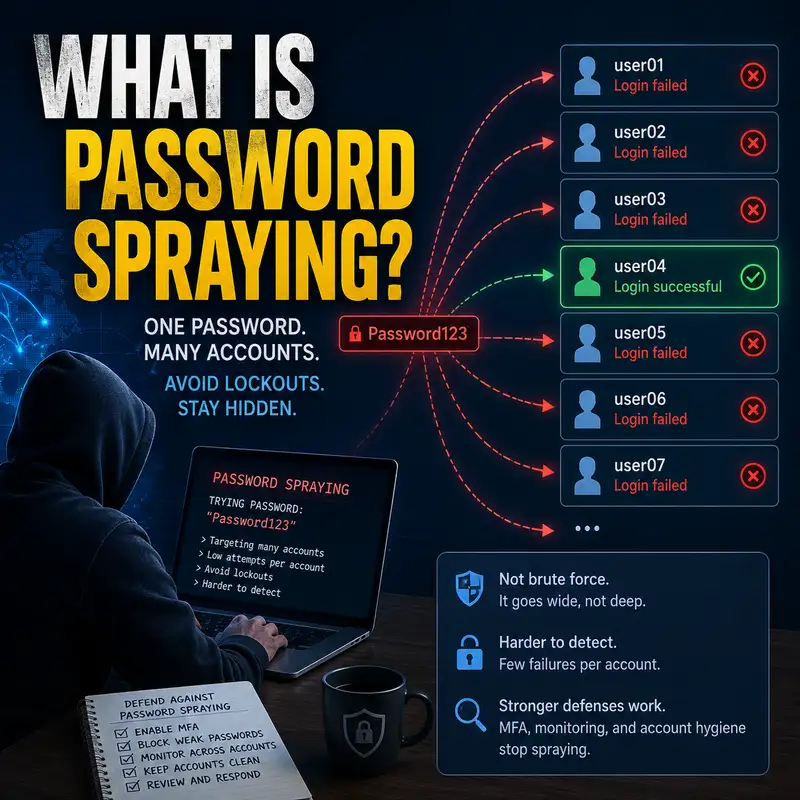
What Is Password Spraying?
Account lockout settings are often treated as the main defense against password guessing, but password spraying is designed to work around that assumption. Instead of hammering one account with many guesses, the attacker spreads a small number of guesses across a large number of accounts. That difference changes what defenders must monitor, because no single user may experience enough failures to trigger a traditional lockout rule. It also changes what prevention looks like, since a control focused only on repeated failures against one account may miss the broader pattern. In this episode, we will answer a practical question: what is password spraying, how is it different from ordinary brute-force activity, and why can it remain difficult to recognize even when authentication logging is enabled? By the end, you should be able to explain the attack clearly and identify the defensive decisions that matter most. Password spraying is a password-guessing technique that tests a small set of common, weak, or predictable passwords against many user accounts. A traditional brute-force attack usually concentrates many password guesses on one account until the correct password is found or the account is locked. Credential stuffing is different again, because it uses username and password combinations obtained from another source and tests whether those same combinations work elsewhere. All three activities involve unauthorized authentication attempts, which is why they are sometimes discussed as though they were interchangeable. The main distinction is how the guesses are distributed. Password spraying goes wide across accounts, brute force goes deep against one account, and credential stuffing relies on previously exposed credentials. That distribution matters because many defenses and alerts were originally designed to notice repeated failures tied to a single username rather than a quiet pattern spread across an entire organization. At a high level, password spraying depends on two conditions. The attacker must have or infer a set of valid account names, and at least one targeted account must use a password that appears among the small group being tested. The method does not require rapid or continuous guessing against each user. Attempts may be separated over time, distributed across different services, or blended into ordinary internet authentication traffic. The purpose of that spacing is to keep the activity below thresholds that would normally lock an account or create an obvious burst of failures. A failed attempt against one user may look routine, especially when employees occasionally mistype passwords or old applications continue using outdated credentials. The security signal becomes clearer only when defenders connect similar failures across many accounts and recognize that the same broader behavior is repeating. Password spraying succeeds most often where password quality and identity controls are uneven. A single weak password can be enough, even when most users follow stronger practices. Predictable password patterns, reused passwords, unchanged temporary passwords, dormant accounts, and accounts that are rarely reviewed all increase exposure. Password-only authentication also leaves the password as the single barrier between an attacker and the account. Legacy authentication methods can make the problem worse when they do not support stronger controls or provide less useful security context. Account lockout helps against concentrated guessing, but it does not eliminate spraying because each account may receive only a few attempts. The practical lesson is that the weakness is not merely the existence of a login page. The weakness is an identity environment in which one guess can still provide access and where defensive rules evaluate accounts in isolation. Recognizing password spraying requires defenders to examine authentication activity as a population rather than as a collection of separate user histories. One failed login is usually not meaningful by itself. A small number of failures for many different accounts, especially when they share a source, client type, application, protocol, or timing pattern, can reveal coordinated activity. Identity provider logs are especially valuable because they may show which accounts were targeted, where attempts originated, what application received them, and whether any attempt succeeded. Defenders should also look for a successful login that follows a broader series of failures, since the success may mark the point where the spraying campaign found a weak password. Detection becomes harder when attempts are distributed across multiple sources, so correlation over time is more useful than a single fixed threshold. The essential question is whether many apparently minor events form one repeated authentication pattern. The difference between password spraying, brute force, and credential stuffing affects both investigation and control selection. A brute-force alert may be triggered by a high number of failures against one account, making the targeted username easy to identify. A credential-stuffing campaign may produce attempts using many distinct password values because the attacker is testing previously exposed pairs. Password spraying often produces the opposite shape, with relatively few guesses per user but a wide set of targeted accounts. A defender who labels every guessing attack as brute force may choose controls that are too narrow. Increasing the lockout duration for one account may slow concentrated guessing, yet it may do little against activity that stays below the threshold. Correct classification helps the team decide whether it needs stronger password policy, broader correlation, modern authentication, multifactor authentication, source-based controls, or a combination of these measures. The consequence of a successful spray depends on what the compromised account can reach and what trust the organization places in that identity. Access to email may expose messages, contacts, password-reset links, and business conversations. Access to cloud storage may reveal files or allow unauthorized changes. A compromised account may also be used to appear legitimate when contacting coworkers or requesting additional access. The first account gained is not always the final objective, but defenders should not assume that every successful login automatically produces the same level of harm. Privilege, data access, active sessions, connected applications, and the ability to approve actions all shape the risk. That is why identity protection must connect authentication evidence to authorization and business impact. The question is not only whether a password was guessed. It is what the authenticated identity was able to do after the guess succeeded. Before we continue, a brief promotional note. This episode is brought to you by the Bare Metal Cyber Academy. The Academy provides a place for people who want to continue developing practical cybersecurity knowledge through clear, structured education. It is designed to help learners build understanding one concept at a time without turning every topic into an exam-preparation exercise. You can visit Bare Metal Cyber dot com to explore the Academy and see the learning opportunities currently available. Topics such as password spraying become easier to manage when identity, logging, access control, and risk are understood as connected parts of the same security problem. Now, let’s return to the defensive controls that make spraying less likely to succeed. The most effective way to reduce the value of password spraying is to make a guessed password insufficient for access. Multifactor Authentication (M F A) adds another requirement beyond the password and can stop many password-only attempts from becoming successful sessions. Passwordless and phishing-resistant authentication methods can reduce dependence on shared secrets even further. These controls must cover the actual authentication paths in use, including remote access, cloud applications, administrative portals, and older protocols. An organization that requires M F A for one modern application but leaves a legacy path protected only by a password still has a gap. Strong authentication should be combined with controls that reject known weak passwords, encourage long unique passwords, and support password managers. The goal is not to make users invent increasingly complicated patterns. It is to reduce the chance that one common guess can unlock a valid identity. Lockout and rate-limiting controls still matter, but they should be designed with password spraying in mind. A simple rule that counts failures only for one account may not detect an attack spread across hundreds of usernames. More capable defenses can evaluate activity by account, source, device, network, application, and organization-wide patterns. Some identity platforms use adaptive or smart lockout features that distinguish familiar user behavior from suspicious guessing, although their effectiveness depends on configuration and coverage. Defenders must also consider denial-of-service risk. If any outside party can lock many accounts by generating a few failed attempts, the defensive control can itself disrupt operations. A balanced approach slows or challenges suspicious authentication without making legitimate access fragile. Lockout is therefore one layer, not the complete answer. It works best when combined with correlation, M F A, conditional access, and strong visibility across all authentication systems. Account hygiene directly reduces the number of useful targets available to a password-spraying campaign. Dormant accounts should not remain enabled simply because no one has noticed them. Access should be removed or changed when people leave, transfer roles, or no longer need a service. Shared accounts create additional difficulty because ownership and normal behavior may be unclear, while service accounts may be overlooked if they do not follow ordinary user-review processes. Each identity should have a defined purpose, an accountable owner, and an authentication method appropriate to its function. Accounts that cannot use interactive M F A require other protections, such as restricted use, managed secrets, limited network paths, and close monitoring. Regular access reviews help identify permissions that have accumulated beyond current needs. Reducing unnecessary accounts and unnecessary privilege does not merely improve administration. It limits both the chance of a successful spray and the damage that a compromised identity can cause. When defenders suspect password spraying, the investigation should separate attempted access from confirmed compromise. Authentication logs can show which accounts were targeted, which attempts failed, and whether any login succeeded. A successful event should be examined for its source, device context, application, authentication method, and activity that followed. Response may include protecting the affected account, changing credentials, revoking active sessions or tokens, confirming M F A status, and reviewing recent access to email, files, applications, and administrative functions. The team should also identify whether the same password weakness could exist elsewhere without collecting or exposing user passwords. Broad password resets may be appropriate in some circumstances, but they should be guided by evidence and coordinated carefully. Preserving relevant logs is important because the campaign may have unfolded slowly. A narrow review of only the first alert can miss earlier attempts or additional accounts that were affected. Several misunderstandings make password spraying easier to miss. The absence of an account lockout does not mean that guessing did not occur, because avoiding lockout is part of the technique’s design. A low number of failures for each user does not make the pattern harmless when the same behavior reaches a large portion of the account population. Activity from more than one internet source does not automatically mean the attempts are unrelated, since distributed traffic can still support one campaign. At the same time, many failed logins do not prove that an attacker succeeded. Old devices, misconfigured applications, expired passwords, and synchronization problems can also create repeated authentication failures. Defenders therefore need context, correlation, and evidence rather than a single assumption. The correct labels are attempted spraying, suspected compromise, and confirmed compromise, depending on what the logs and follow-on activity actually support. A practical way to evaluate possible password spraying is to begin with scope. Determine how many accounts received similar failures, over what period, through which applications or protocols, and from what sources. Then look for the pattern that connects those events, rather than judging each account separately. Check whether any attempt succeeded and whether that success produced new sessions, unusual access, or changes to the account. Next, verify that stronger controls cover the same authentication path, including M F A, conditional access, legacy protocol restrictions, and weak-password blocking. Finally, record what remains uncertain and what additional evidence is needed. This method keeps the investigation focused on observable facts. It also turns the event into a control review, because a spraying pattern may reveal gaps in logging, account lifecycle management, password policy, or authentication coverage even when no compromise is confirmed. Password spraying is a wide, low-volume password-guessing technique that tests a small number of common passwords against many accounts. It differs from traditional brute force because it avoids concentrating enough attempts on one username to trigger familiar lockout and alert thresholds. That design makes the activity harder to recognize when defenders review accounts one at a time. Effective defense therefore combines strong authentication, rejection of weak passwords, modern protocol coverage, account hygiene, organization-wide correlation, and a careful investigation of any successful login. Lockout remains useful, but it cannot carry the entire burden. The most important operational practice is to treat authentication as a connected system and look for patterns across users, applications, and time. When many small failures share the same underlying behavior, the organization should evaluate them as one coordinated identity threat rather than as unrelated typing mistakes.