What Is Privilege Escalation?
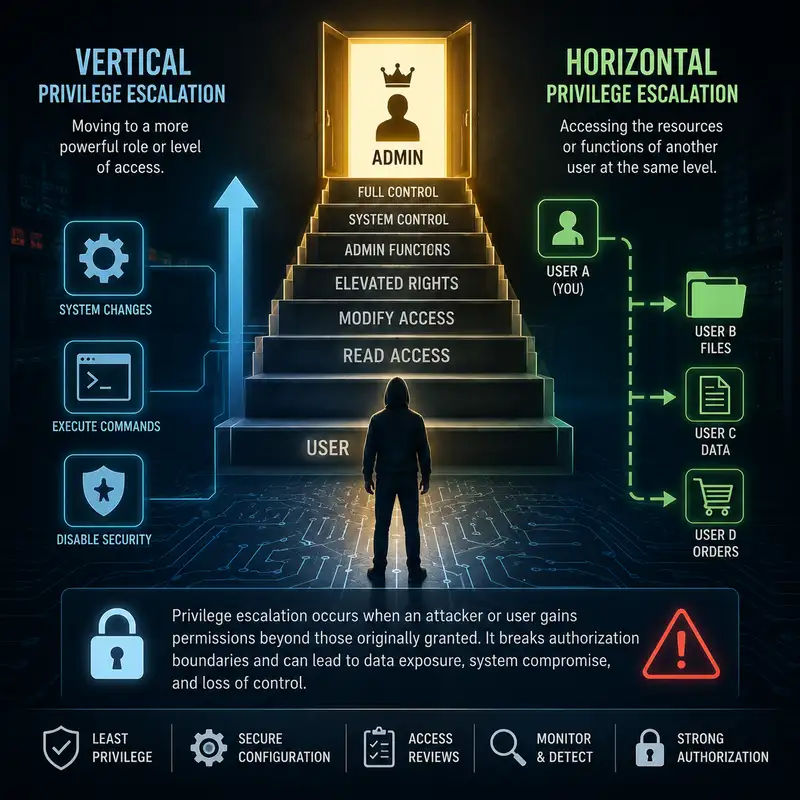
Privilege escalation is often described as an attacker becoming an administrator, but that description is too narrow. A user can gain unauthorized power without receiving the most powerful account on a system, and an attacker can cross an important permission boundary while appearing to remain an ordinary user. The practical question is not simply whether an account was compromised. The question is whether the person or process gained abilities, data access, or control that the original permissions did not allow. That distinction affects how defenders investigate the event, which controls they examine, and how serious the consequences may be. By the end of this episode, you should be able to explain what privilege escalation means, distinguish its two main forms, separate it from related security events, and identify the evidence and controls that matter when permission boundaries fail. A privilege is an approved ability to perform an action or access a resource. Privilege escalation occurs when a user, attacker, application, or process obtains permissions beyond those originally granted. Vertical privilege escalation means moving to a more powerful role, such as gaining administrative or system-level capabilities from a standard account. Horizontal privilege escalation means crossing into the resources or functions of another user who may have a similar level of authority. Both forms violate authorization, which is the decision about what an authenticated identity is allowed to do. They are often confused because each can begin with a valid login and may not require the attacker to create a new account. The main distinction is the direction of the permission change: vertical escalation moves upward in power, while horizontal escalation moves sideways into someone else’s authorized space. Understanding privilege escalation requires separating authentication from authorization. Authentication establishes who or what is presenting an identity, usually through credentials, a token, a certificate, or another proof. Authorization determines what that identity may read, change, execute, approve, or administer after authentication succeeds. A system can authenticate someone correctly and still make a dangerous authorization decision. For example, a valid user account may be allowed to request a record, but the application must still verify that the record belongs to that user or that the user’s role permits access. Privilege boundaries exist wherever different identities receive different capabilities, including operating systems, cloud platforms, applications, databases, network devices, and business workflows. Escalation happens when one of those boundaries is bypassed, misapplied, or weakened enough that the granted authority no longer matches the intended authority. Vertical privilege escalation changes the level of control available to an identity. A standard user may gain the ability to install software, disable security tools, change system settings, read protected files, create accounts, or assign permissions. In an application, a normal customer or employee account may reach administrative functions that should be restricted to support staff, managers, or system operators. The increase does not have to reach the highest possible privilege to qualify. Moving from read-only access to modification rights, from ordinary user to help-desk operator, or from application administrator to infrastructure administrator can all represent vertical escalation when the transition was not authorized. Defenders should therefore look for the specific boundary crossed rather than relying on the word administrator. The security impact depends on what the new role can do, what systems trust it, and whether its actions can affect other identities or critical services. Horizontal privilege escalation does not necessarily make an identity more powerful in the formal role structure. Instead, it allows the identity to reach data, actions, or objects assigned to another user or peer account. A customer who can view another customer’s records, a project member who can modify another team’s files, or an employee who can approve a transaction assigned to a different employee may be experiencing the effects of horizontal escalation. The underlying problem is usually that the system checks whether the requester is logged in but fails to verify ownership, scope, tenancy, or another authorization condition for the specific resource. Horizontal escalation can be severe because it may expose large amounts of personal, financial, operational, or confidential information without producing an obvious role change. The account may still appear ordinary even while its effective access has expanded far beyond what was intended. Privilege escalation can result from several different weaknesses, and the path matters because different controls address different causes. Software vulnerabilities may allow a process to execute with the authority of a more privileged service or operating system component. Security misconfigurations may grant dangerous file permissions, unnecessary administrative rights, overly broad cloud roles, or insecure service settings. Applications may enforce authorization only in the user interface while failing to repeat the same check on the server when a request is processed. Organizations may also create escalation opportunities through excessive permissions, shared accounts, stale group memberships, inherited access, or poorly controlled delegation. Stolen credentials or session information can provide the identity needed to use existing privileges, while a separate weakness may then allow additional access. Calling every path privilege escalation without identifying the failed boundary makes remediation less precise and can leave the original weakness in place. Privilege escalation is related to account compromise, lateral movement, and privilege abuse, but the terms are not interchangeable. Account compromise means an unauthorized person controls or uses an account, yet the account may still operate only within its originally assigned permissions. Lateral movement describes an attacker moving from one system, account, or environment to another, which may occur with or without gaining greater authority. Privilege abuse occurs when someone intentionally misuses permissions they were legitimately granted, while escalation means the person or process obtains permissions that were not authorized in the first place. These events can occur together. A compromised standard account may be used to exploit a weakness, gain administrative rights, and then move to additional systems. Accurate labels help investigators reconstruct the sequence, identify the control failure at each stage, and avoid treating one security event as though it explains the entire incident. Before we continue, this episode is brought to you by the Bare Metal Cyber Academy. The Academy provides a place for people who want to continue developing practical cybersecurity knowledge through clear, structured education. Topics such as access control, authorization, system security, and digital risk become more useful when they are explained in a way that connects technical details to real decisions. You can visit Bare Metal Cyber dot com to explore the Academy and see the learning opportunities currently available. There are no promises of instant expertise or guaranteed outcomes, only an invitation to keep building knowledge with deliberate study. Now, let’s return to privilege escalation and examine why the consequences depend on what the newly gained permissions allow. The consequences of privilege escalation depend on the authority gained, the resources reached, and the trust relationships surrounding the affected identity. Vertical escalation may allow changes that weaken defenses, conceal activity, alter configurations, create persistence, or affect many users at once. Horizontal escalation may expose or modify another person’s data while avoiding the attention that often follows an obvious administrator login. In cloud and distributed environments, one role can also be trusted by other services, so a seemingly limited permission change may open access to additional systems or data stores. Business impact is therefore not determined by the label alone. Investigators must identify what actions became possible, whether those actions occurred, and which assets or processes relied on the compromised authority. The same technical weakness can produce very different risks depending on the value of the affected resources and the scope of the permissions. Several common misunderstandings make privilege escalation harder to recognize. One mistake is assuming that escalation always produces a visible role change, even though horizontal escalation may leave the account name and role unchanged. Another is treating every use of an administrator account as escalation, although an authorized administrator performing approved work has not crossed a permission boundary. A third mistake is assuming that multifactor authentication (M F A) prevents escalation. M F A can reduce the chance that an attacker enters through stolen credentials, but it does not correct a local software flaw, an excessive role assignment, or a broken authorization check inside an application. It is also incorrect to assume that a successful login proves every later action is legitimate. Authentication confirms an identity claim according to the system’s process. It does not replace the need to enforce authorization for each sensitive action and resource. Detecting privilege escalation requires evidence that shows both identity and authorization context. Useful records include account and group changes, role assignments, permission modifications, privileged command execution, changes to security settings, access to protected files, and requests for resources outside an identity’s normal scope. Application logs should record the authenticated identity, the requested object or function, the authorization decision, and the result without exposing sensitive data unnecessarily. Cloud platforms and administrative systems should preserve activity histories that reveal who granted a role, when it became active, and what actions followed. Defenders should also compare current behavior with expected duties rather than relying only on a list of supposedly privileged account names. An ordinary account performing an extraordinary action may be more important than a known administrator performing routine work. Detection becomes stronger when logs allow investigators to reconstruct the boundary that was crossed. Preventing privilege escalation requires controls that match the type of boundary being protected. Least privilege reduces the number of permissions available before an incident and limits the authority that can be inherited or misused. Secure configuration removes unnecessary services, dangerous defaults, excessive file rights, and broad role assignments. Timely patching reduces exposure to known software flaws that can raise the privilege of a process or user. Applications must enforce authorization on the server for every sensitive request, including checks for ownership, role, tenant, and action. Privileged accounts should be separated from everyday accounts, monitored closely, and used only when elevated authority is required. Regular access reviews can find stale memberships and accumulated permissions. None of these controls guarantees that escalation will never occur, but together they reduce opportunities, limit consequences, and make unauthorized changes easier to identify. When privilege escalation is suspected, the response should preserve evidence while limiting further use of the gained authority. Defenders may need to disable or restrict affected accounts, revoke active sessions, remove unauthorized role assignments, isolate systems, and protect critical services from additional changes. The investigation should determine the original permissions, the new effective permissions, the time of the change, the mechanism that enabled it, and the actions performed afterward. Simply resetting a password may be insufficient when the cause is a software vulnerability, a misconfiguration, or a broken application authorization rule. Likewise, removing one role may not reverse files, accounts, policies, or tokens created while elevated access was available. Recovery must correct the failed boundary and review the environment for consequences produced during the escalation. A complete response addresses both the access gained and the condition that made the gain possible. A practical way to classify a suspected privilege escalation event is to ask a small set of focused questions in sequence. What permissions was the identity supposed to have before the event, and what actions or resources became available afterward? Did the identity move into a more powerful role, or did it reach another user’s data or functions without a formal increase in role? Which authorization check, configuration, software component, or administrative process should have prevented that change? What evidence shows that the access was actually used rather than merely available? Finally, which control would remove the path and which control would limit the damage if a similar failure occurred again? These questions separate vertical from horizontal escalation, distinguish escalation from ordinary account compromise, and connect the technical finding to remediation. They also help communicate the issue clearly to system owners and leaders. Privilege escalation occurs when actual permissions exceed the permissions that were originally and legitimately granted. Vertical escalation moves an identity upward into a more powerful role or capability, while horizontal escalation moves it sideways into the protected resources or functions of another user or peer. The event may begin with a compromised account, a software flaw, a misconfiguration, excessive access, or a failed authorization check, but the defining feature is the unauthorized crossing of a permission boundary. Recognizing the direction of that crossing helps defenders choose the right evidence, containment steps, and corrective controls. It also prevents authentication success from being mistaken for authorization approval. The most useful practice is to compare intended authority with effective authority and then identify exactly where they diverged. That comparison turns privilege escalation from a vague warning into a specific, testable security problem.