What Is Separation of Duties?
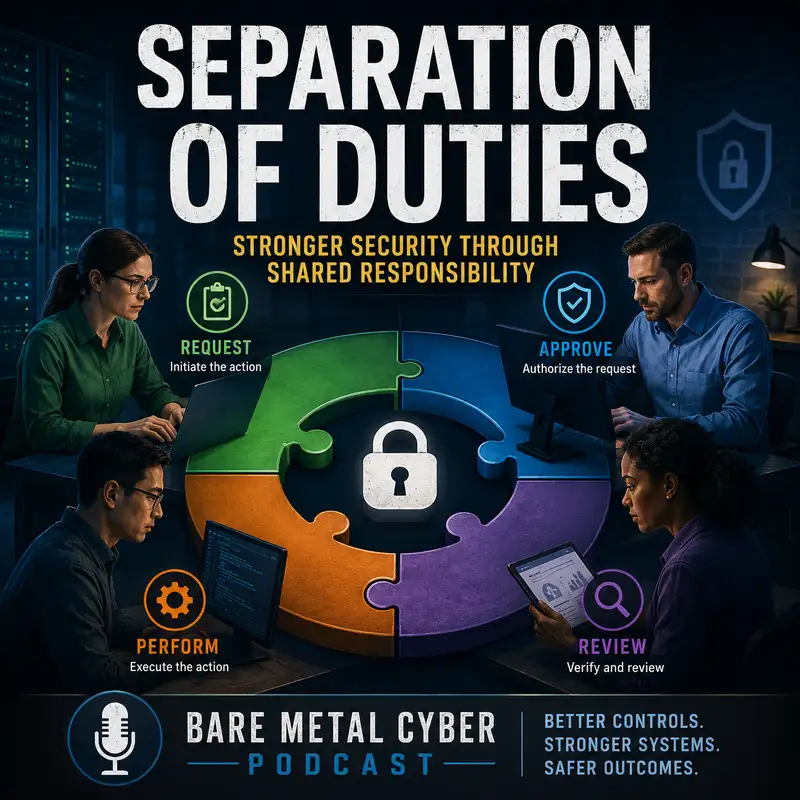
A sensitive process can appear well controlled even when one person still has the power to request an action, approve it, carry it out, and hide the evidence afterward. That concentration of authority creates a practical security problem because trust in one individual is being asked to replace independent control. The concern is not that every administrator, manager, or analyst will act dishonestly. The concern is that a single mistake, compromised account, poor decision, or deliberate misuse can move through the entire process without another participant stopping it. Separation of duties addresses that weakness by dividing important responsibilities among different people or roles. By the end of this episode, you should be able to explain what separation of duties means, why it reduces fraud and error, how it differs from related controls, and how to decide where it belongs in a cybersecurity process. Separation of duties means dividing the authority and actions required for a sensitive process so that one person or role cannot complete the entire process alone. It is also commonly called segregation of duties. One participant may request or initiate an action, another may approve it, a different role may perform it, and someone independent may review the result. The exact division depends on the process and the risk, but the central idea is consistent. No single participant should control every critical step from beginning to end. This is different from least privilege, which limits a person to the access needed for assigned work. Least privilege reduces the amount of power one account holds, while separation of duties divides necessary power across multiple participants. The two controls often work together because limited permissions are more effective when sensitive actions also require independent involvement. The control works by reducing both opportunity and concealment. A person who can initiate a transaction but cannot approve it must involve someone else before the action moves forward. A person who performs a privileged change but cannot erase or rewrite the relevant records has less ability to hide an improper action. Independent participation also creates another opportunity to notice an error before it becomes a larger problem. This does not mean that two people can never make the same mistake or agree to misuse access. Collusion, weak review, compromised accounts, and careless approvals can still defeat the control. Separation of duties reduces risk rather than eliminating it. Its value comes from making unauthorized or mistaken activity harder to complete quietly, while producing clearer evidence about who requested, approved, performed, and reviewed the action. To apply separation of duties well, you first need to identify duties that should not be combined. Sensitive processes commonly include initiation, authorization, execution, custody, recordkeeping, and independent review. In cybersecurity, those functions may appear as requesting access, approving access, creating the account, assigning privileges, monitoring the account, and reviewing whether the access is still justified. The labels change across processes, but the conflict remains the same when one participant can both cause an important action and validate that the action was proper. A person who approves their own request is not providing independent authorization. A person who makes a change and then performs the only review is not providing independent verification. The control begins by separating duties that would otherwise allow one participant to act without meaningful challenge or leave no reliable way to detect misuse. Identity and access management provides one of the clearest uses of separation of duties. The person who needs access may submit the request, but an authorized owner should decide whether the request supports a legitimate need. A provisioning role or automated workflow can then grant only the approved permissions, while a later review confirms that the access remains appropriate. Privileged access deserves stronger separation because administrative permissions can change security settings, create accounts, alter logs, or affect many systems. An administrator should not be able to request elevated access, approve the request, grant the privilege, and certify afterward that the access was appropriate. Emergency access may require a faster path, but it should still create records and trigger prompt independent review. The purpose is to preserve accountability even when speed is necessary. Separation of duties is equally important in software and system change management. The person who writes a change understands the work, but that same person may overlook a defect, misunderstand a requirement, or fail to recognize the security impact. Independent review adds a separate judgment before the change reaches a sensitive environment. Production deployment may also be restricted to an approved role or automated pipeline rather than performed directly by anyone who can write code. This does not require a different human being for every minor action. It requires meaningful separation at the points where one person could introduce, approve, deploy, and conceal a harmful change. Automated testing, code review requirements, protected branches, and deployment approvals can enforce those boundaries. Automation supports separation of duties when it preserves independent authorization instead of merely moving concentrated power into one account or service. Other high-impact activities show why the concept extends beyond account approval and software changes. The ability to create encryption keys should be separated from unrestricted use of those keys when the consequences justify it. The ability to delete backups should not automatically include sole authority to approve the deletion and remove the audit evidence. Security monitoring is weakened when the same administrator responsible for a system can freely alter the logs used to review that administrator’s actions. Incident response may also separate the authority to contain a system from the authority to close the incident and declare the evidence complete. These divisions are not designed to slow every decision. They are designed to prevent one role from controlling the action, the record of the action, and the judgment about whether the action was acceptable. Before we continue, this episode is brought to you by the Bare Metal Cyber Academy. The Academy provides a place for people who want to keep developing practical cybersecurity knowledge through clear, structured education. Topics such as access control, accountability, risk, and security operations become more useful when they are explained in a way that connects concepts to real professional decisions. You can visit Bare Metal Cyber dot com and explore the Academy to see the learning opportunities currently available. There are no promises of guaranteed outcomes, only an invitation to continue building knowledge through deliberate study. Now, let’s return to separation of duties and look more closely at the controls that are often confused with it. Separation of duties is related to several other controls, but the terms are not interchangeable. Least privilege limits what one person or account can do. Dual control requires two authorized participants to complete a particular action, such as releasing a highly sensitive change or accessing protected material. Independent review checks work after or during a process without necessarily requiring the reviewer to perform part of the action. Job rotation and mandatory leave can expose irregular activity by placing another person into a role or temporarily removing the usual operator. Separation of duties is the broader design principle that keeps incompatible responsibilities apart. Dual control may be one way to enforce that principle, while review and rotation may strengthen detection. Understanding the difference matters because a process can use least privilege and still allow one person to approve and complete every sensitive action. A common mistake is to assume that adding more approvals automatically creates strong separation of duties. An approval has little value when the approver lacks the information, authority, or independence needed to challenge the request. Repeated approvals can become routine clicks that create delay without creating judgment. Excessive separation can also produce bottlenecks, encourage people to share accounts, or push work outside the approved process when the official path is too slow. The control must therefore be designed around risk rather than ceremony. High-impact actions deserve stronger separation, while low-risk and easily reversible actions may need a simpler process. The question is not how many people can be placed in the workflow. The question is whether each participant performs a distinct and meaningful function that prevents one person from controlling the entire outcome. Small teams often struggle to create perfect separation because the same people must perform several operational roles. That limitation does not make the principle irrelevant. It means the organization may need compensating controls that reduce the same concentration of power in another way. A sensitive action might be completed by one person when necessary, followed by prompt independent review, automated alerting, immutable logging, transaction limits, or periodic reconciliation by someone outside the immediate process. Those alternatives should be described honestly because after-the-fact review is not identical to preventing an action before it occurs. The organization should know which conflict remains and what evidence would reveal misuse or error. Good control design does not pretend that a staffing constraint has disappeared. It documents the exception, limits its scope, watches it closely, and revisits it when roles or resources change. Technology can make separation of duties more consistent, but only when the technical rules match the intended role boundaries. Access management systems can prevent self-approval, require an owner’s authorization, and record who granted a privilege. Privileged access tools can separate routine accounts from elevated accounts and require approval before administrative access begins. Source control and deployment systems can require independent review before code moves into production. Logging controls can send records to a protected location that the system administrator cannot quietly modify. Cryptographic processes can require more than one authorized participant before a key is activated or a sensitive operation is completed. These mechanisms reduce reliance on memory and informal practice. They still require testing because a hidden administrator path, shared account, emergency override, or poorly configured service account can restore the very concentration of power the control was meant to remove. Governance gives separation of duties a durable form. Policies and procedures should identify which responsibilities are incompatible, who may approve exceptions, how emergency access works, and how conflicts are reviewed. Role descriptions should be specific enough to show where authority begins and ends. Periodic access reviews should look not only at whether permissions are individually justified, but also at whether a combination of permissions allows one person to bypass the intended process. Exceptions should have owners, expiration dates, monitoring requirements, and documented reasons. Evidence matters because an organization cannot demonstrate separation merely by saying that different teams exist. Records should show who initiated, authorized, executed, and reviewed sensitive actions. This is not a statement that trusted employees are suspected of wrongdoing. It is a recognition that people can make mistakes, accounts can be compromised, and no individual should be placed beyond meaningful review. Clear governance turns separation of duties from an informal expectation into a control that can be tested, maintained, and improved. A practical way to apply the concept is to map a sensitive process from request through completion and later review. Identify who can initiate the action, who can authorize it, who can perform it, who controls the related records, and who confirms the result. Then look for combinations that allow one person or account to approve its own work, change both the system and the evidence, or complete a high-impact action without independent involvement. Decide which conflicts must be prevented before the action and which can be monitored through compensating controls. Assign clear roles, enforce them through permissions and workflow rules, preserve reliable logs, and test whether an emergency path can bypass the design. Repeat the review when systems, staffing, or responsibilities change. This method turns a broad principle into a set of specific control decisions tied to the actual process. Separation of duties is the division of a sensitive process so that no single person or role can independently authorize, perform, record, and conceal a high-impact action. Requiring more than one meaningful participant reduces the opportunity for fraud, catches some errors before they spread, and limits the misuse of powerful access. It works best when the divided duties are genuinely independent, the permissions enforce the intended boundaries, and the records allow later verification. It does not eliminate collusion, compromised accounts, weak approvals, or every operational mistake. It also should not be added mechanically to low-risk work where delay creates more harm than protection. The practical decision is to find the points where concentrated authority could produce serious consequences and ensure that another accountable participant must approve, verify, or review the action. That is how separation of duties becomes a working security control rather than a policy phrase.