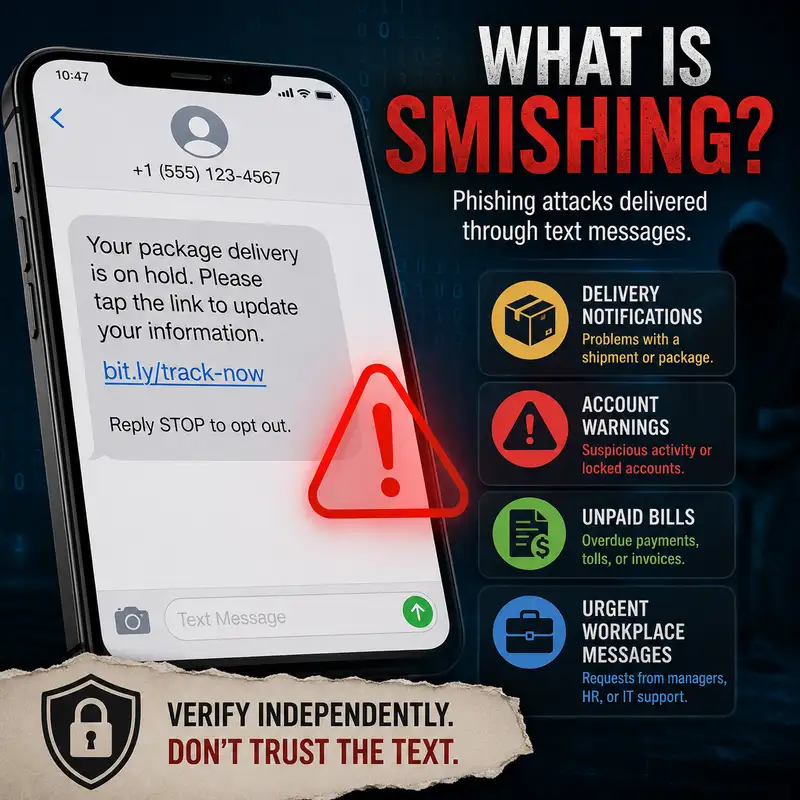
What Is Smishing?
A text message can look routine while asking you to make a security decision in only a few seconds. Delivery notices, account warnings, unpaid bills, and urgent workplace requests all resemble messages people receive during normal life, which makes a malicious version easy to mistake for a legitimate one. The central problem is not simply whether the message looks polished. The practical question is whether the sender is using the speed and familiarity of texting to push you toward a link, a reply, a payment, or a phone call before you verify the request. Misunderstanding that pressure can expose credentials, financial information, account access, or sensitive workplace details. By the end of this episode, you should be able to explain what smishing is, recognize the different actions it may request, distinguish it from nearby forms of phishing, and choose a safer way to verify the message without relying on the message itself. Smishing is phishing conducted through text messaging, including messages delivered through Short Message Service (S M S) and similar mobile messaging channels. Phishing is a form of social engineering that tries to persuade someone to reveal information, approve an action, open a malicious destination, or contact an attacker-controlled service. Smishing uses the text-message channel to create that persuasion. The message may contain a link, ask for a direct reply, request a payment, or encourage the recipient to call a number. The defining feature is the delivery method, not one particular technical trick. A smishing message does not have to contain malware, and it does not have to imitate a bank. It becomes smishing when a deceptive text is used to obtain information or influence an unsafe action. That direct relationship is useful to remember: phishing describes the broader technique, while smishing describes phishing delivered through text. Texting gives smishing several advantages that attackers try to exploit. People often read text messages quickly, on a small screen, while moving between other tasks. That environment makes it harder to inspect a web address, notice an unusual sender pattern, or pause long enough to question the request. Text messages also feel immediate. A warning about a package, a locked account, or an overdue charge can create the impression that delay will make the problem worse. The sender information shown on a phone may also provide less context than a full email address and message header. Even when a phone displays a familiar name or an apparently local number, that display should not be treated as proof of identity. Smishing succeeds by combining a trusted communication habit with urgency, limited context, and a request that appears simple enough to complete immediately. A smishing attempt commonly pushes the recipient toward one of three broad actions, and each action creates a different kind of exposure. A link may lead to a counterfeit sign-in page, a payment form, or a page that asks for personal information. A reply may confirm that the phone number is active or may begin a conversation designed to collect account details, identity information, or authentication codes. A phone number in the message may transfer the interaction into voice phishing, also called vishing, where a caller uses conversation and pressure to continue the deception. These paths can be combined. A text may first create urgency, then direct the recipient to call, and then use the call to request information or approval. Recognizing the requested action helps you evaluate the risk. The message is the delivery mechanism, while the link, reply, payment, or call is the action the attacker wants. The themes used in smishing are effective because they borrow from routine events that already demand attention. Delivery notifications work because many people are expecting packages and know that shipping problems sometimes require action. Account warnings work because security alerts and password-reset notices are familiar and because people fear losing access. Unpaid bills and toll notices create pressure by suggesting penalties, service interruption, or additional fees. Urgent workplace messages may appear to come from a supervisor, help desk, human resources office, or vendor and may ask for a login, a phone call, or a rapid transaction. The theme itself does not prove that a message is malicious. Legitimate organizations do send texts about these subjects. The concern comes from the combination of unexpected context, emotional pressure, and a request that moves the recipient away from a trusted process and toward a destination controlled by the sender. No single visual clue can reliably identify every smishing message, so recognition depends on several signals considered together. An unexpected message deserves more scrutiny when it demands immediate action, threatens a consequence, or asks for information that the claimed sender should not need through text. A shortened or unfamiliar web address can hide the true destination, but a normal-looking address is not automatic proof of safety. Spelling and grammar problems may appear, although well-written messages can still be malicious. A request for a password, payment-card number, one-time authentication code, or remote-access action should be treated cautiously, especially when the request arrives without prior context. Sender identity is also weak evidence because names and numbers displayed by a phone can be misleading. The strongest warning is often the request itself: the message asks you to trust its urgency before independently confirming who sent it and why. It is also important to separate the smishing message from the possible consequences that follow. Receiving a malicious text does not mean the phone or account has already been compromised. Opening the message alone is usually not the same as entering credentials, approving a payment, installing software, or sharing an authentication code. However, interacting with the message can increase exposure. A counterfeit sign-in page may capture a username and password. A payment page may collect financial details. A download prompt may attempt to install unwanted software, while a phone call may continue the social-engineering pressure through conversation. Defenders should therefore ask what action occurred rather than treating every report as identical. The response to a message that was only received is different from the response to credentials entered into a linked page. Accurate reporting supports an accurate response. Before we continue, this episode is brought to you by the Bare Metal Cyber Academy. The Academy provides a place for people who want to continue developing practical cybersecurity knowledge through clear, structured education. Topics such as phishing, identity protection, risk, and defensive decision-making become more useful when they are explained in a way that connects concepts to real responsibilities. You can visit Bare Metal Cyber dot com to explore the Academy and see the learning opportunities currently available. There are no promises of shortcuts or guaranteed outcomes, only an invitation to keep building knowledge in a deliberate way. Now, let’s return to smishing and the choices that reduce its effectiveness. One common misunderstanding is that smishing is only dangerous when someone clicks a link. Links are an important part of the technique, but they are not the only path to harm. A direct reply can reveal information, confirm engagement, or open a conversation in which the sender asks increasingly specific questions. Calling the number in the text can move the target into a voice interaction where urgency and authority are easier to apply. Even a request that appears harmless, such as confirming a name, transaction, or job role, may provide context for later deception. The correct question is not simply whether the message contains a link. Ask what the sender wants you to do and what information, access, money, or trust that action could provide. Smishing is a persuasion method, so the requested behavior is more important than the presence of any one technical feature. The safest verification method is to leave the message and use an independent path to the claimed organization. Open the official application directly, use a saved bookmark, type the known website address yourself, or call a number obtained from a trusted statement, card, directory, or internal contact list. Do not use the web address or phone number supplied by the suspicious message to verify that same message. For a delivery notice, check the order or carrier account through the normal service. For an account warning, sign in through the official application or website and review alerts there. For a workplace request, contact the person or team through a separate communication channel already used by the organization. Independent verification removes the attacker’s control over the next step. It allows the recipient to confirm the underlying issue without trusting the contact information embedded in the text. Technical and administrative controls can reduce smishing risk, although none of them eliminates the need for careful decisions. Mobile carriers and device platforms may filter or label suspicious messages, but filtering can miss new campaigns and can also flag legitimate traffic. Web filtering can block known malicious destinations, while managed mobile-device settings may restrict risky installations or separate organizational data from personal activity. Multi-factor authentication (M F A) can reduce the value of a stolen password, especially when the method is resistant to phishing, but users may still be pressured to reveal codes or approve prompts. Clear payment procedures, callback requirements, and limits on sensitive actions through text can also reduce exposure. Controls work best when they address both the message and the requested action. The organization should make the safe process easier to recognize than the shortcut offered by the attacker. Reporting is another control because one person’s suspicious text may be evidence of a broader campaign. A useful report should preserve the sender information, message content, time received, web address, phone number, and any action already taken. Security teams can use that information to warn others, block destinations, investigate related activity, and determine whether credentials or financial information were exposed. The response should match the interaction. If no action occurred, blocking and awareness may be sufficient. If credentials were entered, password changes, session revocation, and account review may be necessary. If payment information was submitted, financial and fraud-response procedures may apply. Fast reporting should not depend on blaming the recipient. People report more reliably when the process is simple and when the organization treats the report as useful evidence rather than a confession of failure. Smishing also needs to be distinguished from ordinary spam and from related attack terms. Spam is unwanted bulk messaging, but it may be merely promotional rather than deceptive. A text becomes smishing when it uses deception to obtain information or influence an unsafe action. Vishing uses voice communication, although a smishing message can direct someone into a vishing call. Malware describes malicious software, not the social-engineering message that may lead to its installation. Business email compromise usually centers on deceptive email and organizational transactions, while a text-based impersonation request may still use similar pressure and authority. These categories can overlap, but they describe different parts of the activity. Correct labeling helps defenders choose evidence, controls, and response steps. The channel tells you how the approach arrived, while the requested action and resulting exposure tell you what must be protected. A useful way to evaluate a suspicious text is to pause and test five parts of the request without turning the process into a lengthy investigation. First, compare the message with what you already know. Ask whether you were expecting the delivery, warning, bill, or workplace contact. Then examine the requested action and identify what the sender would gain from your response, click, payment, call, or approval. Check whether the message is forcing urgency or discouraging normal verification. Move to an independent channel and confirm the issue using contact information you already trust. Finally, consider whether any exposure has already occurred and report that fact accurately. This method keeps the decision focused on context, action, pressure, verification, and exposure. It does not require you to prove who sent the message before choosing the safer path. Smishing is phishing delivered through text messages to obtain information or persuade someone to take an unsafe action. Its effectiveness comes from the speed, familiarity, and limited context of mobile messaging, especially when the text uses themes such as deliveries, account problems, unpaid bills, or urgent workplace requests. The right response is not to judge the message by appearance alone and not to trust the contact information it provides. Identify what action is being requested, leave the message, and verify the underlying issue through an independent channel. If interaction has already occurred, report exactly what was shared, entered, approved, downloaded, or paid so the response can match the exposure. That practice turns the central question into a practical decision: treat the text as an unverified claim until a trusted source confirms it.