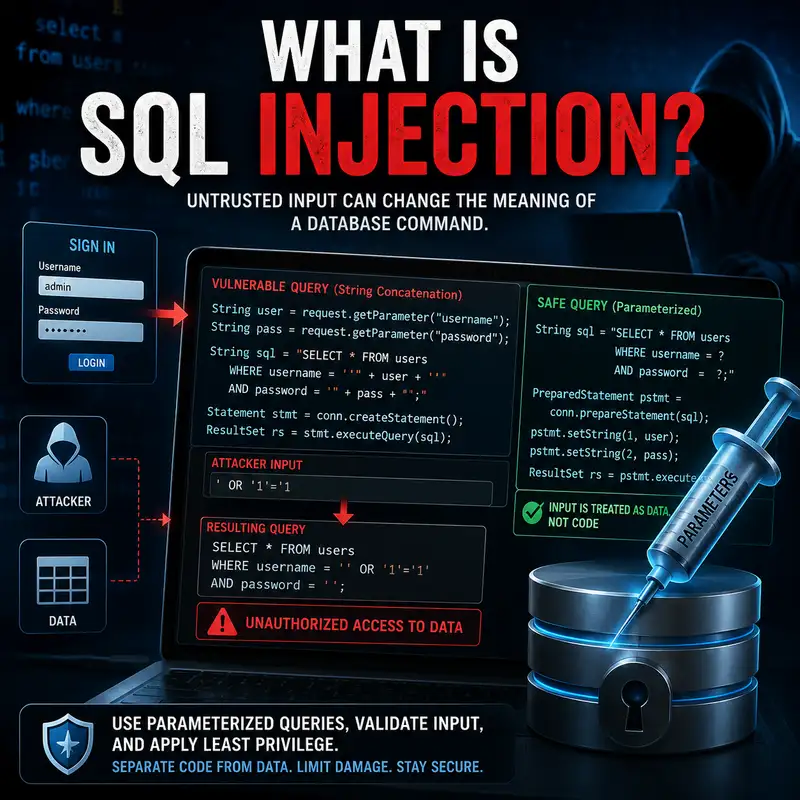
What Is SQL Injection?
S Q L injection is often described as a database attack, but that description can hide the most important point. The problem usually begins in application code when information supplied by a user is placed into a database command without a safe boundary between the command and the value. A field that appears to accept a name, search term, account number, or filter can therefore affect more than the data being searched. It can change what the database is being asked to do. The practical question is not simply whether the database is protected by a password or firewall. It is whether the application constructs its commands so that untrusted input can never become part of the command’s logic. By the end of this episode, you should be able to explain how that boundary fails, what kinds of harm may follow, and why parameterized queries are the primary defense rather than an optional coding preference. Structured Query Language (S Q L) is a language applications use to request, create, update, and remove information in many relational databases. A query is one of those database commands. Untrusted input is any value the application receives from a source it does not fully control, including form fields, web addresses, application programming interface requests, cookies, imported files, and data previously stored by another process. S Q L injection occurs when that input changes the meaning or structure of a database command instead of remaining only a value inside it. The distinction to remember is the difference between code and data. The application intends to provide the database with fixed instructions and separate values. Injection becomes possible when the application combines them in a way that lets the database interpret some of the value as additional instruction. That is why this weakness is fundamentally a command-construction problem, even though the visible result appears inside the database. Many vulnerable designs begin with string construction. The application starts with part of a command, inserts a value received from somewhere else, and then adds the rest of the command. Once those pieces are joined into one string, the database parser sees only the final text. It cannot know which characters the developer intended as instructions and which characters were supposed to be harmless input. If the supplied value contains syntax that changes a condition, adds another operation, or closes one part of the command and begins another, the parser may follow that altered meaning. The database is not necessarily malfunctioning. It may be executing exactly the command it received. The failure occurred earlier, when the application allowed an untrusted value to participate in creating the command itself. Understanding that sequence prevents a common mistake, which is treating injection as an obscure database flaw rather than a predictable consequence of unsafe application logic. A simple example can be explained without using an attack payload. A sign-in function may intend to ask the database for a record whose user name and password-related value match the information submitted. If the application directly inserts those submitted values into the command, specially structured input may alter the condition so that it no longer tests only the intended credentials. The same principle applies to a search function. Input meant to identify one product, customer record, or document may broaden the condition and cause the database to return many records instead. When the application account can modify data, an altered command may also change values, create records, or remove information. The essential point is not the exact punctuation an attacker uses. It is that the application has handed the attacker influence over the command’s grammar. Once that happens, the database may perform an operation the developer never intended to make available through that input field. The potential consequences extend across confidentiality, integrity, and availability. Confidentiality can be lost when an altered query returns information the requester was not authorized to see. Integrity can be damaged when records are changed, fabricated, or deleted. Availability can be affected when data is removed, tables are locked, expensive operations consume resources, or an application can no longer rely on the database’s contents. Injection may also undermine authentication or authorization when the vulnerable command is involved in deciding who may sign in or what records a user may access. The severity depends heavily on context. A read-only application account limits some forms of damage, while an account with broad administrative rights can turn one coding flaw into a much larger compromise. The sensitivity of the data, the exposed functions, and the database permissions all shape the risk. S Q L injection is therefore one vulnerability with several possible business effects, not one fixed outcome. A login form is a familiar teaching example, but vulnerable input can appear almost anywhere an application builds a database command. Search boxes, sorting options, report filters, web address parameters, request headers, cookies, mobile application requests, bulk imports, and administrative tools can all become sources of untrusted values. Even data already stored in the database may remain dangerous if another part of the application later retrieves it and combines it unsafely into a new command. That pattern is sometimes called second-order injection because the harmful interpretation occurs after the value has been stored and reused. The lesson is that trust should not be assigned merely because a value came from an internal table or another service. The important question is how the value reaches the command. Any path that lets data become command syntax deserves review, whether the input arrives directly from a public page or indirectly through several trusted-looking systems. Input validation is useful, but it should not carry the full burden of preventing S Q L injection. Validation checks whether a value matches the expected type, length, format, range, or allowed set. A field intended to contain a positive whole number should reject letters, unexpected punctuation, and values outside the permitted range. That reduces ambiguity and may block malformed requests before they reach deeper application logic. The limitation is that many legitimate values contain spaces, punctuation, international characters, or other symbols that are difficult to classify as universally safe or unsafe. Blacklists also fail when they try to predict every possible expression an attacker might use. Escaping characters can be fragile because the correct method depends on the database, character encoding, connection settings, and exact command context. Validation remains an important control, but parameterization provides the stronger guarantee because it prevents values from being interpreted as command structure in the first place. We will pause briefly for a transparent promotional message. This episode is brought to you by the Bare Metal Cyber Academy. The Academy provides a place for people who want to continue developing practical cybersecurity knowledge through clear, structured education. Topics such as secure application design become more useful when the underlying concepts are explained carefully and connected to real defensive decisions. You can visit Bare Metal Cyber dot com to explore the Academy and see the learning opportunities currently available. There are no promises of guaranteed results, only an invitation to keep building knowledge through focused instruction. Now, let’s return to the main lesson and examine why parameterized queries create the boundary that unsafe string construction lacks. A parameterized query separates the command template from the values supplied to that command. The developer writes the database instruction with placeholders where values belong, and the application sends the values through a binding mechanism provided by the database driver or framework. The database can then parse the command as code while treating each bound value strictly as data. Characters inside the value may still be stored, compared, or searched, but they do not become new operators or clauses in the command. This is often implemented through prepared statements, although the exact programming interface varies by language and database. The security property is the separation, not the product name of the feature. Parameterization should be used consistently for every value that can be bound. It is not enough to protect only passwords or public forms. Any untrusted or changeable value that enters a database command should remain outside the command’s grammar. Parameterization does have an important boundary. Database systems usually allow parameters to represent values, but not structural elements such as table names, column names, sorting directions, or complete fragments of a condition. When those elements must vary, the application should map a small set of permitted choices to fixed identifiers written by the developer rather than insert supplied text directly. This is allowlisting applied to command structure. The same care is required with object-relational mapping tools, query builders, and stored procedures. High-level methods that bind values may be safe, while raw query features, string interpolation, or dynamic S Q L can reintroduce the vulnerability. A stored procedure protects the application only when it keeps parameters separate from the command. Code review should therefore examine how the final database operation is produced, not merely whether a preferred framework appears in the project. The decisive question is whether untrusted data ever gains control over syntax. Parameterization should be supported by defense in depth. The database account used by an application should receive only the permissions the application actually needs. A service that only reads a limited set of records should not connect with authority to create tables, alter schemas, manage users, or delete unrelated data. Separate functions may justify separate accounts so that a reporting component does not inherit the privileges required by an administrative workflow. Views, stored access rules, and carefully scoped roles can further limit which data an application can reach. Credentials should be protected and rotated through appropriate secrets-management practices, and database access should be restricted to the systems that require it. These controls do not repair an injectable command. They reduce the possible consequence if a coding flaw survives. Least privilege changes an application-level mistake from unrestricted database control into a more contained failure, which gives defenders another layer of protection. Detection requires attention to both the application and the database. Secure code review can find unsafe command construction before release, especially when reviewers trace input from its source to the database call. Static analysis tools may flag suspicious concatenation or raw-query use, while dynamic testing can reveal that unexpected input changes application behavior. Logs may show unusual errors, repeated malformed requests, unexpected query patterns, large result sets, or database operations that do not match normal use. Database activity monitoring can add visibility into sensitive commands and unusual access. A web application firewall may block some known patterns, but it should not be treated as the primary fix because requests can be encoded, transformed, or expressed in ways a rule does not recognize. Error messages should also be handled carefully. Detailed database errors can help an attacker understand the application, but hiding errors alone does not remove the underlying injection path. Several misunderstandings lead teams to believe they have solved the problem when they have only changed its appearance. Removing a few special characters is not a complete defense because safe and unsafe meaning depends on context. Hiding database errors may reduce information disclosure, but the altered command can still execute. Encrypting stored data protects certain forms of disclosure, yet the application may be authorized to decrypt or retrieve that data during a successful injected query. Restricting attention to public form fields misses headers, cookies, imported content, internal services, and stored values that later reach a query. A successful penetration test from one path also does not prove that every query is safely constructed. Finally, a web application firewall can provide useful detection and temporary risk reduction, but it cannot establish the code-and-data boundary as reliably as parameter binding. The durable correction must happen where the command is created. A practical review begins by tracing each value that can influence a database operation. Identify where the value originates, how it is transformed, which function constructs the query, and which database account executes it. Inspect whether the code uses a parameter-binding interface for every value. When structural choices must be dynamic, confirm that the application selects from a fixed allowlist rather than inserting supplied text. Add tests that use unexpected lengths, types, encodings, and punctuation, not to reproduce harmful payloads, but to confirm that the command structure never changes. Review the application account’s permissions so that a failure cannot reach more data or functions than necessary. Check logging and alerting for unusual database behavior, and make sure detailed errors are not exposed to users. This method turns a broad warning about injection into specific questions that developers, testers, and defenders can answer for each data path. S Q L injection occurs when untrusted input is allowed to change the meaning of a database command. The attack succeeds because an application fails to maintain a dependable boundary between instructions and values, not because the database somehow mistakes ordinary data on its own. An altered command may expose information, bypass an access check, modify records, or disrupt availability, with the final impact determined by the query and the privileges of the application account. Parameterized queries are the key defense because they let the database treat the command as code and the bound input as data, even when that input contains characters that would otherwise have syntactic meaning. Validation, least privilege, careful error handling, testing, and monitoring strengthen the design, but they do not replace that separation. The practical decision is straightforward: whenever an application sends changeable values to a relational database, bind those values through a parameterized interface and allow only fixed, approved choices to shape the command itself.