What Is Vishing?
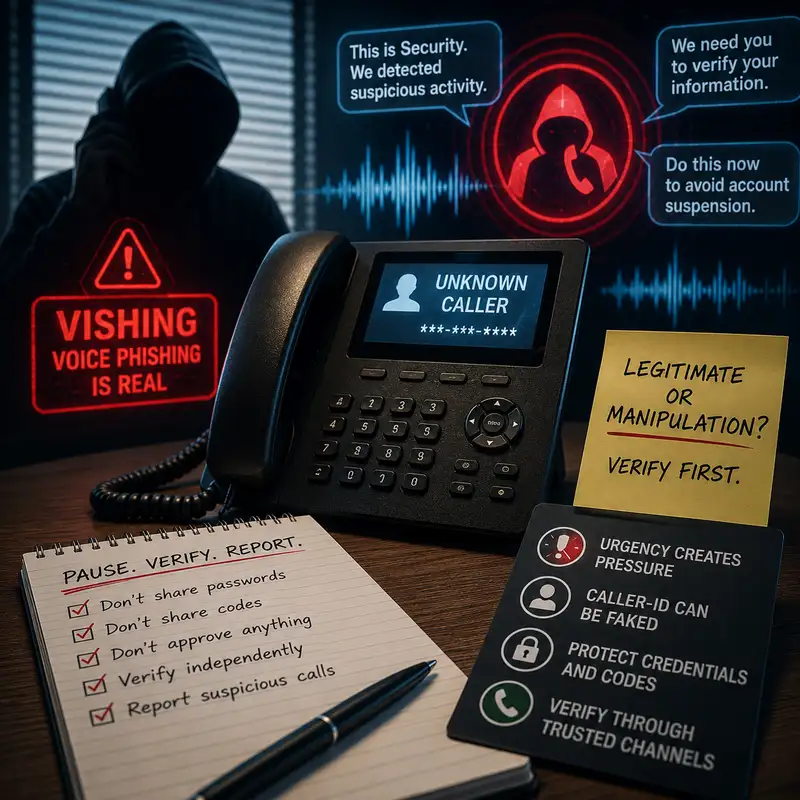
Vishing is often mistaken for an ordinary suspicious phone call, but the real issue is not whether the caller sounds strange. The practical question is whether someone is using voice communication to manipulate you into revealing information, changing access, sending money, or approving an action that benefits the caller. A vishing attempt may sound polished, familiar, urgent, or completely routine, which is why confidence in the voice is not reliable evidence of legitimacy. The danger comes from the combination of social pressure and a communication channel that encourages an immediate response. By the end of this episode, you should be able to explain what vishing is, recognize the methods that make it persuasive, separate a caller’s claims from verifiable facts, and choose a safe response without depending on instinct alone. Vishing is phishing conducted through telephone or voice communication. The word combines voice with phishing, and it describes a social-engineering attack that uses spoken interaction rather than relying mainly on a deceptive email, text message, or website. The caller’s goal is usually to persuade the target to disclose credentials, provide a one-time code, approve a transaction, install software, change account information, or take another action that weakens security. Vishing is related to email phishing and text-message phishing because all three depend on deception, but the voice channel changes the pressure. A live caller can react to hesitation, answer objections, repeat a demand, and create the feeling that a decision must be made before the conversation ends. That interactive pressure is the main distinction to remember. Urgency is one of the strongest tools in a vishing attempt because it reduces the time available for independent thought. The caller may claim that an account is being attacked, a payment is about to fail, a service will be disconnected, or an executive request must be completed immediately. The exact claim can vary, but the purpose is consistent. Urgency moves attention away from verification and toward compliance. A legitimate organization may sometimes contact people about a real time-sensitive issue, so urgency by itself does not prove fraud. The warning sign appears when the caller uses urgency to discourage normal safeguards, such as calling an official number, checking an account directly, consulting another person, or following an established approval process. Pressure that demands speed while resisting verification should be treated as evidence of manipulation. Authority and familiarity can make that urgency more convincing. A caller may claim to represent a bank, a technology support team, a government office, a vendor, a manager, or another trusted source. The voice may sound confident and may use professional language that matches the claimed role. None of those qualities confirms identity. People often treat a spoken conversation as more personal and trustworthy than a written message, especially when the caller appears to know how an organization works. Vishing takes advantage of that tendency by presenting authority as something the listener should obey rather than verify. The safest response is to separate the role being claimed from the identity that has actually been proven. A caller can state a title, department, or relationship in seconds, but legitimate identity requires confirmation through an independent and trusted channel. Caller identification (caller I D) is another source of false confidence. The number or name displayed on a phone can be manipulated so that the call appears to come from a trusted organization, a familiar area code, or even an internal extension. This manipulation is often called caller I D spoofing. Spoofing does not require the caller to control the real number, and the displayed information should therefore be treated as a label rather than proof. The same caution applies when a voicemail shows a recognizable number or when a caller asks you to compare the display with a number listed on a website. A safe verification process does not continue through the suspicious call. End the conversation, locate the official contact information independently, and begin a new call using a number you already trust. Personal information can make a vishing call sound authentic without proving that the caller is legitimate. Names, job titles, email addresses, phone numbers, account details, vendor relationships, and other background information may be available through public sources, prior breaches, business records, social media, or earlier interactions. An attacker can use those facts to create the impression of inside knowledge. The mistake is assuming that anyone who knows something about you must be authorized to act on your behalf. Knowledge and identity are different. A caller may accurately state your address or the name of a coworker while still lying about who they are and why they are calling. Treat personal details as information the caller possesses, not as authentication. Verification should rely on approved processes, not on how many familiar facts the caller can repeat. Convincing scripts also make vishing effective because they give the conversation structure and help the caller manage resistance. A script may include a believable introduction, an explanation for the call, a reason normal procedures cannot be followed, and a request framed as routine assistance. The caller may sound patient rather than aggressive, because calm professionalism can be more persuasive than obvious intimidation. Some calls use recorded messages or automated menus, while others involve a live person who adapts to questions. The listener does not need to identify the exact script or technology to respond safely. Focus on the requested action and the verification method. When a caller asks you to bypass policy, disclose a secret, approve something you did not initiate, or remain on the line while completing a sensitive task, the request matters more than the caller’s performance. Before continuing, this is a brief promotional message. This episode is brought to you by the Bare Metal Cyber Academy. The Academy provides a place for people who want to continue developing practical cybersecurity knowledge through clear, structured education. It is designed for learners and professionals who want careful explanations that connect security concepts to the decisions people make at work. You can visit Bare Metal Cyber dot com to explore the Academy and review the learning opportunities currently available. Vishing succeeds when people are pressured to act before they understand what is being requested, so building steady knowledge can make those moments easier to evaluate. Now, let’s return to the lesson and examine the actions a caller may try to obtain. Requests for credentials, passwords, recovery information, or one-time passcodes are major warning signs because those secrets are used to prove identity or authorize access. A legitimate support representative may guide you through an account process, but should not need your password. A caller who asks for a code sent to your phone may be attempting to complete a login, reset, or transaction that they initiated elsewhere. Multi-factor authentication (M F A) provides stronger protection only when the additional factor remains under the user’s control. Reading an M F A code aloud can transfer that protection to the caller. The same principle applies to security questions, recovery codes, and approval prompts. A caller may even describe an unexpected approval prompt as the way to cancel fraud, although approving it may instead authorize the activity. Information designed to authenticate you should not be shared or approved merely because a caller claims it is needed to protect the account. Vishing can also target financial approvals rather than login credentials. A caller may request a wire transfer, payment-card change, refund, gift-card purchase, invoice update, or confirmation of banking details. The request may be presented as a correction, an emergency, or a final step in an existing process. The safest decision does not depend on whether the explanation sounds reasonable. Sensitive financial actions should follow established approval paths, separation of duties, and independent confirmation using known contact information. Verification should use information already held in trusted records rather than contact details supplied during the call. A voice instruction should not override controls simply because the caller claims seniority or urgency. When the request changes where money will go, who will receive it, or how quickly it must be sent, the organization should treat the change itself as a risk event that requires verification before approval. Voicemail, automated calls, and callback messages can be part of vishing even when no live conversation begins immediately. A recorded message may claim that an account is locked, a charge has been detected, or a legal or service problem requires immediate attention. The message may direct the listener to press a key, call a supplied number, or provide information through an automated system. A polished recording, realistic menu, or professional greeting does not verify the source. The danger is that the message controls the next step and keeps the target inside the attacker’s communication path. Do not use the phone number, extension, or link supplied by an unverified message for a sensitive response. Instead, open the official application, use a trusted statement or card, or locate the organization’s contact information independently. Verification is stronger when the target chooses the channel rather than the caller. Defending against vishing requires both individual habits and organizational controls. People need permission to pause, end a call, and verify a request without being criticized for delaying an urgent action. Policies should identify which information may never be requested by phone, which transactions require secondary approval, and how employees should report suspicious calls. Training should reinforce the right to interrupt and verify, not merely provide a list of phrases that might sound suspicious. Technical controls can support the process through call filtering, fraud warnings, transaction limits, logging, and stronger authentication, but technology cannot judge every conversation. Security teams should also treat reported calls as useful evidence. A single report may reveal a broader campaign targeting multiple employees, customers, or departments. The response should preserve relevant details, warn likely targets, review affected accounts or transactions, and improve the control that the caller attempted to bypass. A common misunderstanding is that vishing can be avoided by learning to recognize a suspicious tone, foreign accent, background noise, or poor grammar. Those signals are unreliable and can encourage false confidence when a skilled caller sounds professional. Another mistake is believing that refusing to provide a password is enough. A caller may instead seek an approval click, an account reset, a change to payment details, a remote-access session, or information that supports a later attack. A familiar voice or speaking style should not replace identity verification, just as caller I D should not. The better question is not whether the caller sounds like a criminal. Ask whether the caller’s identity has been independently verified and whether the requested action follows an approved process. That approach evaluates the security decision rather than the caller’s style, and it remains useful as voice technology and attack methods change. A practical way to handle a questionable call is to use a pause, verify, and report method. Pause before sharing information or approving anything, especially when the caller introduces urgency, secrecy, fear, or authority. Verify by ending the call and contacting the person or organization through a known number, official application, internal directory, or established workflow. Do not let the caller choose the verification channel or remain connected while you perform it. Report the attempt through the organization’s normal security or fraud process, including the displayed number, claimed identity, time, request, and any action already taken. If information was disclosed or a transaction was approved, report that immediately so accounts, sessions, payments, or access can be reviewed. This method turns uncertainty into a controlled process. Vishing is phishing carried out through voice communication, and it succeeds by making spoken claims feel urgent, personal, and authoritative. Caller I D, familiar information, a convincing script, and even a recognizable voice can support the deception, but none of them independently proves identity or authorization. The central defensive decision is to separate the caller’s story from the action being requested. Credentials, authentication codes, transaction approvals, access changes, and confidential information should be protected by processes that continue to work when the caller sounds believable. When a request is sensitive, pause the conversation, verify through a channel you selected, and report the attempt. That practice does not require you to solve the caller’s identity in real time. It prevents an unverified voice from becoming sufficient authority for a security decision.