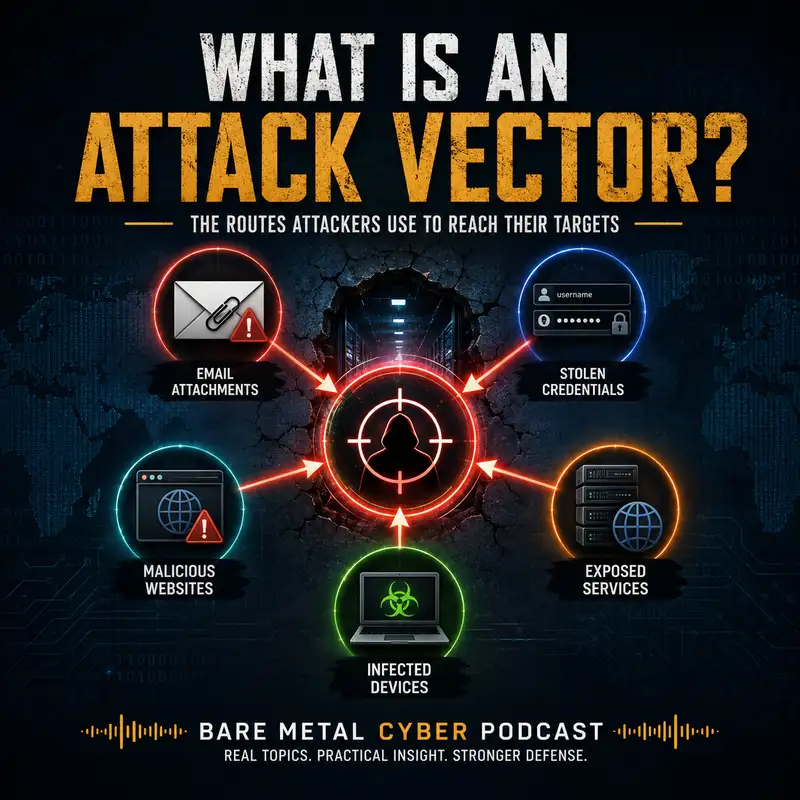
What Is an Attack Vector?
The phrase attack vector is often used as a catchall for anything associated with a cyberattack. People may use it to describe a weakness, a malicious file, an exposed system, or even the attacker. Those things can be connected, but they do not all mean the same thing. An attack vector is specifically the route or method an attacker uses to reach a target, gain access, deliver harmful content, or create an opportunity for further action. Identifying the vector matters because the response depends on how the attacker is approaching the target. A control that reduces malicious email may do little against an exposed remote service, while stronger authentication may reduce the value of stolen passwords. By the end of this episode, you should be able to recognize an attack vector, separate it from nearby concepts, and connect the correct vector to a practical defensive decision. Let’s start with a direct working definition. An attack vector is the route or method used to approach and affect a target. The target may be an account, device, application, service, network, person, or business process. A vulnerability is the weakness that may make the vector effective, while an exploit is a technique or action that takes advantage of a weakness. The attack surface is the full set of places where an attacker might try to interact with the environment. These terms are often confused because they can appear in the same incident, but each describes a different part of the problem. The vector answers how the attacker reaches or approaches the target. The vulnerability answers what weakness may allow the attempt to succeed. Keeping that distinction clear improves investigation, control selection, and communication. An attack vector can be thought of as a channel of approach, but the word channel should not make it sound passive. The vector may carry a malicious attachment, support the use of stolen credentials, expose an accessible service, or connect an infected device to a protected environment. In each case, the vector describes the way access or influence is attempted. It does not automatically tell you who the attacker is, what the final objective may be, or what damage will occur. The same vector can support many different outcomes. A malicious website may attempt to collect credentials, deliver harmful software, or persuade a user to approve an unsafe action. The vector stays the same at a high level even though the attacker’s goal and the resulting impact may differ. That is why identifying the route is an early analytical step rather than a complete explanation of the attack. Email attachments are a familiar attack vector because email provides a direct route to users and their devices. The attachment may contain harmful content, or it may encourage a user to take an action that weakens security. Stolen credentials form another vector when an attacker uses valid usernames, passwords, session tokens, or other authentication material to enter through a legitimate access point. Malicious websites can act as vectors by presenting deceptive content, collecting information, or delivering unwanted code through the browser. Exposed services provide a technical route when an internet-facing system accepts connections that an attacker can probe or abuse. Infected devices can become vectors when they connect to trusted networks, synchronize data, or communicate with internal systems. These examples differ in form, but each describes a route through which the target can be reached. The nearest concept to an attack vector is often a vulnerability, and confusing the two leads to weak analysis. A vulnerability is a weakness or condition that may make harm possible. An attack vector is the route used to reach that weakness or take advantage of it. A reused password is a vulnerability because it makes unauthorized access easier. The use of that password through a remote login portal is the attack vector. An unpatched service may contain a technical vulnerability, while the exposed network service is the vector that gives an attacker a way to interact with it. The distinction affects remediation. Fixing the vulnerability may remove the weakness, while reducing the vector may block or limit the route. In many environments, defenders need both actions because closing one weakness does not eliminate every route, and restricting one route does not repair every weakness. An exploit is also related, but it is not identical to the vector. The vector describes how the attacker reaches the target, while the exploit describes the action or technique used to take advantage of a weakness. A malicious website can be the vector, a browser flaw can be the vulnerability, and code that triggers the flaw can be the exploit. These parts can appear together, but they answer different questions. The entry point is the specific location where access begins, such as a login page, mailbox, exposed application interface, or connected device. An attack path is broader because it may include several steps from the first point of contact to the final objective. The vector may begin that path, support a later step, or change as the attacker moves. Clear labeling helps defenders avoid treating a whole sequence as though it were one undifferentiated action. Attack vectors become visible through evidence, but the evidence rarely arrives with a perfect label. Email security tools may record a suspicious attachment, authentication systems may show unusual use of an account, web filters may identify access to a harmful domain, and network monitoring may reveal unexpected connections to an exposed service. Those observations may indicate a vector, but they must be interpreted in context. A failed login attempt is evidence of activity, not proof that access occurred. A blocked attachment shows that a vector was attempted, but it does not prove the device was compromised. An infected device connecting to the network may confirm one route of exposure while leaving the original source of infection unknown. The goal is to identify what the evidence supports, avoid overstating the conclusion, and choose the next defensive question based on the likely route of approach. Before we continue, this is a brief promotional message. This episode is brought to you by the Bare Metal Cyber Academy. The Academy is a place for people who want to continue developing practical cybersecurity knowledge through clear, structured education. Topics such as attack vectors become easier to apply when the definitions, relationships, and defensive decisions are taught in a direct way. You can visit Bare Metal Cyber dot com to explore the Academy and see the learning opportunities currently available. There are no promises of instant expertise or guaranteed results, only an invitation to keep building useful knowledge with careful instruction. Now, let’s return to how attack vectors shape the controls defenders choose. A useful defense begins by matching the control to the vector rather than choosing a control only because it is familiar. Email-based vectors may be reduced through attachment filtering, link inspection, sender authentication, user awareness, and safe handling of unexpected messages. Credential-based vectors may require Multi-Factor Authentication (M F A), strong password practices, session protection, access monitoring, and rapid credential revocation. Malicious website vectors may be reduced through browser protections, domain filtering, software updates, and restrictions on risky content. Exposed services may require patching, secure configuration, network access controls, and removal of unnecessary internet exposure. Infected devices may call for endpoint protection, device health checks, network segmentation, and containment procedures. No single control addresses every vector. The value of the term is that it directs attention toward the route that must be blocked, monitored, limited, or made less useful. One common mistake is to call the malicious payload the attack vector. A payload is the harmful content or action delivered after the route has been used, while the vector is the method of delivery or access. Another mistake is to label the resulting incident as the vector. Data theft, service disruption, and unauthorized changes are outcomes, not routes. People also confuse the vector with the threat actor. The attacker is the person or group taking action, while the vector is the means used to approach the target. These distinctions prevent vague statements such as malware was the vector when the real route may have been email, a malicious website, or an infected removable device. Precise language is not merely academic. It tells investigators what evidence to seek and tells defenders which part of the environment needs attention. Attack vectors can also be chained together, which explains why one event may contain several correct vector labels. Stolen credentials may have been collected through a malicious website and then used through a remote access service. An infected device may enter through a trusted connection and later reach additional internal services. Email may deliver a link rather than an attachment, making email the initial route and the website the next route. The presence of several vectors does not make the concept meaningless. It means the attack path contains multiple methods of approach at different stages. Defenders should identify each vector at the level supported by evidence and avoid forcing the entire sequence into one label. This is especially important when controls are owned by different teams, because email security, identity security, endpoint security, and network security may each address a different part of the same path. Not every available attack vector creates the same level of risk. Risk depends on whether the vector is exposed, whether a relevant weakness exists, how likely the attempt is to succeed, and what consequence could follow. An exposed service supporting a critical business process may deserve more attention than an isolated test service with limited access and no sensitive data. A credential vector becomes more serious when accounts have broad privileges, weak authentication, or poor monitoring. Email remains widely used, but the level of risk changes with filtering, user behavior, attachment controls, and the value of the accounts being targeted. Prioritization therefore requires more than listing possible vectors. It requires connecting each route to the actual target, the weaknesses present, the controls already in place, and the consequence of successful access. Attack-vector analysis also supports defense in depth because it reveals where one control may fail and another must still provide protection. Email filtering may block many harmful attachments, but endpoint protection is still needed when something passes through. M F A can reduce the value of stolen passwords, but session theft, approval abuse, and weak recovery processes may leave other identity routes open. Patching an exposed service can remove a known weakness, while network restrictions can reduce who is able to reach the service at all. Monitoring adds another layer by helping defenders recognize when a vector is being tested or used. These controls do not guarantee that attacks will stop. They reduce opportunity, increase the effort required, limit the effect of successful access, and improve the chance of detection. Thinking in vectors helps place each control where it can interrupt the route. A practical way to test whether something is an attack vector is to ask what role it plays in the sequence. Does it describe the route or method used to reach the target? If so, attack vector is probably the correct label. If it describes a weakness, then vulnerability is more accurate. If it describes the action that takes advantage of the weakness, then exploit may be the better term. If it describes the harm that follows, then you are discussing impact or consequence. After naming the vector, identify the specific target, the evidence that supports the label, the weakness that may make the vector effective, and the control that can reduce it. This method turns terminology into action. It also makes security discussions more useful because each label points toward a different question, owner, and response. An attack vector is the route or method an attacker uses to reach a target, and that definition should guide the way the term is applied. Email attachments, stolen credentials, malicious websites, exposed services, and infected devices are attack vectors because they provide channels through which access, influence, or harmful content can reach something the organization values. The vector is not the attacker, the vulnerability, the exploit, the payload, or the final impact, although all of those may be connected in the same event. Correctly identifying the vector helps defenders select controls, interpret evidence, assign ownership, and explain how an attack became possible. When the route is clear, the defensive decision becomes more precise. The organization can focus on blocking the approach, reducing the weakness behind it, detecting its use, and limiting what can happen if the route succeeds.