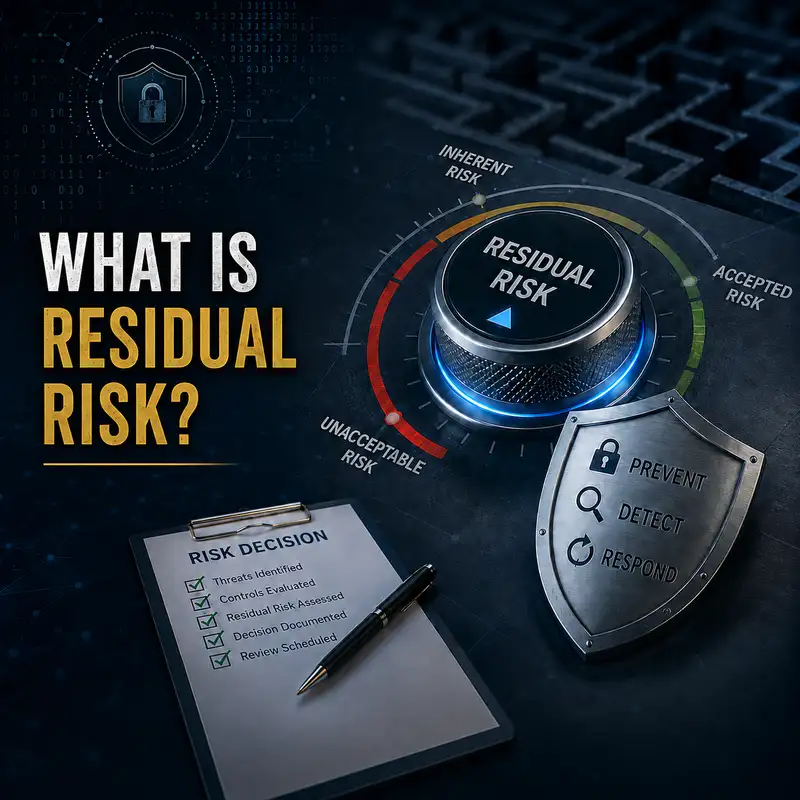
What Is Residual Risk?
A security control can be working as designed and still leave the organization exposed to harm. That fact often creates confusion because people may hear that a control has been implemented and assume the related risk has been removed. The practical question is not whether a safeguard exists, but how much risk remains after that safeguard has done what it can reasonably do. Residual risk gives us the language for answering that question. It helps security teams, system owners, and leaders separate the presence of a control from the actual level of protection the control provides. By the end of this episode, you should be able to explain what residual risk means, why it can never be reduced to absolute zero in most real environments, how it differs from accepted risk, and what information a decision maker needs before deciding whether the remaining exposure is acceptable. Residual risk is the risk that remains after security controls have been applied. A closely related term is inherent risk, which describes the level of risk that exists before those controls are considered. The difference between the two is the effect of the safeguards, processes, and decisions used to reduce the possibility or consequence of harm. A control may lower the likelihood of an event, reduce the damage that would follow, improve detection and response, or affect several of those factors at once. Residual risk is not automatically small, and it is not automatically acceptable. It is simply the remaining risk after the current controls are taken into account. The distinction matters because implementing a control is an action, while evaluating residual risk is a judgment about what exposure still exists after that action. Controls reduce risk by changing the conditions that make harm possible or by limiting the consequences when harm occurs. Multifactor authentication can make unauthorized account access more difficult, but it cannot prevent every form of account compromise. Encryption can reduce the likelihood that exposed data will be readable, but it does not prevent all misuse, deletion, or disruption. Backups can reduce the operational consequence of data loss, but only if the backups are complete, protected, and recoverable when needed. These examples show why a control should be evaluated according to the specific part of risk it is meant to reduce. A safeguard may be effective against one threat path and irrelevant to another. Residual risk remains because controls have boundaries, dependencies, and assumptions. Understanding those limits is more useful than simply counting how many controls have been installed. No control eliminates every possibility of harm because controls operate within real systems, organizations, and human processes. Technical safeguards can fail, be misconfigured, become outdated, or depend on services that are unavailable during an incident. Administrative controls such as policies and procedures depend on people understanding and following them. Physical controls can be bypassed, damaged, or applied inconsistently. Even a strong control may protect only one layer of a larger environment. Risk also comes from uncertainty. Security teams may not know every vulnerability, every dependency, every misuse path, or every future change that could affect the system. Residual risk therefore includes more than a known weakness that has not been fixed. It also reflects the possibility that current protections may not perform exactly as expected under every condition. The goal is not perfect certainty, but a defensible understanding of what remains. The effectiveness of a control must be demonstrated rather than assumed. A control may exist in documentation but not be implemented everywhere it is required. It may be enabled but configured incorrectly. It may work during routine operations but fail during high demand, emergency recovery, or a change in system architecture. Control testing helps determine whether the safeguard is present, operating, and producing the intended effect. Evidence may include configuration reviews, access records, recovery tests, monitoring results, maintenance records, or other information appropriate to the control. The quality of that evidence directly affects confidence in the residual risk estimate. When evidence is weak, the organization should not treat uncertainty as proof that the control is effective. A realistic residual risk assessment accounts for both the control’s expected benefit and the possibility that its performance is incomplete, inconsistent, or dependent on conditions that may change. Residual risk is usually understood by considering both likelihood and consequence after controls are applied. Likelihood asks how plausible it is that the harmful event will occur under the remaining conditions. Consequence asks what the organization could lose if it does occur, including effects on operations, data, finances, legal obligations, safety, reputation, or mission performance. A control may reduce one side more than the other. Detection tools may not stop an initial attempt, but they can shorten the time before response and reduce the resulting damage. Segmentation may not remove a vulnerability, but it can limit how far an attacker or failure can spread. The same residual technical weakness can create very different levels of business risk depending on the value and criticality of the affected system. Residual risk must therefore be described in terms of possible harm, not just in terms of remaining technical conditions. Several controls may work together, but layers do not automatically produce a simple or predictable reduction in risk. Controls can overlap, depend on the same underlying service, or fail for the same reason. Two safeguards that both rely on one identity platform may provide less independence than their number suggests. A preventive control may be strengthened by a detective control and a response process, because the combination reduces both the chance of success and the duration of harm. Yet each layer must still be evaluated for coverage and reliability. Residual risk is shaped by how the controls interact, not merely by how many are listed. This is why a control inventory is not the same as a risk assessment. The inventory tells you what safeguards are supposed to exist. The residual risk evaluation asks whether those safeguards meaningfully reduce the relevant threat, weakness, and consequence to a level that can be justified. Before continuing, this is a brief promotional message. This episode is brought to you by the Bare Metal Cyber Academy. The Academy is a place for people who want to continue developing practical cybersecurity knowledge through clear, structured education. It supports learners and working professionals who want explanations that connect security concepts to the decisions they face. You can visit Bare Metal Cyber dot com to explore the Academy and see the learning opportunities currently available. Residual risk is a useful example of why clear education matters, because knowing the name of a control is different from understanding what that control can and cannot accomplish. Now, let’s return to how the remaining risk becomes a decision. Residual risk and accepted risk are related, but they are not the same thing. Residual risk describes the exposure that remains after controls are considered. Risk acceptance is a deliberate decision to live with some or all of that remaining exposure for a defined period and under stated conditions. The fact that residual risk exists does not prove that anyone has approved it. An organization may decide that the remaining risk is too high and require additional controls, a different design, reduced system use, transfer through insurance or contracts, or complete avoidance of the activity. It may also accept the risk because further reduction is impractical, too costly compared with the benefit, or inconsistent with the organization’s mission priorities. The essential distinction is that residual risk is a condition to be evaluated, while acceptance is one possible response to that condition. The decision to accept residual risk should belong to someone with the authority to understand and own the possible consequence. Security personnel can analyze threats, weaknesses, control performance, and likely effects, but they do not automatically own every business or mission decision. A system owner, business leader, authorizing official, or another designated decision maker may be responsible, depending on the organization. That person needs a clear description of what could happen, how likely it appears, which controls are in place, where the evidence is strong or weak, and what alternatives are available. The written decision should identify the remaining exposure, the reasoning behind the judgment, any conditions attached to acceptance, and the point at which the risk must be reviewed again. Acceptance should not be treated as a signature collected after the real decision has already been made. It is an accountable judgment about whether the expected benefit of continuing the activity justifies the remaining possibility of harm. Without clear ownership and documentation, residual risk can become everyone’s concern and no one’s decision. Risk appetite and risk tolerance help place residual risk within the organization’s broader boundaries. Risk appetite describes the general amount and type of risk an organization is willing to pursue or retain while working toward its objectives. Risk tolerance provides more specific limits for a particular activity, system, service, or consequence. These boundaries should guide decisions, but they do not remove the need for judgment. A residual risk rating that appears acceptable in one context may be unacceptable in another because the affected mission, data, legal duty, or safety concern is different. Tolerance can also depend on duration. A temporary exposure during a controlled transition may be treated differently from the same exposure left in place indefinitely. The decision maker must compare the remaining risk with the organization’s stated limits and explain any exception rather than using a vague label such as manageable or low enough. Residual risk is not fixed at the moment a control is approved. Systems change, threats change, business processes change, and controls lose effectiveness over time. A software update can introduce a new weakness. A vendor dependency can expand the attack surface. Staff turnover can weaken a manual process that once worked reliably. Monitoring can reveal that attempted attacks are more frequent than the original assessment assumed. The value or criticality of the affected service can also increase, raising the possible consequence even when the technical conditions remain the same. For these reasons, accepted residual risk should include a review condition or review date when appropriate. Continuous monitoring does not mean constantly rewriting every assessment. It means watching the indicators that could invalidate the assumptions behind the current decision and reopening the risk when those conditions materially change. One common mistake is to describe any unresolved problem as residual risk without first considering whether the planned controls were actually implemented and effective. An untreated weakness is not automatically residual simply because time has passed. Another mistake is to subtract a control from an initial rating as though risk reduction were a precise arithmetic calculation. Risk estimates often involve judgment, incomplete information, and qualitative scales. The assessment should show why the likelihood or consequence changed instead of pretending that a control always reduces risk by a fixed amount. A third mistake is to treat a low residual rating as proof that no further attention is needed. Low risk can accumulate across many systems, and some exposures remain important because of legal, safety, or mission requirements. Residual risk is a decision input, not a label that ends all discussion. A practical way to evaluate residual risk is to move through a small set of questions in plain language. Start by describing the harm that could affect something the organization values. Identify the conditions that make that harm possible and the controls intended to change those conditions. Then ask whether each control is fully implemented, how its performance has been verified, which part of likelihood or consequence it reduces, and what limitations remain. Reassess the likelihood and consequence using the current evidence rather than the intended design alone. Compare the result with the organization’s appetite, tolerance, and obligations. Finally, identify the person authorized to choose the response, record the reasoning, and set conditions for monitoring or review. This method keeps the analysis tied to evidence and decisions. It also makes it easier to explain why additional treatment is required or why acceptance is defensible. Residual risk is the possibility and consequence of harm that remain after current security controls have been applied and their real effectiveness has been considered. It exists because every control has limits, every environment changes, and every assessment contains some uncertainty. The presence of residual risk does not mean the controls failed, and it does not mean the remaining exposure has been approved. Someone with appropriate authority must decide whether that exposure fits the organization’s objectives, obligations, and risk boundaries, or whether more treatment is required. A sound decision names the remaining harm, uses evidence to explain the effect of the controls, acknowledges assumptions, assigns ownership, and defines when the decision must be reviewed. The practical standard is not whether risk has disappeared. It is whether the remaining risk is understood clearly enough for an accountable person to make and maintain a defensible decision.