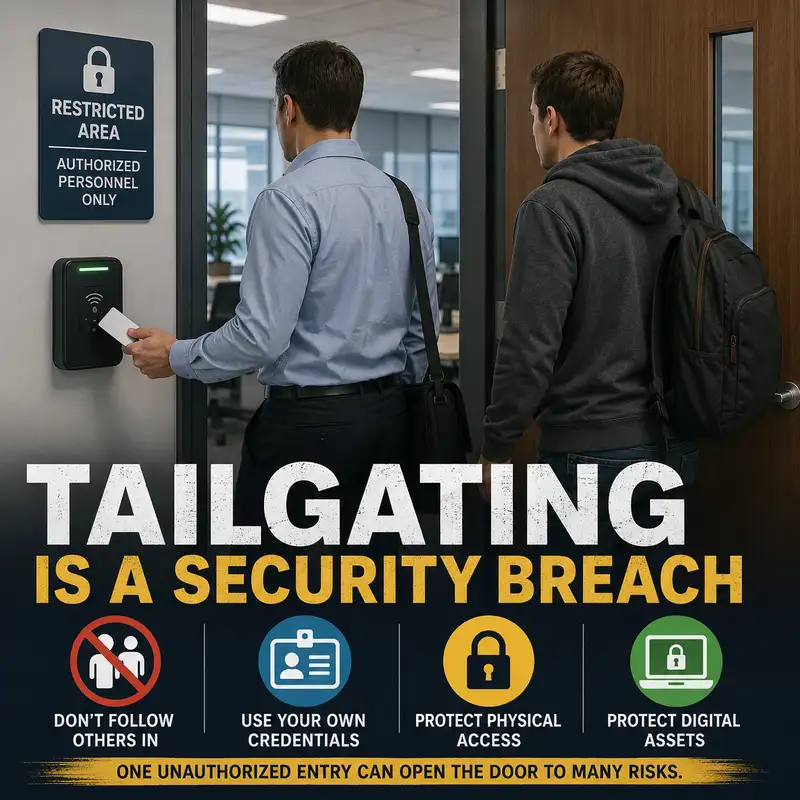
What Is Tailgating?
Tailgating is often treated as a minor breach of office etiquette, but it is actually an access-control failure with cybersecurity consequences. The practical question is not simply whether someone held a door for another person. The real question is whether every individual who entered a restricted area was independently authorized and properly verified. When that verification is skipped, an organization may lose control over who can reach offices, equipment, records, network connections, and unattended devices. By the end of this episode, you should be able to explain what tailgating is, why ordinary politeness can weaken a security boundary, how physical entry can enable digital compromise, and what organizations and individuals can do without turning every doorway into a hostile encounter. Tailgating occurs when an unauthorized person enters a restricted physical area by following someone who is authorized to enter. The authorized person may unlock a door with a badge, key, code, or other credential, while the second person passes through before the door closes. Physical access control is the collection of people, rules, barriers, credentials, and monitoring practices used to limit entry to approved areas. Authentication confirms an identity, while authorization determines what that identity is allowed to access. Tailgating bypasses the normal authentication step at the doorway, so the organization never receives reliable evidence that the follower is permitted to enter. The central distinction is simple: sharing the same open doorway is not the same as sharing the same authorization. A restricted area is any physical location where entry is limited because the people, systems, information, or operations inside require protection. That may include an office suite, storage room, wiring closet, server room, records area, laboratory, operations center, or any space containing sensitive equipment. The door marks more than a physical boundary. It also marks a decision point where the organization is supposed to verify identity and apply access rules. When one successful badge use allows several people to enter without separate checks, the control records only the first person and leaves the others unverified. The security problem is therefore not that the door opened. The problem is that the organization can no longer say with confidence who crossed the boundary or whether each person had a valid reason to do so. Tailgating succeeds because access systems depend partly on human behavior. Many people are naturally reluctant to let a door close in front of someone, especially when the person appears familiar, carries work materials, wears appropriate clothing, or acts as though entry is routine. Courtesy is valuable, but it cannot replace verification in a restricted space. A person may also feel uncomfortable asking a coworker, visitor, delivery worker, or senior leader to use a badge. That discomfort creates an opportunity for unauthorized access even when the electronic control works exactly as designed. The correct security behavior is not to accuse everyone of wrongdoing. It is to apply the same neutral rule to everyone: each person should use the approved entry process, and uncertainty should be directed to reception, security personnel, or another established point of verification. The term piggybacking is sometimes used alongside tailgating, and the distinction varies across organizations. Some use tailgating for entry without the authorized person’s awareness and piggybacking for entry with that person’s knowledge or consent. Others use the words interchangeably for any situation in which one person follows another through a controlled entrance without separate authorization. The label matters less than the underlying control failure. Someone crossed a boundary without an independent access decision, and the system may not contain an accurate record of that entry. Clear internal terminology is still useful because it improves reporting and training, but people should not spend so much time debating the word that they overlook the event. The practical response begins by determining who entered, whether that person was authorized, what areas became reachable, and what actions may have followed. Physical entry can lead to digital compromise because computers and networks exist in physical places. An unauthorized person who reaches an office may encounter an unlocked workstation, printed credentials, removable media, sensitive documents, exposed network connections, or devices left unattended. Entry to an equipment room may provide proximity to servers, network hardware, backup systems, power controls, and administrative consoles. Even brief access can matter when a device is already signed in or when sensitive information is visible. Physical presence may also allow observation of work patterns, badges, screens, conversations, and security procedures that support later social engineering. Tailgating therefore should not be separated from cybersecurity as though it belongs only to facilities management. It can become the first step in unauthorized system access, data exposure, service disruption, theft, or preparation for another attack. Effective prevention uses layers because no single doorway control can solve every circumstance. Individual badge use, doors that close and latch reliably, visitor registration, visible identification, reception procedures, security awareness, and monitoring can support one another. Higher-risk locations may use additional measures that allow only one verified person to pass at a time, but those measures must be selected with safety, accessibility, emergency movement, and operational needs in mind. Technology can record access attempts, yet people still need clear instructions about what to do when someone tries to follow them inside. The strongest design makes the secure action easy and socially acceptable. Employees should be able to point to a standard rule rather than making a personal judgment about someone’s appearance, status, or explanation at the door. Before we continue, this is a brief promotional message. This episode is brought to you by the Bare Metal Cyber Academy. The Academy provides a place for people who want to continue developing practical cybersecurity knowledge through clear, structured education. Topics such as access control become more useful when you can connect policy, technology, human behavior, and risk instead of treating each one as an isolated subject. Visit Bare Metal Cyber dot com today to explore the Academy and see the learning opportunities currently available. Now, let’s return to how organizations can reduce tailgating without relying on suspicion or confrontation. Training should focus on repeatable behavior rather than dramatic warnings. People need to know which entrances are controlled, when individual credentials are required, how visitors are identified, and whom to contact when something does not look right. They also need language they can use without escalating the situation. A calm reminder that everyone must badge in separately is usually more effective than a personal challenge. Training should make clear that apparent familiarity is not proof of authorization, and organizational rank should not create an exception to the rule. It should also explain that reporting a questionable entry is not an accusation of malicious intent. The report gives security staff an opportunity to verify access, correct a misunderstanding, or investigate a genuine breach before the uncertainty grows. Control design affects whether people follow the rule. A badge reader placed too far from the natural path, a door that stays open too long, a crowded entrance, or an unreliable credential system can encourage workarounds. Frequent false alarms or slow visitor procedures may also teach people that bypassing the process is the fastest way to keep work moving. Security teams should therefore examine the environment, not merely blame users after an event. A well-designed process should support normal traffic, accommodate approved visitors, provide alternatives when credentials fail, and preserve emergency egress. It should also account for accessibility, maintenance, deliveries, temporary workers, and other legitimate operational needs. When exceptions are necessary, they should be defined, approved, and monitored instead of improvised at the entrance. The goal is to protect the boundary while giving people a safe, respectful, and workable way to handle unusual circumstances. When the official process is practical, consistent, and supported by leadership, people are more likely to follow it under routine pressure. Detection begins with recognizing that a valid badge event does not always prove that only one person entered. Access logs show credential use, but they may not show the number or identity of everyone who passed through the opening. Camera review, guard observations, door sensors, visitor records, and reports from employees may provide additional context where those measures are lawful and appropriate. A reported tailgating event should be evaluated as a possible access incident, not dismissed automatically because no damage is immediately visible. The response may include verifying identities, identifying reachable areas, checking whether devices or records were disturbed, reviewing relevant logs, and correcting the condition that allowed entry. The depth of review should match the sensitivity of the location and the uncertainty surrounding the event. One common misunderstanding is that tailgating requires an obviously malicious intruder. It does not. The unauthorized person may be lost, may misunderstand the rules, may have forgotten a credential, or may have a legitimate business purpose but still lack approval for that entrance or area. Intent affects how the event is handled, but it does not change whether the access control was bypassed. Another misunderstanding is that recognizing the follower makes the entry acceptable. Familiarity does not establish current authorization because roles, employment status, assignments, and access permissions can change. A third mistake is assuming that an occupied office is automatically safe. Busy environments often contain more open sessions, conversations, papers, and movement, which can make unauthorized presence harder to notice rather than easier. Tailgating should also be distinguished from related physical security problems. A stolen badge involves misuse of a credential, while tailgating may involve no credential at all. Propping a controlled door open disables the boundary for an extended period, whereas tailgating often occurs during a single authorized opening. Allowing a visitor to move without an escort may begin with proper entry but later violate movement restrictions inside the facility. Leaving a workstation unlocked is a separate control weakness, though tailgating can make that weakness reachable by someone who should not be present. These issues can combine, but each calls for a different corrective action. Accurate description helps the organization choose whether to address credential management, door hardware, visitor procedures, employee behavior, device locking, monitoring, or several controls together. A practical way to apply this lesson is to ask three questions whenever someone crosses a controlled doorway. First, was this person independently identified through the approved process? Second, was this person authorized for this specific area at this time? Third, will the organization have an accurate record or responsible escort that accounts for the entry? If any answer is uncertain, do not rely on appearance, confidence, familiarity, or a convincing explanation. Direct the person to the established verification process, notify the appropriate staff, or report the event according to policy. Organizations can apply the same questions during walkthroughs and access reviews. The purpose is to test whether the doorway creates a real security decision or merely gives the appearance of control while groups can pass through on one person’s authorization. Tailgating is the unauthorized use of another person’s successful entry to cross a restricted physical boundary without independent verification. It matters to cybersecurity because physical access can expose systems, network equipment, credentials, documents, conversations, and unattended devices that digital controls assume are already protected by the building. Preventing it requires more than telling people not to hold doors. The organization must combine clear rules, workable entry procedures, individual authentication, visitor management, appropriate monitoring, and a culture that makes verification routine rather than confrontational. The most useful decision is to treat every controlled entrance as an access-control point where identity and authorization must be established for each person. When that decision remains intact, the door protects both the physical space and the digital assets inside it.